
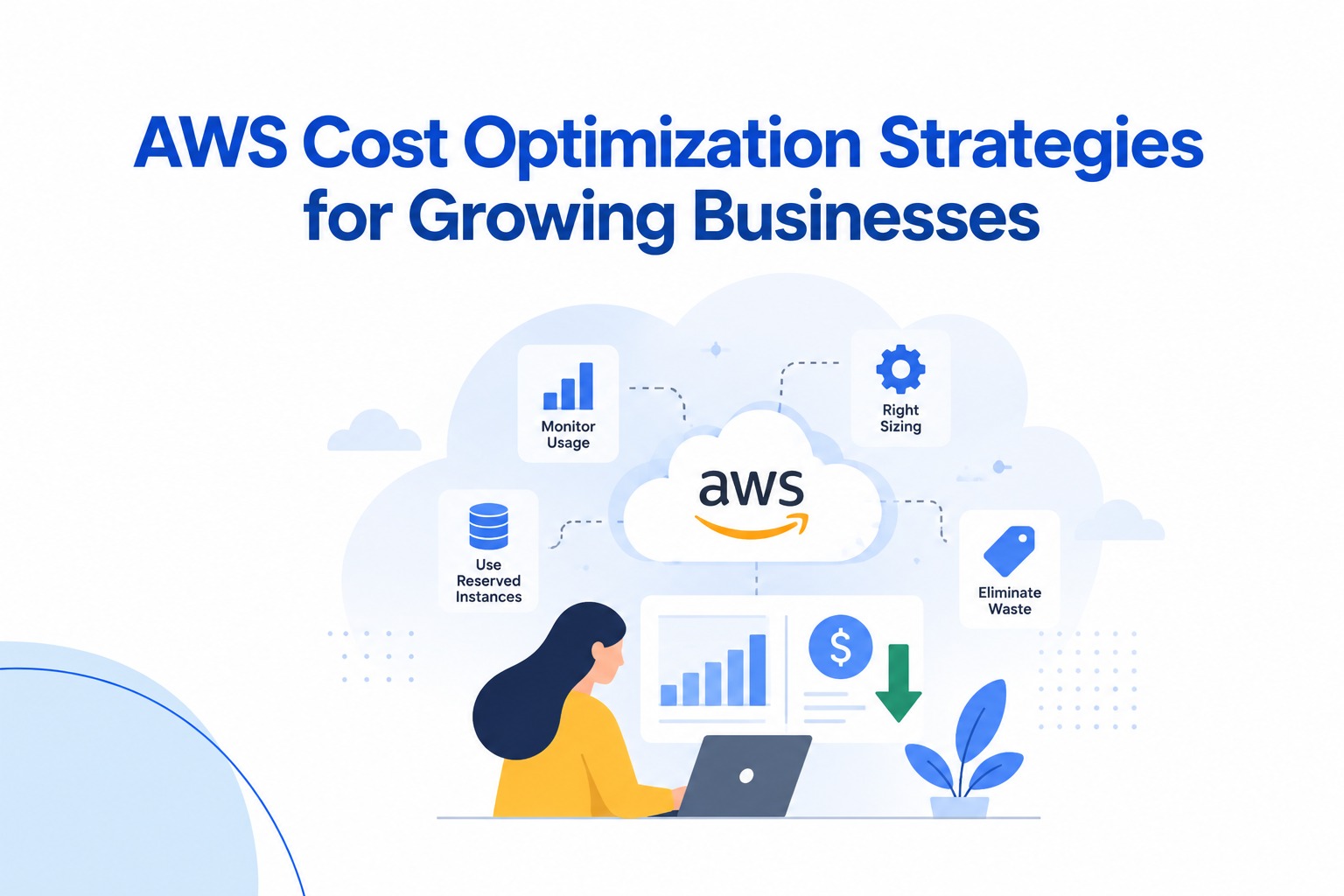
Picture this. Your business is growing, more customers are signing up, your app is handling more traffic, and everything feels like it's finally working. Then the AWS bill arrives, and it's almost double what you expected. Nobody on your team can fully explain why.
This happens to more growing businesses than you might think. AWS makes it incredibly easy to spin up new resources, but it doesn't automatically stop you from paying for things you no longer need. That's where AWS cost optimization comes in. It's not about cutting corners or slowing down your growth. It's about making sure the money you spend on AWS is actually working for your business instead of quietly disappearing.
This blog walks through practical strategies any growing business can use to keep AWS costs under control, without needing a huge finance team or complicated tools.
Before jumping into solutions, it helps to understand why this problem shows up in the first place.
When a business is small, one or two people usually manage the entire AWS account. It's easy to keep track of what's running. But as the team grows, more people get access.
Developers spin up test servers and forget to shut them down. Old projects get abandoned but their databases keep running in the background. Storage keeps piling up because nobody wants to be the one who deletes something important by mistake.
None of this happens because anyone is careless. It happens because cloud resources are invisible. You can't see a forgotten server sitting in a warehouse the way you'd notice unused furniture in an office. It just sits there, quietly adding to your bill every single day.
You cannot fix what you cannot see. Before making any changes, get a clear picture of where your money is actually going.
AWS provides a free tool called Cost Explorer, which shows your spending patterns over time and helps you spot unusual jumps. Another tool called AWS Budgets lets you set spending limits for specific projects or teams and sends an alert when you get close to that limit.
Set aside time each month, even just an hour, to go through this data. Look for services that are costing more than expected, or costs that keep climbing without a clear reason. This single habit alone catches a surprising number of problems before they turn into a real crisis.
One of the most common mistakes growing businesses make is choosing bigger, more powerful servers than they actually need, just to be safe. This is called over provisioning, and it is one of the biggest sources of wasted spend on AWS.
The fix is called right sizing. This simply means regularly checking how much of your server's capacity you're actually using and adjusting it to match real demand. If a server is running at 20 percent capacity most of the time, you're likely paying for far more power than your business needs.
The good news is that AWS makes this easy to check. Reviewing usage reports every few weeks helps you catch these situations early, especially as your workload changes over time.
AWS offers more than one way to pay for the same resource, and choosing the wrong one is a quiet but expensive mistake.
On demand pricing, where you pay for exactly what you use with no commitment, is flexible but usually the most expensive option over time. If you know you'll need a certain amount of computing power for a long stretch, Reserved Instances or Savings Plans can lower your costs significantly in exchange for committing to a set usage level.
For workloads that can handle interruptions, like batch processing or background tasks, Spot Instances offer steep discounts because you're using AWS's spare capacity.
The key is matching the pricing model to how predictable your usage actually is. A growing business rarely fits into just one category, so a mix of these options often works best.
This sounds obvious, but it's one of the most overlooked parts of AWS cost optimization. Development and testing environments are a common culprit here. These systems are often only needed during work hours, yet many businesses leave them running around the clock, seven days a week.
Setting up automatic schedules to shut these environments down outside of business hours can cut related costs significantly, sometimes by more than half, without affecting anyone's actual work.
The same applies to storage. Old backups, unused snapshots, and log files pile up quietly over months and years. Setting up lifecycle policies that automatically move older data to cheaper storage tiers, or delete it after a certain period, keeps this from becoming an expensive habit.
Many growing businesses overlook this one until it becomes a real problem. Moving data out of AWS, especially to users in different regions or to other services outside AWS, comes with its own charges called data transfer fees. These can add up fast, particularly for businesses with a lot of traffic or a global customer base.
Using a content delivery network to cache content closer to your users, and designing your systems to reduce unnecessary data movement between services, can meaningfully lower these charges while often improving performance for your customers at the same time.
Tools and settings only get you so far. The businesses that manage AWS costs well tend to build a habit of thinking about cost as part of everyday decisions, not just something the finance team deals with once a month.
This doesn't need to be complicated. It can be as simple as asking, before launching a new service, whether it needs to run continuously or only occasionally. It can mean tagging resources with the project or team name so it's clear who owns what. It can mean setting a reminder to review unused resources every quarter.
Small habits like these prevent the slow, invisible waste that eventually turns into a shocking bill.
As a business grows, its AWS setup often grows more complex than any one person can fully track. At this point, working with a team that specializes in cloud infrastructure and cost management can save far more money than it costs. An outside team can spot patterns and inefficiencies that are easy to miss when you're focused on running the business day to day.
Growing a business shouldn't mean losing control of your cloud spending. AWS cost optimization isn't a one time project you finish and forget about. It's an ongoing habit built on visibility, right sized resources, smart pricing choices, and a team that pays attention to where the money goes.
Start small. Pick one or two of the strategies in this blog, put them into practice this month, and build from there. Over time, these small changes add up to real savings, giving your business more room to invest in the things that actually help it grow.










 India
India

 Canada
 United Kingdom
 New Zealand
 USA
USA
 UAE
UAE
 SGP
SGP
 Australia
 CALL
NOW
CALL
NOW