
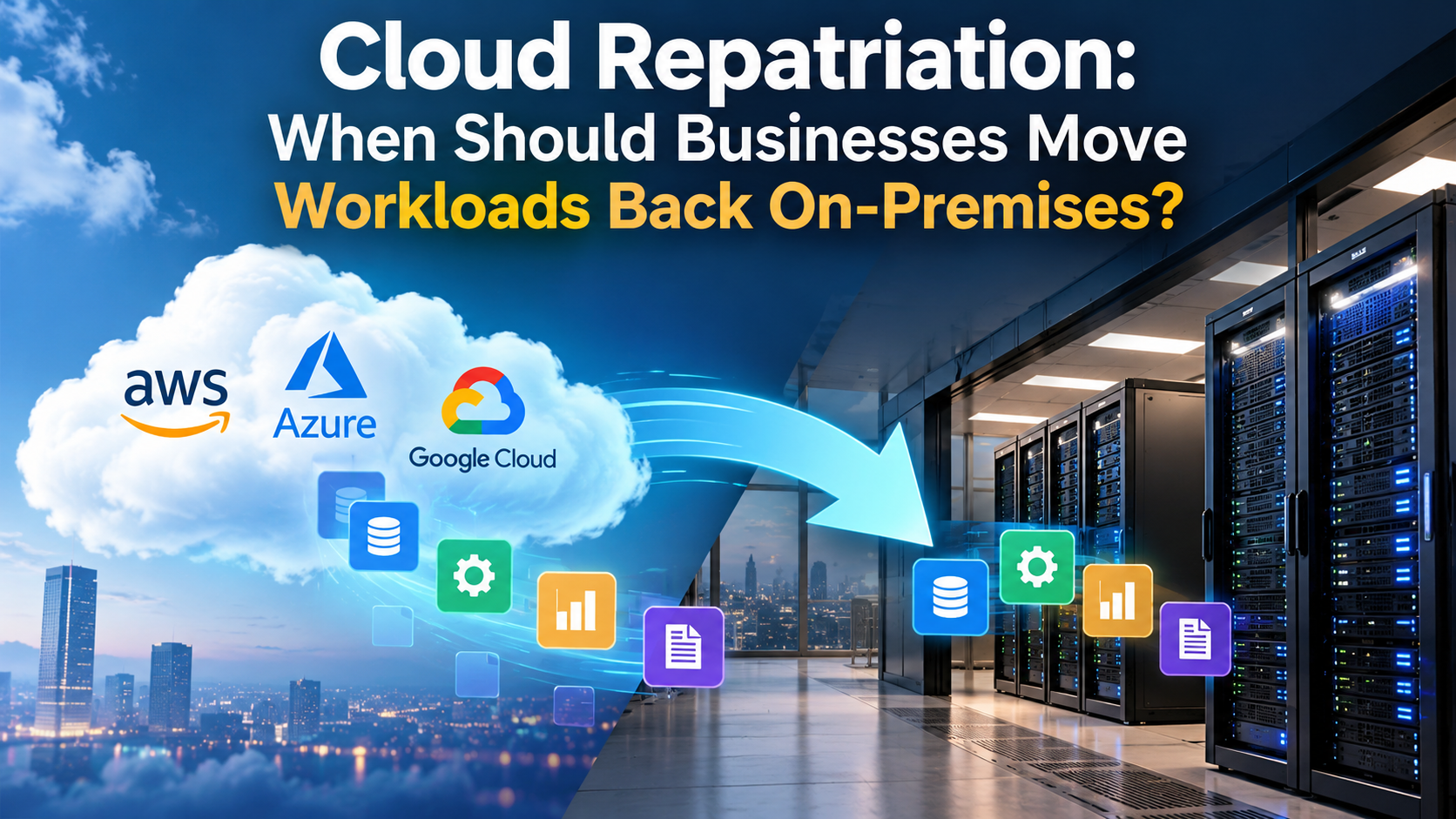
Cloud adoption has changed how businesses build, run, and scale their IT environments. Moving workloads to the cloud can offer flexibility, faster deployment, and access to managed services. But the cloud does not automatically become the right place for every workload forever.
As cloud environments grow, some businesses discover that certain applications are becoming expensive, difficult to manage, or unsuitable for their operational needs. In these situations, moving selected workloads back to an on-premises environment may make sense.
This process is known as Cloud Repatriation. It does not mean abandoning cloud technology. Instead, it involves reviewing workload requirements and deciding where each application should run based on cost, performance, security, compliance, and business needs.
Cloud Repatriation is the process of moving applications, workloads, data, or infrastructure services from a public cloud environment back to an on-premises data center or privately managed infrastructure.
The decision is usually selective rather than a complete reversal of cloud adoption.
For example, a company might keep customer-facing applications in the cloud while moving a predictable, resource-intensive database back to its own infrastructure. Another business may repatriate workloads because long-term cloud usage costs more than maintaining dedicated infrastructure.
The goal is to find the most practical location for each workload rather than following a cloud-first approach for every application.
Cloud migration can solve many infrastructure challenges, but it can also introduce new costs and operational considerations.
Some businesses experience increasing expenses as workloads become larger or more complex. Data transfer charges, storage growth, always-on compute resources, and managed service costs can significantly affect the total bill.
Other organizations may have concerns around data control, regulatory requirements, latency, or specialized hardware.
A workload that made financial sense in the cloud during its early stages may have different requirements after several years of continuous operation.
This is why businesses are taking a closer look at cloud migration costs and the long-term economics of where workloads should run.
1. Cloud Costs Have Become Difficult to Control
One of the most common reasons for considering repatriation is rising infrastructure spending.
A workload with steady, predictable resource requirements may not benefit much from the flexibility of pay-as-you-go cloud infrastructure. If the same resources are running continuously, owning or privately hosting the required infrastructure could potentially provide a different cost structure.
Businesses should compare more than their monthly cloud bill. The analysis should include hardware, data center operations, software licensing, maintenance, staffing, energy, networking, backup, and security costs.
Only a complete cost comparison can show whether repatriation is financially sensible.
2. Workloads Require Consistent Performance
Some applications have highly predictable workloads and strict performance requirements.
If an application needs dedicated computing resources or specialized hardware continuously, moving it to on-premises infrastructure may provide greater control over the underlying environment.
This can be relevant for organizations running databases, analytics systems, manufacturing applications, or other workloads where predictable performance is more important than rapid infrastructure changes.
3. Data Residency and Compliance Requirements Matter
Certain workloads contain sensitive information subject to specific regulatory or contractual requirements.
Keeping data within an organization's own infrastructure can sometimes make data governance easier, depending on the applicable rules and architecture.
However, repatriation should not be treated as an automatic compliance solution. Businesses still need appropriate access controls, encryption, monitoring, backups, and security processes in their private environments.
4. Network and Data Transfer Costs Are High
Applications that constantly move large amounts of data between cloud services and external systems can generate significant network traffic.
If data is repeatedly transferred between environments, organizations should examine whether the architecture itself is creating unnecessary costs and latency.
In some cases, placing related workloads closer together on private infrastructure can improve the overall design.
5. Workloads Have Become Stable
Cloud environments are particularly useful when businesses need flexibility. But not every workload requires frequent scaling.
An application that has reached a stable and predictable level of demand may be easier to operate on dedicated infrastructure.
This is where workload placement becomes important. Instead of asking whether the company should be in the cloud or on-premises, teams should ask where each workload delivers the best combination of cost, performance, control, and reliability.
A common misunderstanding is that repatriation means returning the entire IT environment to a private data center.
In practice, many businesses can use a hybrid cloud strategy, keeping different workloads in different environments.
For example:
This approach gives businesses more flexibility when deciding where applications and data should reside.
Moving a workload back from the cloud requires more than comparing infrastructure prices.
Businesses should review:
A repatriation decision should be based on the complete operating model, not simply a comparison between a cloud invoice and server prices.
A practical cloud repatriation strategy starts with workload discovery.
First, identify which applications are running in the cloud and understand their resource consumption, dependencies, performance requirements, and data flows.
Next, calculate the actual long-term cost of keeping each workload in the cloud. Then estimate the total cost of operating the same workload privately.
After that, assess technical requirements such as hardware, networking, security, backup, monitoring, and disaster recovery.
Finally, test the workload before making a full move. A phased approach can reduce operational risk and give teams an opportunity to identify unexpected dependencies.
Cloud and on-premises infrastructure should not be treated as competing choices where one must replace the other.
Different workloads have different characteristics. Some benefit from cloud elasticity, while others may be better suited to dedicated infrastructure.
Cloud Repatriation gives organizations another option when their requirements change. The important part is making the decision based on measurable factors rather than assuming that every workload should remain in its original environment.
Cloud Repatriation can be a practical option when cloud costs, performance requirements, data considerations, or workload characteristics make another infrastructure model more suitable.
However, moving workloads back on-premises is not automatically cheaper or better. Businesses need to examine total costs, operational responsibilities, security, performance, availability, and future requirements before making the move.
For many organizations, the answer may not be cloud versus on-premises. A well-planned hybrid cloud strategy can provide a middle ground where each workload runs in the environment that best matches its needs.
What is Cloud Repatriation?
Cloud Repatriation is the process of moving applications, workloads, or data from public cloud environments back to on-premises or privately managed infrastructure.
Why do companies repatriate workloads?
Companies may consider repatriation because of increasing cloud costs, predictable workloads, performance requirements, data governance needs, or high data transfer expenses.
Is Cloud Repatriation the same as leaving the cloud?
No. Businesses can repatriate selected workloads while continuing to run other applications in public cloud environments. A hybrid model is often possible.
How can businesses determine whether repatriation will save money?
They should compare the complete long-term cost of both environments, including cloud services, hardware, maintenance, staffing, facilities, networking, security, backup, and energy.
Which workloads are suitable for repatriation?
Workloads with stable resource requirements, predictable demand, specialized hardware needs, high data transfer volumes, or specific infrastructure requirements may be candidates for evaluation.









 India
India

 Canada
 United Kingdom
 New Zealand
 USA
USA
 UAE
UAE
 SGP
SGP
 Australia
 CALL
NOW
CALL
NOW