
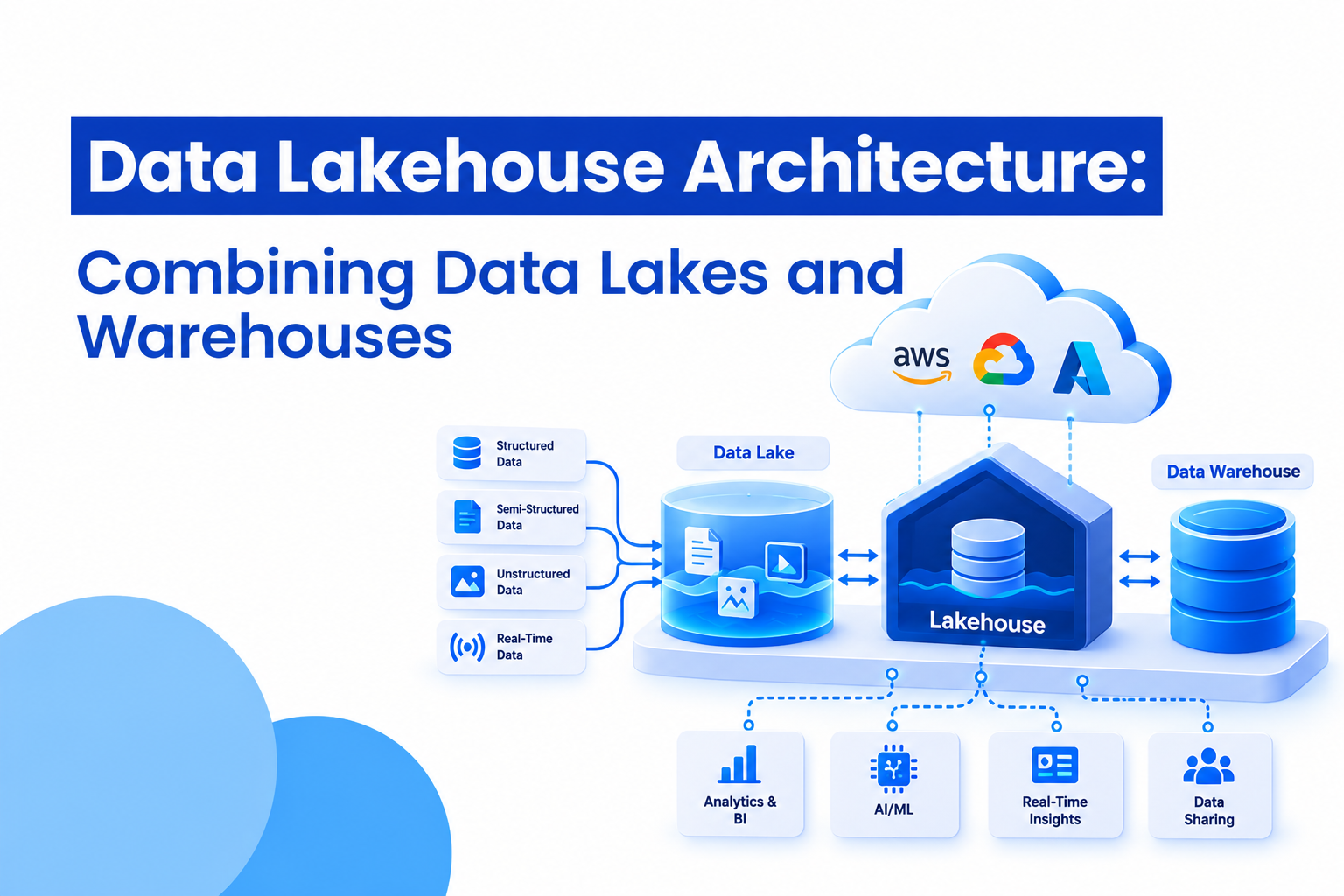
For years, businesses have had to choose between two familiar approaches to storing and analyzing data.
Data lakes offered a flexible place to keep large volumes of raw information. Data warehouses provided structured, reliable data for reporting and business intelligence. Both had clear strengths, but maintaining separate systems could create duplicated data, complex pipelines, and additional management work.
The Data Lakehouse Architecture brings these ideas together.
Instead of treating data lakes and warehouses as completely separate platforms, a lakehouse aims to provide the flexibility of a data lake with many of the management and analytics capabilities traditionally associated with a warehouse.
Imagine a company collecting information from its website, mobile application, CRM, payment systems, IoT devices, and internal applications.
Some of this data is structured. Some arrives as JSON files, logs, images, or other unstructured formats.
Traditionally, the organization might store raw information in a data lake and move selected datasets into a warehouse for reporting.
Over time, this can create a chain of problems.
Data may be copied multiple times. Different teams may work with different versions of the same information. Data pipelines become harder to maintain, and analysts may have to wait for engineering teams to prepare datasets before they can use them.
The bigger the organization becomes, the harder this separation can be to manage.
A lakehouse attempts to reduce this gap.
A data lakehouse is a data architecture that combines characteristics of data lakes and data warehouses within a more unified environment.
The idea is relatively simple:
Keep a broad range of data in a flexible storage layer while adding the organization, governance, reliability, and analytical capabilities businesses expect from a warehouse.
This makes the lakehouse particularly interesting for organizations dealing with growing data volumes and increasingly diverse analytics requirements.
Instead of creating separate copies of data for different teams, a lakehouse can provide a shared foundation for analytics, data engineering, machine learning, and business intelligence.
The easiest way to understand the architecture is to think about what happens to data after it enters the organization.
Data arrives from multiple sources
Customer applications, enterprise software, databases, APIs, connected devices, and third-party services continuously generate information.
Raw information is stored
Instead of forcing every dataset into a rigid structure immediately, organizations can retain data in its original or near-original form.
Data is organized and prepared
Data engineers can clean, transform, validate, and organize information for different analytical requirements.
Teams consume the same underlying data
Analysts, data scientists, engineers, and business applications can access governed datasets without necessarily creating completely separate copies for every use case.
This shared approach is one of the main reasons lakehouse architecture has become part of modern data discussions.
The real value of a lakehouse is not simply putting a lake and warehouse together.
It is about changing how organizations think about their data environment.
A traditional architecture may involve several specialized systems connected through pipelines. A modern data architecture aims to make data easier to discover, govern, process, and use across different workloads.
This can support:
The same underlying data can support different teams without requiring every group to build its own isolated data store.
It would be a mistake to assume that lakehouse architecture makes traditional warehouses irrelevant.
Data warehouses remain useful for structured analytical workloads, reporting, performance optimization, governance, and business intelligence.
The difference is that a lakehouse can bring more data types and processing workloads into the same broader architecture.
This is especially useful when organizations need to combine structured business records with semi-structured or unstructured information.
For example, an enterprise analytics team may want to analyze customer transactions alongside application logs and product usage data. A lakehouse can provide an architectural foundation for working with these different forms of information.
Consider an online retailer.
It generates:
A conventional warehouse may be excellent for analyzing orders, revenue, and customer information. But website logs, reviews, and other less structured data may require different storage and processing systems.
A data lakehouse can provide a common environment where these datasets are stored and prepared for different analytical needs.
The marketing team can analyze customer behavior. Data scientists can build recommendation models. Finance teams can work with sales information. Engineers can investigate application data.
Instead of creating disconnected data environments for every team, the organization works from a more unified foundation.
Many enterprises still operate older warehouse environments that were designed around earlier data requirements.
Meanwhile, data volumes have increased and organizations now expect analytics platforms to support machine learning, AI, streaming data, and diverse file formats.
This has pushed businesses toward data warehouse modernization.
Modernization does not always mean completely replacing an existing warehouse. Organizations may gradually move workloads, introduce cloud storage, modernize pipelines, or adopt lakehouse capabilities alongside existing systems.
A phased approach can reduce disruption while allowing teams to modernize their data environment over time.
Cloud infrastructure has made lakehouse architectures easier to build and expand.
A cloud data platform can provide elastic storage and computing resources while reducing the need for organizations to maintain large physical data infrastructure.
It can also make it easier to connect data ingestion, processing, storage, analytics, and machine learning services.
However, moving to a cloud-based architecture does not automatically solve data management problems.
Organizations still need clear ownership, governance, access policies, security controls, data quality processes, and cost monitoring.
Lakehouse architecture brings flexibility, but flexibility without governance can quickly create another data problem.
Organizations should establish clear rules for:
Data quality: Teams need confidence that datasets are accurate and usable.
Access: Sensitive information should only be available to authorized users and applications.
Metadata: Users need to know what datasets contain, where they came from, and how they should be used.
Data lifecycle: Old or unnecessary information should not remain indefinitely without a reason.
Cost: Storage and processing can grow rapidly when large datasets are retained and queried frequently.
A modern architecture still needs disciplined data management.
Not necessarily.
A smaller organization with limited data sources and straightforward reporting requirements may not need the complexity of a lakehouse.
The architecture becomes more attractive when an organization has multiple data types, large data volumes, diverse analytical workloads, and teams that need access to the same information for different purposes.
The important question is not whether lakehouse architecture is modern. It is whether it solves a real problem within the organization's existing data environment.
The boundaries between data lakes, warehouses, analytics platforms, and AI infrastructure are becoming less rigid.
Businesses increasingly want one environment that can support traditional reporting alongside machine learning, advanced analytics, and AI workloads.
That is where Data Lakehouse Architecture fits into the larger picture.
It provides a way to bring flexible data storage and structured analytics closer together without forcing organizations to treat every workload as a separate data project.
The appeal of a data lakehouse comes from a simple idea: businesses should not have to maintain completely disconnected systems for every type of data and every analytical workload.
By combining flexible storage with stronger organization, governance, and analytical capabilities, lakehouse architecture can provide a practical foundation for enterprise analytics and modern data workloads.
For organizations considering modernization, the right approach is to start with current data challenges, understand existing systems, and then determine where lakehouse principles can actually add value.
What is Data Lakehouse Architecture?
Data Lakehouse Architecture combines the flexible storage approach of a data lake with capabilities traditionally associated with data warehouses, creating a shared environment for different data workloads.
How is a lakehouse different from a data lake?
A data lake primarily focuses on storing large amounts of raw or varied data. A lakehouse adds stronger capabilities for organization, governance, reliability, and analytical workloads.
Does a lakehouse replace a data warehouse?
Not always. Organizations may continue using warehouse technologies alongside lakehouse components, particularly during modernization or when specific workloads benefit from a warehouse approach.
Why are businesses moving toward lakehouse architecture?
Growing data volumes, diverse data formats, AI workloads, and the need to support multiple analytical teams are some of the reasons organizations are exploring lakehouse architectures.
Is a lakehouse suitable for enterprise analytics?
It can be useful for enterprise analytics when organizations need to bring structured, semi-structured, and unstructured data together for reporting, data science, machine learning, and advanced analysis.








 India

 Canada
 United Kingdom
 New Zealand
 USA
 UAE
 SGP
 Australia
 CALL
NOW