
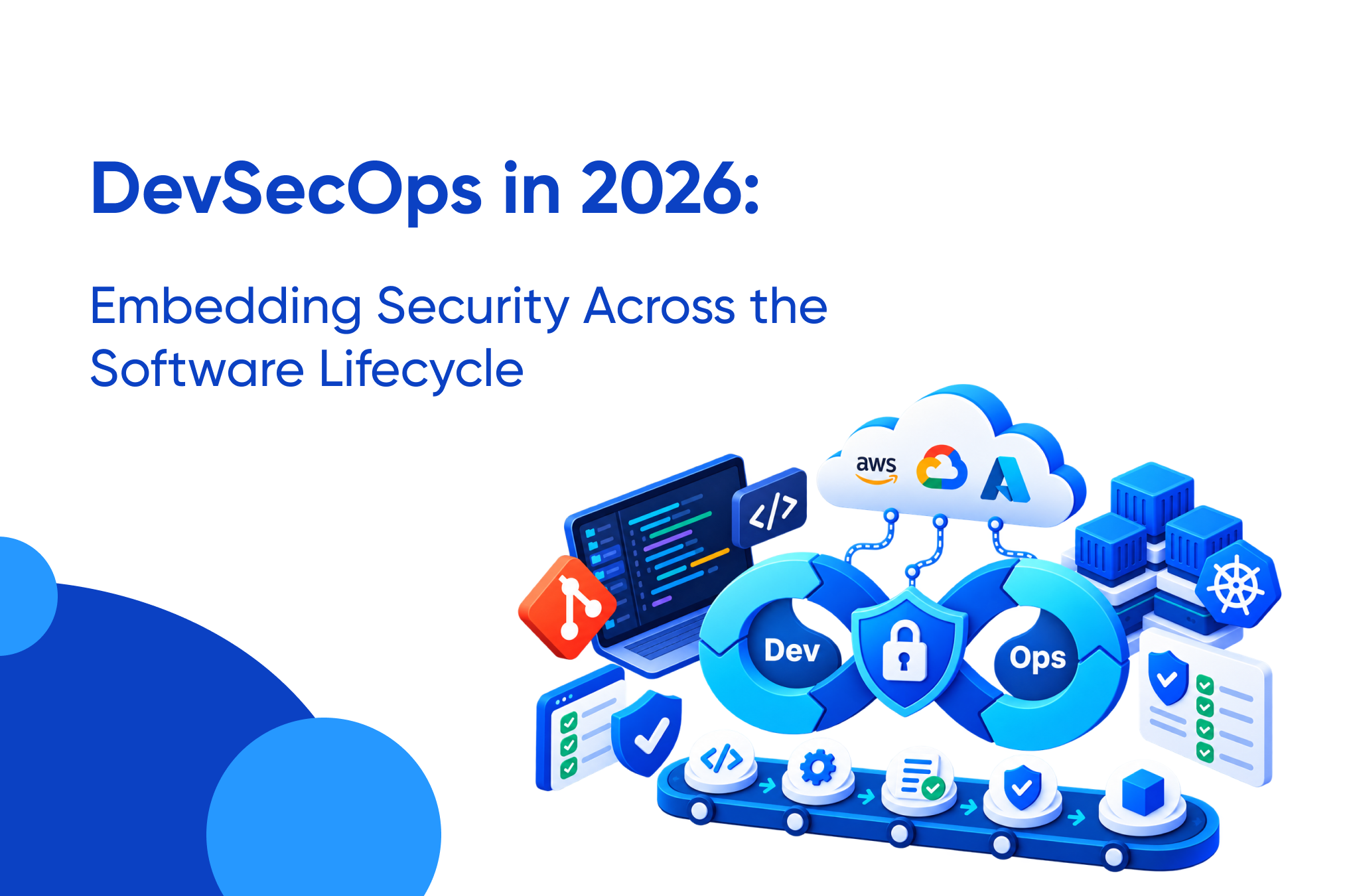
Software development moves quickly, and security needs to keep pace. Applications are updated frequently, development teams depend on open-source components, and cloud environments have become part of everyday software delivery. Finding security problems only after an application is deployed can create delays, additional costs, and unnecessary exposure.
This is why DevSecOps has become an important approach to modern software development. Instead of treating security as a separate activity performed near the end of development, DevSecOps brings security checks into planning, coding, testing, deployment, and ongoing operations.
In 2026, organizations are increasingly looking at security as a shared responsibility across development, security, and operations teams. The goal is to identify risks earlier while maintaining the speed that modern development teams need.
DevSecOps combines development, security, and operations practices within a shared software delivery process. Developers and operations teams work with security teams throughout the lifecycle rather than handing an application to security specialists only before release.
This approach can include secure coding practices, dependency scanning, infrastructure checks, application testing, access controls, vulnerability monitoring, and security policies within automated deployment workflows.
The exact implementation depends on the application and technology stack, but the underlying idea remains the same: security should be considered continuously rather than added as a final checkpoint.
Security issues discovered late in development can require developers to revisit code, change configurations, repeat testing, or delay releases.
Shift-left security moves appropriate security activities closer to the beginning of the software lifecycle. Developers can identify issues while writing and reviewing code instead of waiting until an application reaches a later testing stage.
Early checks can cover coding practices, dependencies, secrets, configurations, and known vulnerabilities. This does not eliminate the need for security testing later, but it can reduce the number of issues that reach production.
A secure CI/CD pipeline is an important part of DevSecOps. Automated pipelines control how code moves from development into testing and production, making them an important area for security controls.
Organizations can integrate security checks into different stages of the pipeline. Source code can be scanned for common security issues, dependencies can be checked for known vulnerabilities, and infrastructure configurations can be reviewed before deployment.
Pipeline access should also be restricted. Credentials, tokens, and deployment permissions should be protected carefully because a compromised pipeline can affect multiple applications or environments.
Application security should not depend entirely on a final security review. Developers should have access to security guidance and tools while building applications.
Code review, static analysis, dependency checks, API testing, and other security activities can be incorporated into development workflows.
Teams should also pay attention to authentication, authorization, input validation, error handling, data protection, and secure configuration.
When security requirements are clear from the beginning, developers can address them as part of normal development rather than treating them as separate tasks.
Modern applications often depend on open-source packages, frameworks, libraries, APIs, and external services. These components can introduce vulnerabilities that may not exist in an organization's own code.
DevSecOps processes should include dependency visibility and regular vulnerability checks. Teams should know which components their applications use and monitor important security updates.
Where a vulnerable dependency is identified, teams can assess its actual use and determine whether an update, replacement, or additional security control is required.
This makes dependency management an ongoing part of software development security.
Applications increasingly depend on cloud infrastructure, containers, orchestration platforms, databases, and infrastructure-as-code.
A secure software lifecycle therefore needs to consider more than application code.
Infrastructure configurations can be checked for insecure settings before resources are deployed. Access permissions, network exposure, storage configurations, secrets, and other infrastructure controls should be reviewed as part of the delivery process.
This is especially useful in environments where infrastructure changes are frequently made through automated workflows.
Automation allows teams to perform repeatable security checks without requiring every change to go through a lengthy manual process.
Security tools can be integrated into development and deployment workflows to identify issues such as vulnerable dependencies, exposed secrets, insecure configurations, and certain classes of coding problems.
However, automation should be designed carefully. Too many low-value alerts can create unnecessary noise and cause developers to ignore security findings.
Teams should prioritize meaningful checks and establish clear processes for handling security findings.
Developers play an important role in DevSecOps, but they need useful information to act on security findings.
Security alerts should explain what the issue is, where it exists, why it matters, and what action may resolve it where practical.
Clear ownership also matters. Teams should know who is responsible for investigating vulnerabilities, reviewing exceptions, updating dependencies, and approving security-sensitive changes.
When developers and security teams share visibility, security issues can be addressed more efficiently.
Security does not end when software reaches production. New vulnerabilities can be discovered after deployment, while application behavior and infrastructure can change over time.
Continuous monitoring can help organizations identify suspicious activity, unexpected configuration changes, authentication anomalies, and other security events.
Production monitoring also provides feedback that can improve future development and security processes.
A mature DevSecOps approach connects development, deployment, and operational security rather than treating them as separate stages.
Technology alone cannot create an effective DevSecOps process. Teams also need shared responsibility and clear security expectations.
Developers should understand common application security risks. Operations teams should understand infrastructure security requirements. Security teams should work closely with developers and provide practical guidance that fits development workflows.
Organizations can support this culture through security training, secure coding guidelines, regular reviews, and clear processes for reporting and addressing vulnerabilities.
DevSecOps brings security into the software lifecycle from development through deployment and ongoing operations. By introducing shift-left security, securing CI/CD pipelines, protecting dependencies, checking cloud configurations, and monitoring production environments, organizations can identify security concerns earlier.
The objective is not to slow development with additional barriers. It is to make security part of the existing development process so that teams can identify and address risks as software evolves.
As applications and cloud environments continue to change, embedding security throughout the lifecycle can help organizations maintain stronger control over their software without separating security from everyday development work.
What is DevSecOps?
DevSecOps integrates security into development and operations processes. It encourages development, security, and operations teams to work together throughout the software lifecycle.
How does shift-left security help development teams?
Shift-left security moves appropriate security checks earlier in development. This can help teams identify vulnerabilities and insecure configurations before applications reach later testing or production stages.
What should a secure CI/CD pipeline include?
A secure CI/CD pipeline can include code analysis, dependency scanning, secret detection, infrastructure checks, access controls, and security testing appropriate to the application and deployment environment.
Why is application security important in DevSecOps?
Application security helps identify weaknesses in software before and after deployment. Integrating security practices into development allows teams to consider authentication, authorization, dependencies, data protection, and other risks throughout the lifecycle.
Does DevSecOps replace security testing?
No. DevSecOps changes how security is integrated into development but does not eliminate the need for security testing. Different testing and monitoring methods can be used at appropriate stages of the software lifecycle.









 India
India

 Canada
 United Kingdom
 New Zealand
 USA
USA
 UAE
UAE
 SGP
SGP
 Australia
 CALL
NOW
CALL
NOW