
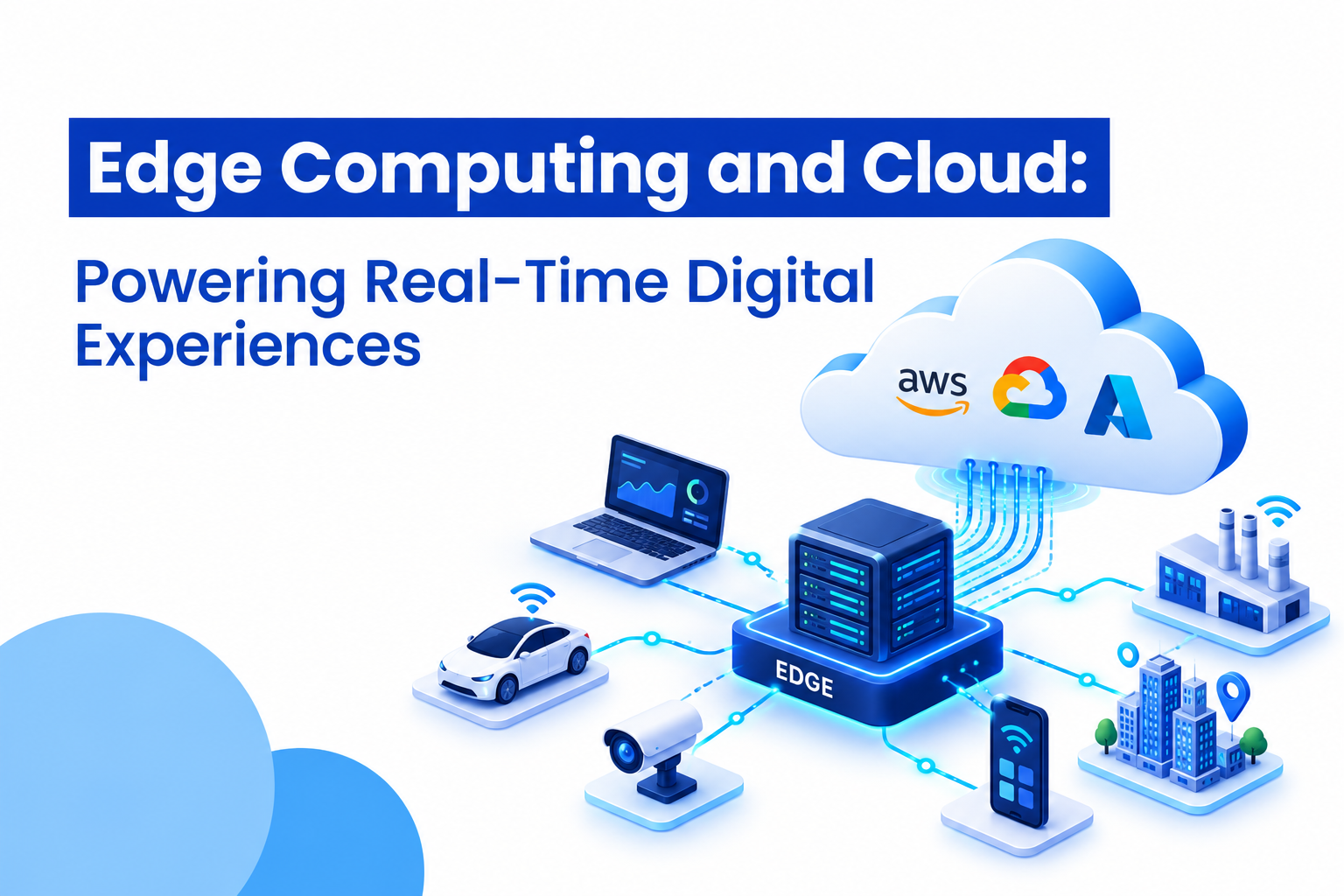
People expect digital services to respond almost instantly. Whether it is a connected vehicle sending sensor data, a smart factory detecting equipment issues, or a mobile application processing a location-based request, even small delays can affect the user experience.
Traditional cloud architecture sends most data to centralized data centers for processing. While this model works well for many applications, it can create delays when devices and users are located far from the cloud infrastructure.
This is where Edge Computing and Cloud work together. Instead of sending every piece of data to a central cloud environment, some processing happens closer to where the data is generated. The cloud can then handle centralized storage, analytics, application management, and workloads that do not require an immediate response.
Edge computing is an approach where data processing takes place closer to the devices, users, and systems generating the data.
Rather than sending every request to a distant cloud data center, edge infrastructure can process selected workloads locally or at a nearby location.
For example, a manufacturing facility can process machine sensor data at an edge location instead of sending every reading to a central cloud platform first. Only important events, summaries, or selected datasets may then be transferred to the cloud.
This can reduce network delays and make applications more responsive.
Edge computing does not replace cloud computing. In many modern architectures, the two work as complementary layers.
The edge handles workloads that need fast responses or local processing, while the cloud provides centralized resources for storage, analytics, application services, security, and management.
A typical flow may look like this:
Device → Edge Location → Cloud Platform → Centralized Analytics
For example, an IoT device can collect sensor information and send it to an edge system. The edge system can immediately detect an unusual condition and trigger an action. Relevant information can then be sent to the cloud for long-term analysis.
This combination is the foundation of effective cloud-edge integration.
Many applications cannot afford to wait for every piece of data to travel to a centralized cloud environment and return with a response.
Consider a security camera that needs to identify unusual activity, or an industrial machine that needs to react when a sensor detects a dangerous condition.
In these situations, real-time data processing closer to the source can reduce the time between detecting an event and responding to it.
Edge computing can be particularly useful when applications need:
Lower Latency
Processing data closer to users and devices can reduce the distance information needs to travel.
This is especially valuable for low-latency applications such as industrial automation, connected vehicles, interactive applications, and real-time monitoring.
Reduced Network Traffic
Not every piece of data needs to be sent to a central cloud platform.
Edge systems can filter, aggregate, or process information locally before sending relevant data to the cloud. This can reduce unnecessary network traffic and help manage bandwidth requirements.
Better Application Responsiveness
Applications can respond to local events more quickly when processing happens near the source.
For users, this can translate into faster interactions. For businesses, it can support processes where delays can affect operations.
Continued Local Processing
Some edge environments need to continue operating even when connectivity to the central cloud is temporarily unavailable.
Local processing can allow selected functions to continue until cloud connectivity is restored.
The relationship between edge computing and IoT is particularly important because connected devices can generate enormous amounts of data.
A large industrial operation may have thousands of sensors producing information continuously. Sending all raw data directly to the cloud may not always be efficient.
An IoT cloud infrastructure can use edge systems to process information locally before forwarding relevant data to centralized cloud services.
For example, edge devices can identify abnormal temperature readings from industrial equipment and immediately notify operators. The cloud can store historical measurements and analyze long-term equipment performance.
This creates a balance between local responsiveness and centralized intelligence.
Smart Manufacturing
Factories can use edge systems to process equipment data, monitor production lines, and identify potential problems quickly.
Connected Vehicles
Vehicles can generate large amounts of sensor and telemetry data. Local processing can support applications where immediate responses are important.
Retail
Retail environments can use edge technology for inventory monitoring, smart cameras, point-of-sale systems, and personalized customer experiences.
Healthcare
Edge processing can support connected medical devices and monitoring systems where timely analysis can be important.
Smart Cities
Traffic systems, surveillance infrastructure, public transportation, and environmental sensors can use edge processing to respond to local conditions.
While the benefits are significant, combining edge and cloud infrastructure also creates new challenges.
Managing Distributed Infrastructure
Unlike a centralized cloud environment, edge deployments may involve hundreds or thousands of locations.
Organizations need effective monitoring, configuration management, software updates, and security controls across these distributed environments.
Security
Edge devices can operate in locations that are more difficult to physically secure.
Businesses need strong identity management, encryption, access controls, device security, and continuous monitoring to protect the infrastructure.
Data Management
Organizations need to determine which data should be processed locally, which information should be transferred to the cloud, and how long each type of data should be retained.
Poorly designed data flows can increase network usage and operational complexity.
A practical approach starts with the application rather than the technology.
Businesses should identify workloads where latency, connectivity, or data volume creates a clear reason for local processing.
Next, teams can determine which tasks belong at the edge and which are better handled by centralized cloud services.
Security and monitoring should be designed across both environments from the beginning. Teams should also establish clear policies for software updates, device management, data movement, and failure recovery.
Starting with a focused use case can help organizations understand the operational requirements before expanding an edge deployment.
As connected devices, AI applications, industrial automation, and real-time digital services continue to grow, the need for distributed computing will also increase.
The cloud will remain important for centralized analytics, storage, application management, and large-scale processing. At the same time, edge infrastructure can bring selected computing capabilities closer to where data is generated.
This makes Edge Computing and Cloud less about choosing one model over another and more about deciding where each workload should run.
Edge Computing and Cloud provide complementary ways to build faster and more responsive digital services.
Edge computing brings processing closer to users and devices, while cloud platforms provide centralized storage, analytics, management, and computing resources. Together, they can support real-time data processing, IoT workloads, and other applications where latency and responsiveness matter.
For businesses considering edge computing solutions, the right starting point is to identify workloads that genuinely benefit from local processing and then design the edge and cloud environments around those requirements.
What is Edge Computing and Cloud?
Edge Computing and Cloud refers to an architecture where some workloads are processed closer to users or devices at the edge, while centralized cloud platforms handle storage, analytics, and other larger workloads.
How does edge computing reduce latency?
Edge computing processes selected data closer to where it is generated. This reduces the distance data needs to travel to a centralized cloud environment before a response can be produced.
Is edge computing replacing cloud computing?
No. Edge and cloud computing often work together. Edge infrastructure handles workloads requiring local or rapid processing, while cloud platforms provide centralized services and large-scale computing capabilities.
How does edge computing support IoT?
Edge systems can process IoT sensor data closer to the devices generating it. This can reduce network traffic and allow important events to be detected without sending every piece of raw data to the cloud.
Which applications benefit from edge computing?
Applications involving real-time monitoring, industrial automation, connected vehicles, smart infrastructure, IoT devices, and other low-latency applications can benefit from edge computing.







 India

 Canada
 United Kingdom
 New Zealand
 USA
 UAE
 SGP
 Australia
 CALL
NOW