
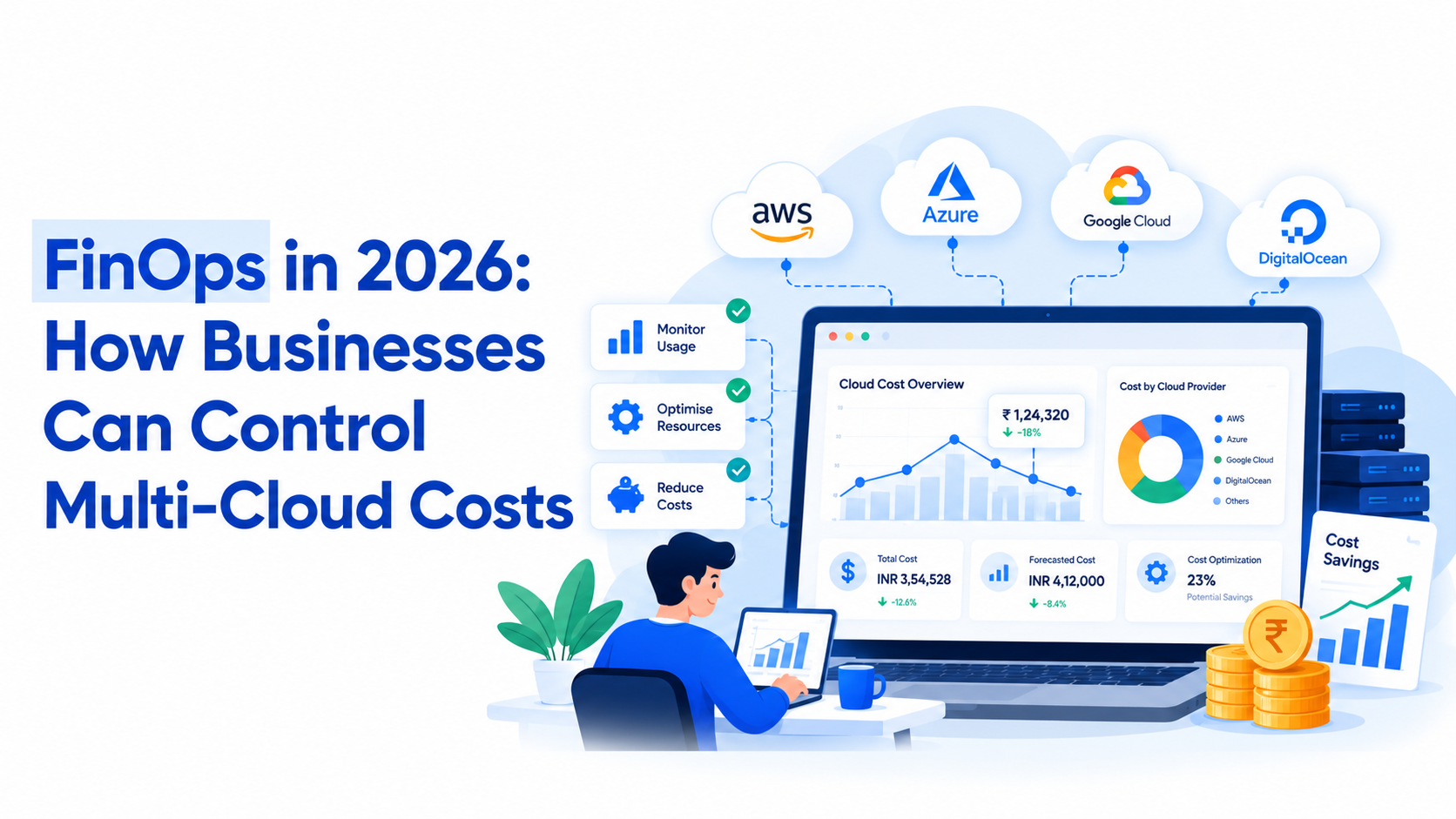
Cloud spending can become difficult to track when a business uses multiple cloud platforms. Different pricing models, services, teams, workloads, and billing structures can make it hard to understand where money is going. A resource that looks inexpensive on its own can become a significant expense when it runs continuously across several environments.
This is where FinOps can make a practical difference. Rather than treating cloud costs as a finance-only concern, FinOps brings finance, technology, and business teams together to understand cloud usage and make better spending decisions.
For businesses managing AWS, Azure, Google Cloud, or other cloud environments, the goal is not simply to spend less. It is to understand what the business is paying for, whether that spending supports actual requirements, and where unnecessary costs can be reduced.
FinOps is a way of managing cloud spending by bringing financial awareness into technology decisions. It helps engineering, finance, and business teams work with the same view of cloud usage and costs.
In a traditional setup, developers may focus on application performance, infrastructure teams may focus on reliability, and finance teams may focus on budgets. FinOps creates a common process where these teams can discuss how infrastructure choices affect spending.
This becomes especially useful as cloud environments grow and teams gain more freedom to create and modify resources.
Using multiple cloud providers can give businesses flexibility, but it also makes cost visibility more complicated.
Each provider has its own pricing structure, billing tools, discounts, resource types, and terminology. Comparing costs across platforms can therefore take significant effort.
There may also be different teams responsible for different environments. Without consistent tagging, reporting, and ownership, it can be difficult to determine which application or department is responsible for a particular expense.
A strong multi-cloud cost management approach starts with creating visibility across these environments.
Before trying to reduce spending, businesses need to understand their current usage.
Cloud cost data should ideally be organized by factors such as application, team, project, environment, or business function. Consistent tagging and naming practices can make this information easier to analyze.
Instead of looking only at the total monthly bill, teams can examine which services are increasing, which workloads consume the most resources, and whether spending matches business activity.
This gives teams a more useful starting point for cloud spending optimization.
Unused and underused resources are common sources of unnecessary cloud spending.
Development environments may remain active after a project has ended. Storage volumes may remain attached to resources that are no longer required. Virtual machines can also continue running even when their workloads are inactive.
Regular reviews can help identify these resources.
The solution does not always mean deleting everything immediately. Teams should first confirm ownership and business requirements before making changes. Once unused resources are confirmed, removing them or adjusting their configuration can reduce avoidable costs.
A resource can be working correctly while still being larger than necessary.
For example, an application may run on a compute resource with significantly more CPU or memory than it normally uses. The business continues paying for that capacity even though the workload does not require it.
Right-sizing means comparing actual usage with allocated capacity and making adjustments where appropriate.
This should be done carefully. Reducing resources too aggressively can affect application performance, so cost decisions should be considered alongside reliability and workload requirements.
One of the important ideas behind cloud financial operations is that cloud spending should not be reviewed only when the monthly invoice arrives.
When teams plan a new application, migrate a workload, or increase infrastructure capacity, cost should be considered alongside technical requirements.
Developers do not need to become finance specialists. They simply need enough cost visibility to understand how infrastructure decisions affect spending.
This can encourage more thoughtful resource usage without slowing down development.
Cloud cost management works better when responsibility is shared.
Finance teams can provide budget visibility and financial context. Engineering teams understand workload behavior and infrastructure requirements. Business teams can explain the value and priority of applications.
A FinOps framework creates a common process for these groups to work together.
Regular cost reviews can help teams discuss unusual spending, upcoming infrastructure changes, optimization opportunities, and business priorities before costs become difficult to control.
Manual cost reviews can become difficult as cloud environments grow.
Automation can help identify idle resources, unusual spending patterns, unused storage, and workloads that may need attention. Teams can also establish notifications when spending crosses defined thresholds.
Automation should support human decision-making rather than blindly making infrastructure changes.
For example, an alert can notify a team that a development environment has been running continuously for several days. The team can then decide whether the environment should remain active or be scaled down.
Cloud spending is not limited to virtual machines or containers.
Storage, databases, networking, backups, data transfers, managed services, and monitoring tools can all contribute to the overall bill.
This is particularly important in multi-cloud environments, where data may move between different regions or providers.
A complete cloud spending optimization strategy should therefore consider the entire environment rather than focusing on one service category.
A single monthly figure does not always explain what is happening inside a cloud environment.
Teams should look at spending trends over time and compare them with workload growth, application usage, deployments, and business activity.
If cloud costs increase by 20% while application usage increases by 50%, the situation may be different from a 20% cost increase with no corresponding growth in usage.
This kind of context helps teams make more informed decisions about infrastructure efficiency.
Cloud environments change constantly. New applications are launched, workloads grow, resources are replaced, and business requirements shift.
Because of this, FinOps should be treated as an ongoing practice rather than a one-time cost-cutting exercise.
Regular reviews, clear ownership, accurate cost allocation, resource optimization, and collaboration between technical and financial teams can help businesses maintain better control as their cloud environments expand.
Managing cloud costs across multiple providers requires more than simply searching for cheaper resources. Businesses need visibility into usage, clear ownership, practical optimization processes, and regular communication between technology and finance teams.
FinOps provides a framework for bringing these activities together. By identifying unused resources, right-sizing infrastructure, tracking cost trends, improving allocation, and making spending part of everyday technology decisions, businesses can gain greater control over multi-cloud expenses.
The goal is not to reduce cloud spending at any cost. It is to make sure cloud resources are being used thoughtfully and that the money spent on them supports genuine business and technical requirements.
What is FinOps?
FinOps is a cloud financial management approach that brings engineering, finance, and business teams together to understand cloud usage, manage spending, and make informed infrastructure decisions.
Why is FinOps important for multi-cloud environments?
Multi-cloud environments can have different pricing models, billing systems, and resource structures. FinOps helps businesses create better visibility and establish consistent processes for managing costs across these environments.
How can businesses reduce unnecessary cloud spending?
Businesses can review unused resources, right-size infrastructure, optimize storage, monitor data transfer costs, improve resource allocation, and regularly review spending against actual workload requirements.
What is a FinOps framework?
A FinOps framework provides a structured way for teams to manage cloud costs through visibility, accountability, budgeting, optimization, and collaboration between technical and financial stakeholders.
Does FinOps mean simply cutting cloud costs?
No. The purpose of FinOps is not to reduce spending blindly. It focuses on understanding cloud costs and ensuring that resources are used efficiently while still meeting performance, reliability, and business requirements.









 India
India

 Canada
 United Kingdom
 New Zealand
 USA
USA
 UAE
UAE
 SGP
SGP
 Australia
 CALL
NOW
CALL
NOW