
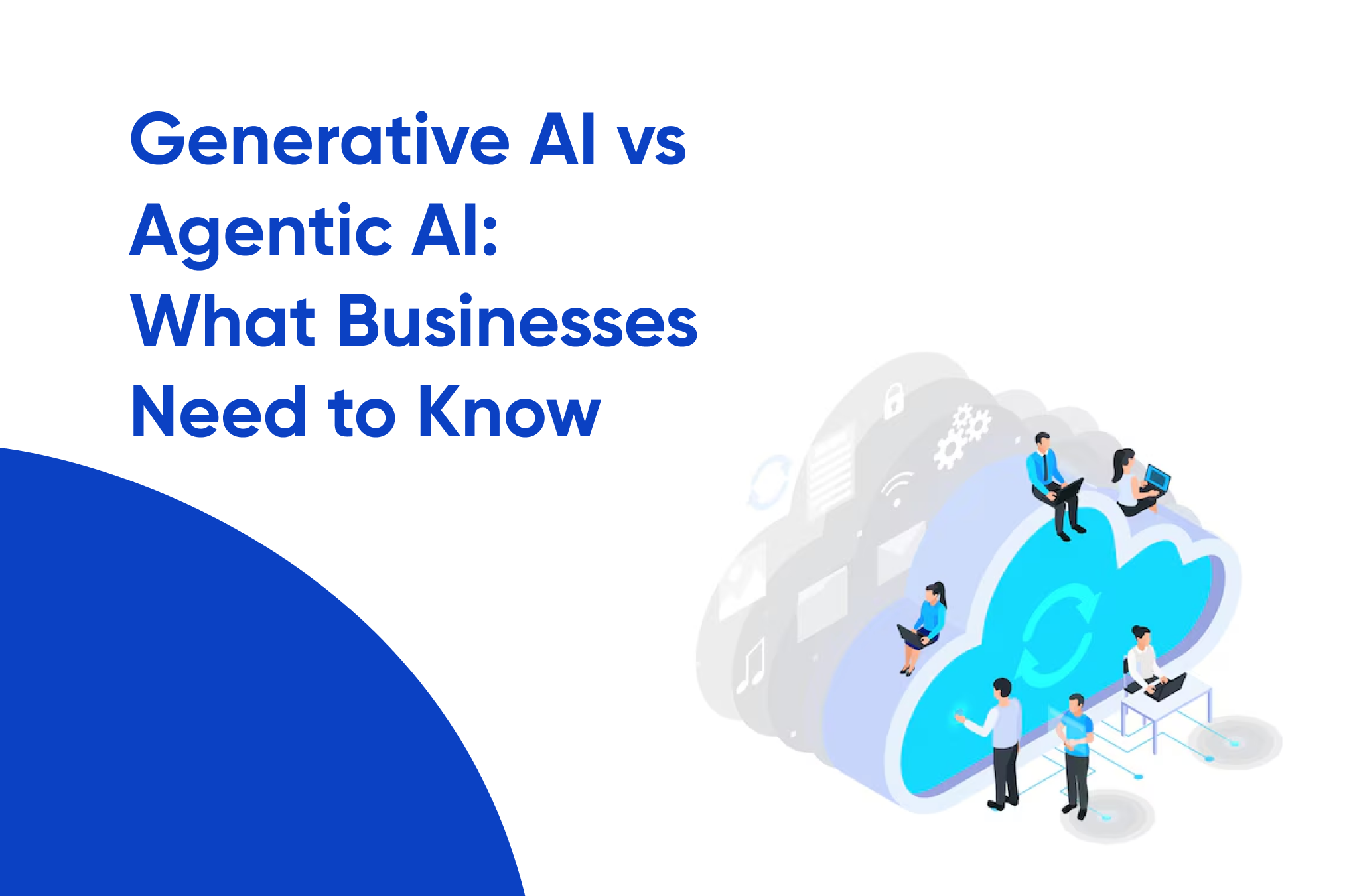
Artificial intelligence is no longer limited to answering questions or creating content. Businesses are now using AI for research, customer support, data analysis, software development, decision-making, and many other activities. As AI continues to develop, two terms are becoming especially important: Generative AI and Agentic AI.
Although both technologies use advanced AI models, they are designed for different purposes. Generative AI creates new content based on a user's instructions, while Agentic AI can work toward a goal by planning tasks and taking actions.
Understanding this difference can help businesses decide where each technology fits into their operations. The right choice depends on the problem a company wants to solve, the level of automation required, and how much control people need over the process.
Generative AI is designed to produce content. It can create text, images, code, summaries, ideas, reports, and other outputs after receiving a prompt or set of instructions.
For example, a marketing team can use Generative AI to create a product description. A software team can ask it to explain code or generate a code example. A customer service team can use it to draft responses to common questions.
Generative AI solutions are therefore useful when the main requirement is creating or processing information.
Agentic AI takes a different approach. Instead of only producing an answer, an AI agent can work through several steps to complete a task. It may gather information, use connected tools, make decisions within defined limits, and check whether the task has been completed.
In simple terms, Generative AI mainly helps create, while Agentic AI can help act.
Generative AI has already become useful across many departments because it can reduce the time required for content and information-based work.
Businesses can use generative AI solutions for:
The technology is particularly useful when employees need help producing a first draft or understanding large amounts of information.
However, Generative AI usually waits for an instruction before producing an output. It does not automatically manage an entire business process unless it is connected to other systems and given additional capabilities.
Agentic AI is built around completing objectives rather than simply generating responses. An agent can receive a goal and determine the steps needed to achieve it.
Imagine a company wants to follow up with potential customers. A Generative AI tool could write personalized follow-up emails. An Agentic AI system could identify prospects, review their information, decide which contacts need follow-up, prepare messages, send approved communications, update the CRM, and report the results.
This is where agentic AI systems can provide a different level of support.
They can connect multiple actions into one process. Instead of asking an employee to start each task, an agent can move through approved steps on its own and involve a person when a decision requires human approval.
A practical AI technology comparison becomes easier when we look at how each system works.
| Area |
Generative AI |
Agentic AI |
|---|---|---|
| Main purpose | Creates or transforms content | Completes tasks and goals |
| Typical input | Prompt or instruction | Goal, task, or trigger |
| Output | Text, image, code, summary, or other content | Actions, decisions, updates, and results |
| Workflow | Usually responds to a request | Can manage multiple steps |
| Tool usage | May use connected tools | Often designed to use multiple tools |
| Human involvement | Usually frequent | Can be reduced for approved tasks |
| Best use | Content and information work | Multi-step business processes |
The two technologies are not competitors in every situation. In many cases, they work better together.
Companies do not necessarily have to choose between Generative AI and Agentic AI. They can use both technologies for different parts of the same process.
Consider a customer support operation. Generative AI can understand a customer's message and prepare a suitable response. An agent can take the next steps by checking customer information, reviewing order details, updating a ticket, and escalating the issue when necessary.
In this setup, Generative AI provides the language and content capabilities, while Agentic AI manages the wider task.
This combination can make intelligent automation more useful because businesses can automate both information handling and actions.
Enterprise AI adoption is not simply about adding an AI chatbot to a website. Larger organizations need to consider data access, security, employee roles, existing software, compliance requirements, and business goals.
Companies should first identify processes where AI can provide measurable value. A process that involves repetitive work, large amounts of information, and several connected systems may be a strong candidate for Agentic AI.
Generative AI may be a better starting point for teams that mainly need help with writing, research, analysis, coding, or knowledge management.
The best approach is usually to start with a defined use case instead of trying to introduce AI across every department at once.
The choice between the two technologies can vary by department.
Marketing: Generative AI can create campaign ideas, content, and summaries. Agentic AI can coordinate research, campaign tasks, reporting, and follow-ups.
Sales: Generative AI can prepare emails and meeting summaries. Agentic AI can update CRM records, identify follow-up tasks, and coordinate approved outreach.
Finance: Generative AI can explain financial documents and create summaries. Agentic AI can help manage invoice workflows, check records, and route exceptions.
Human Resources: Generative AI can help write job descriptions and answer common employee questions. Agentic AI can coordinate onboarding steps, document collection, and scheduling.
IT: Generative AI can explain technical problems and suggest solutions. Agentic AI can monitor events, gather information, perform approved actions, and escalate issues.
These examples show that the difference is not only about technology. It is also about the type of work a business wants AI to perform.
Generative AI is often easier to introduce because many applications can be used with relatively simple prompts. Businesses can begin with individual employees or departments and gradually expand usage.
Agentic AI can require more planning. Agents may need access to business applications, databases, APIs, internal knowledge, and workflow systems. Companies also need to define permissions and decide which actions require human approval.
As a result, agentic AI systems can offer greater automation but may also require more technical planning and stronger controls.
The goal should not be maximum automation. The goal should be useful automation that produces reliable results without creating unnecessary risk.
Giving an AI system the ability to take action creates responsibilities that businesses cannot ignore.
Organizations should control what an agent can access and what actions it can perform. Sensitive tasks may require approval before an agent can complete them. Businesses should also maintain records of important actions so teams can review what happened.
Human oversight remains important, especially for decisions involving money, employees, customers, confidential information, or business-critical systems.
Generative AI also needs safeguards because generated information can sometimes be inaccurate. Human review and reliable business data remain important regardless of which AI approach is used.
A simple way to decide is to ask what the business actually needs.
If the requirement is to create content, summarize information, generate ideas, assist employees, or support research, Generative AI may be the better fit.
If the requirement is to complete a multi-step task, work across different applications, respond to changing conditions, and take approved actions, Agentic AI may provide greater value.
Some processes will benefit from both. Generative AI can handle communication and reasoning, while an agent can coordinate the actions around that output.
Generative AI and Agentic AI represent different stages of how businesses can use artificial intelligence. Generative AI has made it easier for employees to create and understand information. Agentic AI is extending that capability toward completing tasks and managing workflows.
For businesses, the most useful strategy is not choosing the technology that sounds more advanced. It is choosing the technology that matches the work.
As enterprise AI adoption grows, companies will likely combine generative AI solutions, agentic AI systems, and intelligent automation to create practical systems that support employees and improve everyday operations.
The future of business AI will not be about replacing every human task. It will be about deciding which work technology can handle well, where human judgment remains necessary, and how both can work together effectively.









 India
India

 Canada
 United Kingdom
 New Zealand
 USA
USA
 UAE
UAE
 SGP
SGP
 Australia
 CALL
NOW
CALL
NOW