
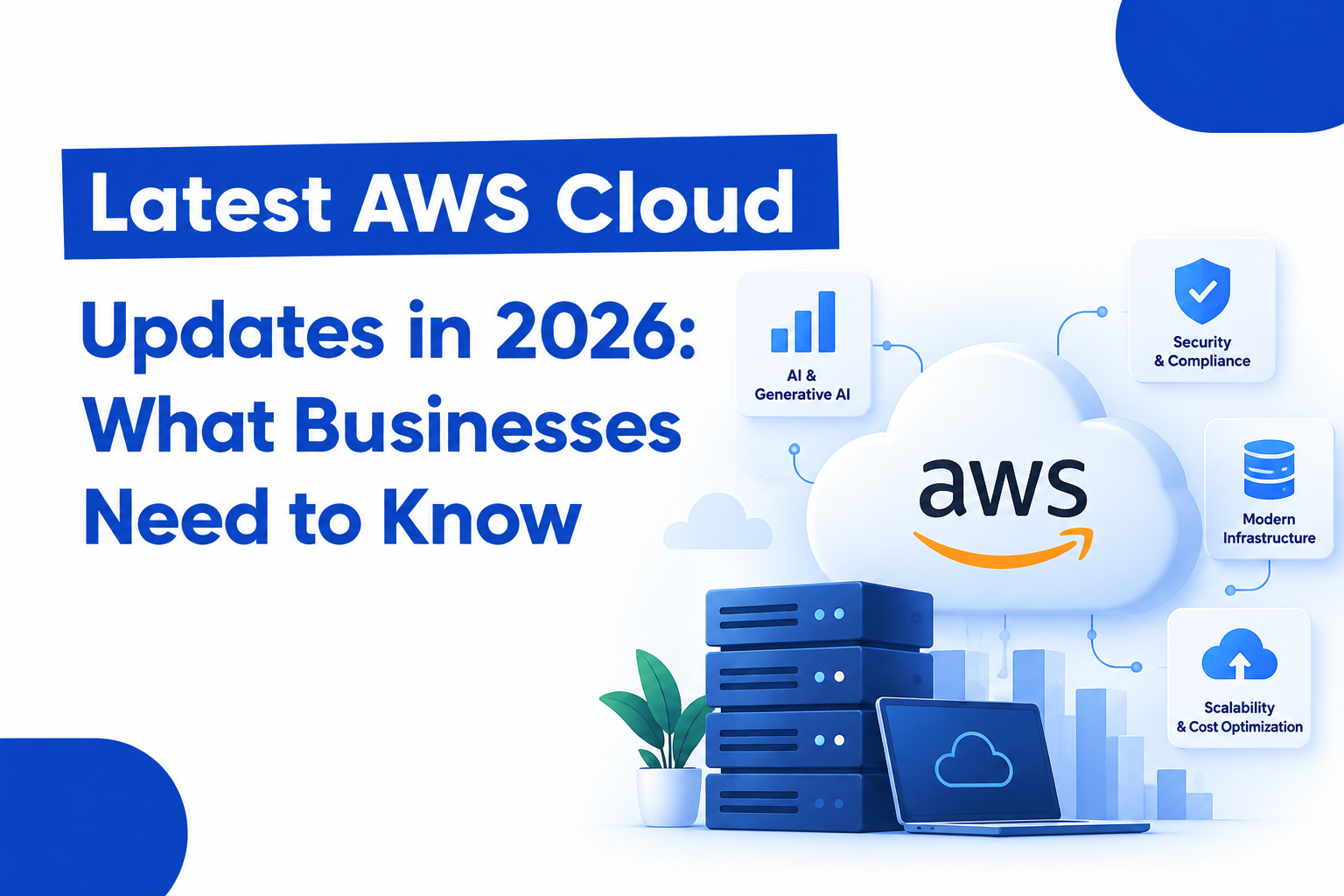
Cloud computing continues to play an important role in how businesses build applications, manage data, improve security, and support daily operations. As technology develops, companies are also expecting cloud platforms to do more. Artificial intelligence, automation, data analytics, cybersecurity, and modern infrastructure are now becoming closely connected.
Amazon Web Services remains one of the major cloud platforms used by businesses across different industries. In 2026, organizations are paying close attention to new developments that can help them improve cloud operations and prepare for changing technology requirements.
The AWS latest updates in 2026 are expected to focus strongly on artificial intelligence, cloud infrastructure, data, security, and application development. Businesses are no longer using the cloud only for hosting websites or storing files. They are building complete digital environments that support customers, employees, applications, and business growth.
Understanding the direction of AWS / Cloud News can help organizations make better technology decisions. In this blog, we will look at the major AWS developments and trends businesses need to know in 2026.
Artificial intelligence is one of the biggest technology areas influencing cloud computing in 2026.
Businesses are using AI for many different purposes. Customer support, content creation, software development, data analysis, automation, and business reporting are just a few examples.
As AI adoption grows, cloud platforms are becoming important for providing the infrastructure needed to build and run AI applications.
One of the important areas within the AWS latest updates is the continued focus on generative AI and AI-powered business applications.
Businesses want more than basic AI tools. They want AI systems that can work with business information while maintaining proper security and control.
AWS provides cloud services that can help organizations develop, test, and deploy AI applications based on their requirements.
In 2026, more companies are expected to move from experimenting with AI towards using it in practical business operations.
For example, AI can help employees find information faster, analyse large amounts of content, support customers, and automate selected repetitive tasks.
However, businesses should not adopt AI without proper planning. They need to understand where AI can provide real value and what infrastructure is required to support it.
During the early stages of generative AI adoption, many businesses experimented with chatbots and content generation tools.
Now, companies are beginning to look at more practical applications.
Businesses want to connect AI with internal systems, customer information, documents, and business processes. This allows AI to provide more useful and relevant support.
For example, an organization may use AI to help employees search internal knowledge, prepare reports, analyse customer requests, or support software development.
This shift is important because it changes the role of cloud infrastructure.
AI applications need access to computing resources, storage, data, and secure networks. Businesses also need proper systems for managing how AI applications access information.
The AWS latest updates reflect the growing need for cloud platforms that can support AI throughout its lifecycle.
Organizations need to think about more than choosing an AI model. They also need to consider data quality, infrastructure, security, integration, and ongoing management.
A successful AI strategy depends on all these areas working together.
Cloud infrastructure is also changing because modern applications have greater requirements.
Traditional applications may need basic computing and storage resources. However, AI, data analytics, and large business applications can require much more processing power.
AWS continues to provide different infrastructure options to support different workloads.
Businesses can choose computing resources based on their requirements instead of investing in and managing all physical hardware themselves.
This flexibility is one of the main reasons cloud computing remains valuable.
The direction of AWS / Cloud News in 2026 shows that businesses are increasingly looking for infrastructure that is powerful, flexible, and cost-effective.
Companies need to manage workloads that can change quickly. An application may have low demand during one period and experience a sudden increase in usage later.
Cloud infrastructure allows businesses to adjust resources according to changing needs.
For organizations working with AI and large-scale data, access to specialized computing infrastructure is becoming even more important.
AI requires significant computing power, especially when businesses work with advanced models and large amounts of data.
One important trend in the AWS latest updates is the continued development of specialized infrastructure for AI workloads.
AWS has invested in its own cloud chips designed for different computing requirements.
This includes technologies that support AI training and inference workloads.
Training involves helping an AI model learn from large amounts of information. Inference refers to using a trained model to generate results.
Different AI workloads can have different infrastructure requirements.
By providing specialized options, cloud platforms can help organizations choose infrastructure based on the type of AI application they are building.
For businesses, this can provide greater flexibility when planning AI projects.
However, selecting infrastructure should depend on actual business and technical requirements.
Companies should consider factors such as workload size, expected usage, performance needs, and overall cloud costs.
Data remains one of the most valuable parts of modern business operations.
Companies collect information from customers, websites, applications, sales platforms, employees, and many other sources.
However, managing this information can become difficult when data is spread across multiple systems.
Businesses need ways to collect, process, analyse, and use data effectively.
The AWS latest updates in the data space are important because AI and analytics depend heavily on quality information.
A business may have large amounts of data, but that does not always mean the data is ready for analysis or AI applications.
Organizations need to understand:
A strong data strategy can help businesses make better decisions and improve their operations.
In 2026, more organizations are expected to focus on making data easier to access while maintaining proper security and governance.
Data analytics is changing with the growth of AI.
Traditionally, analysing large amounts of information often required technical skills and specialized tools.
AI can make some data interactions easier by helping users understand information and identify patterns.
For example, business teams may be able to ask questions about their data and receive useful explanations or summaries.
This can help more employees use data as part of their decision-making process.
However, businesses still need proper data management.
AI cannot solve every data problem automatically. If the underlying information is incomplete or inaccurate, the results may also be unreliable.
This is why the connection between AI and data remains important in AWS / Cloud News.
Businesses that want to benefit from advanced analytics should first focus on building a reliable data foundation.
As businesses move more applications and information to the cloud, security continues to be a major concern.
Cloud environments can include applications, databases, employee accounts, customer information, and important business systems.
Protecting these resources requires a strong security strategy.
The AWS latest updates continue to highlight the importance of identity management, data protection, monitoring, and threat detection.
Cloud security is not only the responsibility of a technology provider.
Businesses also need to manage user access, configure their systems properly, and follow security best practices.
A strong cloud security approach should include:
Automation is also becoming increasingly useful for security teams.
Modern cloud environments can generate large amounts of activity and security information. Automated tools can help organizations identify potential problems faster.
However, businesses still need skilled people and proper processes to respond to security issues.
Businesses today need to develop and update applications more quickly.
Customer expectations change, technology develops, and companies need to respond to new requirements.
Cloud platforms help development teams build and deploy applications without managing every part of the underlying physical infrastructure.
AWS continues to support modern application development through cloud-native technologies, containers, serverless computing, and automation.
These technologies can help organizations develop applications that are easier to manage and update.
One important trend in 2026 is the growing use of AI in software development.
AI tools can support developers by helping with code generation, testing, documentation, and problem-solving.
This does not remove the need for skilled developers. Instead, AI can help development teams complete certain tasks faster.
The combination of cloud technology and AI is changing how software is created and maintained.
Many organizations want to spend less time managing infrastructure and more time focusing on applications and business goals.
Serverless technology can help with this approach.
Instead of managing servers directly, businesses can focus on running applications and services.
Automation also plays an important role in cloud operations.
Companies can automate repetitive processes such as infrastructure setup, monitoring, application deployment, and system management.
The goal is not to automate everything without human involvement.
Businesses should identify tasks where automation can reduce manual work and improve consistency.
The AWS latest updates continue to show the importance of automation in modern cloud environments.
As technology environments become more complex, automation can help businesses manage resources more effectively.
Not every organization operates entirely in one cloud environment.
Some businesses continue to use on-premises systems, while others use services from multiple cloud providers.
This makes hybrid and multi-cloud strategies important.
A hybrid approach can combine cloud services with existing infrastructure.
A multi-cloud approach can involve using services from more than one cloud provider.
Businesses may choose these strategies for different reasons, including technical requirements, existing systems, business needs, and operational flexibility.
However, using multiple environments can also increase complexity.
Organizations need proper planning to manage applications, data, security, and costs across different platforms.
The important point is not whether every business should use one cloud or multiple clouds.
The right approach depends on the organization's requirements.
As businesses use more cloud services, managing costs becomes increasingly important.
Cloud computing provides flexibility, but companies still need to understand how resources are being used.
Unused resources, incorrect configurations, and unnecessary services can increase cloud spending.
Cost management is therefore becoming an important part of cloud strategy.
Businesses should regularly review their cloud environment and understand where money is being spent.
They should also choose resources based on actual workload requirements.
The AWS latest updates and wider cloud trends show that organizations are becoming more focused on balancing performance with cost.
The goal should not always be to choose the most powerful infrastructure.
Instead, businesses should choose resources that provide the right level of performance for their needs.
The changing cloud environment gives businesses many new opportunities, but technology adoption should always begin with clear goals.
Organizations should review their existing cloud environment and identify areas that need improvement.
Important questions include:
Businesses should also avoid trying to adopt every new technology immediately.
A better approach is to identify specific business problems and find technology that can help solve them.
For example, a company may begin by improving data management before introducing advanced AI applications.
Another organization may focus on cloud security or application modernization.
A step-by-step approach can make cloud adoption easier to manage.
The AWS latest updates in 2026 show how quickly cloud technology is changing.
Artificial intelligence, data, infrastructure, security, and application development are becoming more closely connected. Businesses are moving beyond basic cloud adoption and exploring ways to use cloud technology for more advanced and practical purposes.
AI is creating new opportunities, but it also requires reliable infrastructure and quality data. At the same time, organizations need to maintain strong security and manage cloud costs carefully.
The future of cloud computing is becoming more intelligent and more connected to business operations.
For companies following AWS / Cloud News, 2026 is an important year to understand how these developments can affect their technology strategy.
Businesses that focus on strong infrastructure, reliable data, security, and practical AI adoption will be better prepared for the future. The key is to adopt technology with a clear purpose and build a cloud environment that supports both current needs and future growth.













 India
India

 Canada
 United Kingdom
 New Zealand
 USA
USA
 UAE
UAE
 SGP
SGP
 Australia
 CALL
NOW
CALL
NOW