
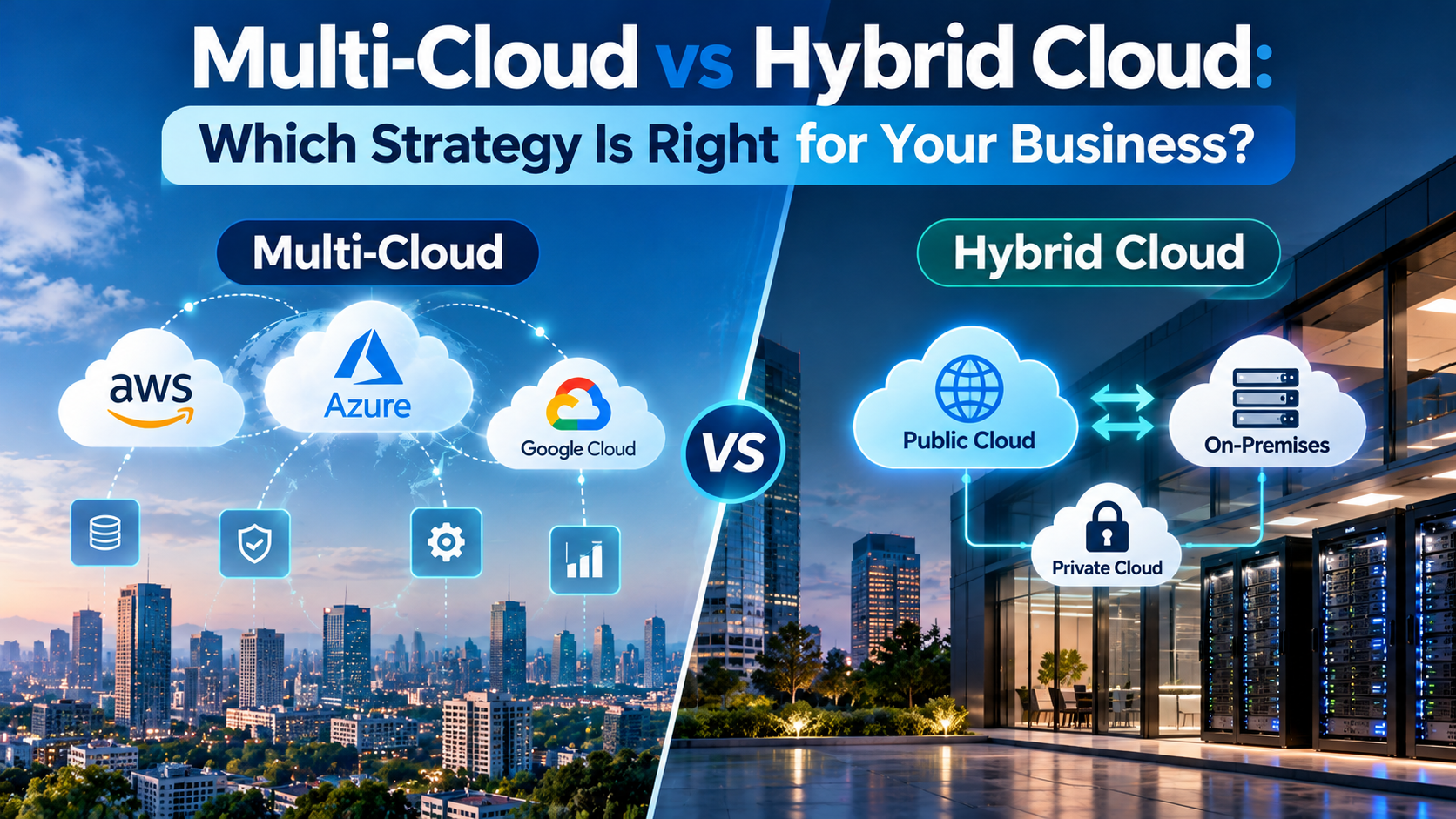
Choosing a cloud environment is no longer as simple as deciding whether to move applications to the cloud. Businesses now have several ways to organize their infrastructure, and two approaches that often come up are multi-cloud and hybrid cloud.
The terms sound similar, but they describe different cloud deployment models.
A multi-cloud environment uses services from two or more cloud providers, while a hybrid cloud combines private infrastructure with public cloud resources. Both approaches can provide flexibility, but they solve different infrastructure challenges.
Understanding the difference between Multi-Cloud vs Hybrid Cloud can help businesses choose an architecture that fits their applications, data, security requirements, and long-term plans.
A multi-cloud strategy means using cloud services from multiple public cloud providers.
For example, a business could use one provider for application hosting, another for analytics, and a third for specialized database or AI services.
The workloads do not necessarily have to work together as a single environment. The main idea is that the organization uses more than one public cloud platform based on its requirements.
Businesses may choose multi-cloud for several reasons:
Multi-cloud can provide choice, but it also introduces additional management and operational complexity.
A hybrid cloud combines private infrastructure with public cloud resources.
The private side could be an organization's own data center or a privately managed cloud environment. The public side can include one or more public cloud providers.
The two environments may be connected so that applications, workloads, or data can move between them or work together.
For example, a business might keep sensitive databases on private infrastructure while running customer-facing applications in a public cloud.
A hybrid cloud solution can be useful when organizations need both infrastructure control and public cloud flexibility.
The easiest way to understand the difference is to look at what environments are being combined.
Multi-cloud generally means:
Public cloud + Public cloud
Hybrid cloud generally means:
Private infrastructure + Public cloud
An organization can also use both approaches at the same time. For example, a company could maintain private infrastructure while using AWS and Azure for different workloads.
This would create a hybrid and multi-cloud environment.
The choice therefore depends on the business problem the architecture needs to solve.
Avoiding Provider Dependency
Relying heavily on one cloud provider can make an organization dependent on that platform's services, pricing, and technical ecosystem.
Using multiple providers can give businesses more flexibility when planning future infrastructure decisions.
However, moving workloads between providers is not always simple. Applications may depend heavily on provider-specific databases, APIs, networking, or managed services.
Access to Different Cloud Services
Cloud providers have different strengths and service offerings.
A business may prefer one platform for data analytics, another for application hosting, and another for a specialized workload.
A multi-cloud environment allows teams to make these decisions workload by workload.
Geographic Requirements
Organizations operating across different markets may need infrastructure in locations where a particular provider offers better coverage or service availability.
Multi-cloud can provide additional deployment options when geographic requirements vary.
Keeping Sensitive Workloads Private
Some applications or datasets may require greater infrastructure control.
Organizations can keep selected workloads on private infrastructure while using public cloud resources for applications that benefit from cloud flexibility.
Supporting Existing Infrastructure
Many enterprises already have significant investments in data centers, applications, and infrastructure.
Moving everything to a public cloud may not be practical or necessary. Hybrid architecture allows organizations to continue using existing systems while gradually adopting cloud services.
Managing Variable Workloads
Some applications have predictable baseline demand but experience occasional spikes.
A hybrid model can allow organizations to maintain core infrastructure privately while using public cloud capacity when additional resources are needed.
Security considerations exist in both models, but the challenges are different.
With multi-cloud, teams need consistent identity management, access controls, monitoring, networking, and security policies across multiple cloud platforms.
With hybrid cloud, teams must secure both public cloud services and private infrastructure while managing the connections between them.
In both cases, centralized visibility becomes important.
Organizations should understand where workloads are running, who has access, how data moves between environments, and how security events are monitored.
Cost can become complicated in both architectures.
A multi-cloud strategy may increase operational costs because teams need expertise across several platforms. Data transfer between providers can also create additional charges.
Hybrid environments introduce their own expenses, including hardware, facilities, maintenance, networking, and staff for private infrastructure.
Businesses should therefore avoid choosing an architecture based only on individual cloud service prices.
A proper evaluation should consider infrastructure, licensing, operations, networking, staffing, security, backup, and long-term management costs.
There is no universal answer when comparing Multi-Cloud vs Hybrid Cloud. The right choice depends on the organization's technical and business requirements.
Consider a multi-cloud approach when:
Consider hybrid cloud when:
In some cases, businesses may benefit from combining both approaches.
A successful enterprise cloud architecture starts with workload requirements rather than choosing a cloud model first.
Businesses should map their applications, data, dependencies, security requirements, performance expectations, and compliance needs.
From there, each workload can be assigned to the environment that makes the most sense.
This approach prevents organizations from adopting a complex architecture simply because it is popular. It also makes future changes easier because infrastructure decisions are tied to clear business and technical requirements.
One common mistake is adopting multi-cloud without a clear reason. Managing several providers adds complexity, so there should be a specific business or technical benefit.
Another mistake is assuming hybrid cloud automatically provides better security. Connecting private and public environments creates additional network and access requirements that must be properly managed.
Businesses should also avoid ignoring data movement. Transferring large amounts of information between environments can affect both performance and cost.
Finally, teams should plan for monitoring and governance from the beginning instead of adding them after the architecture becomes difficult to manage.
Multi-Cloud vs Hybrid Cloud is not simply a choice between two competing technologies. They represent different ways of organizing cloud infrastructure.
Multi-cloud focuses on using multiple public cloud providers, while hybrid cloud combines public cloud with private infrastructure.
The right approach depends on workload requirements, existing infrastructure, security needs, costs, compliance requirements, and the level of operational complexity a business is prepared to manage.
For some organizations, one model may be enough. Others may use a combination of both to create a flexible cloud infrastructure that supports different workloads and business requirements.
What is the difference between multi-cloud and hybrid cloud?
Multi-cloud uses services from two or more public cloud providers. Hybrid cloud combines public cloud resources with private infrastructure such as an organization's data center or private cloud.
Is multi-cloud more expensive than hybrid cloud?
Not necessarily. Costs depend on workloads, data transfer, infrastructure, licensing, staffing, and management requirements. Multi-cloud can increase operational complexity, while hybrid cloud also carries private infrastructure costs.
Can a business use both multi-cloud and hybrid cloud?
Yes. An organization can use private infrastructure alongside multiple public cloud providers. This creates an environment that combines both hybrid and multi-cloud approaches.
Which strategy is better for data-sensitive workloads?
The answer depends on the specific security, compliance, and operational requirements. Hybrid cloud can provide greater control over workloads that need private infrastructure, while cloud providers can also offer specialized security and compliance capabilities.
How should a business choose between the two?
Start by reviewing application requirements, data location, security, compliance, performance, cost, existing infrastructure, and operational capabilities. Then select the architecture that fits those requirements rather than choosing based on the model alone.









 India
India

 Canada
 United Kingdom
 New Zealand
 USA
USA
 UAE
UAE
 SGP
SGP
 Australia
 CALL
NOW
CALL
NOW