
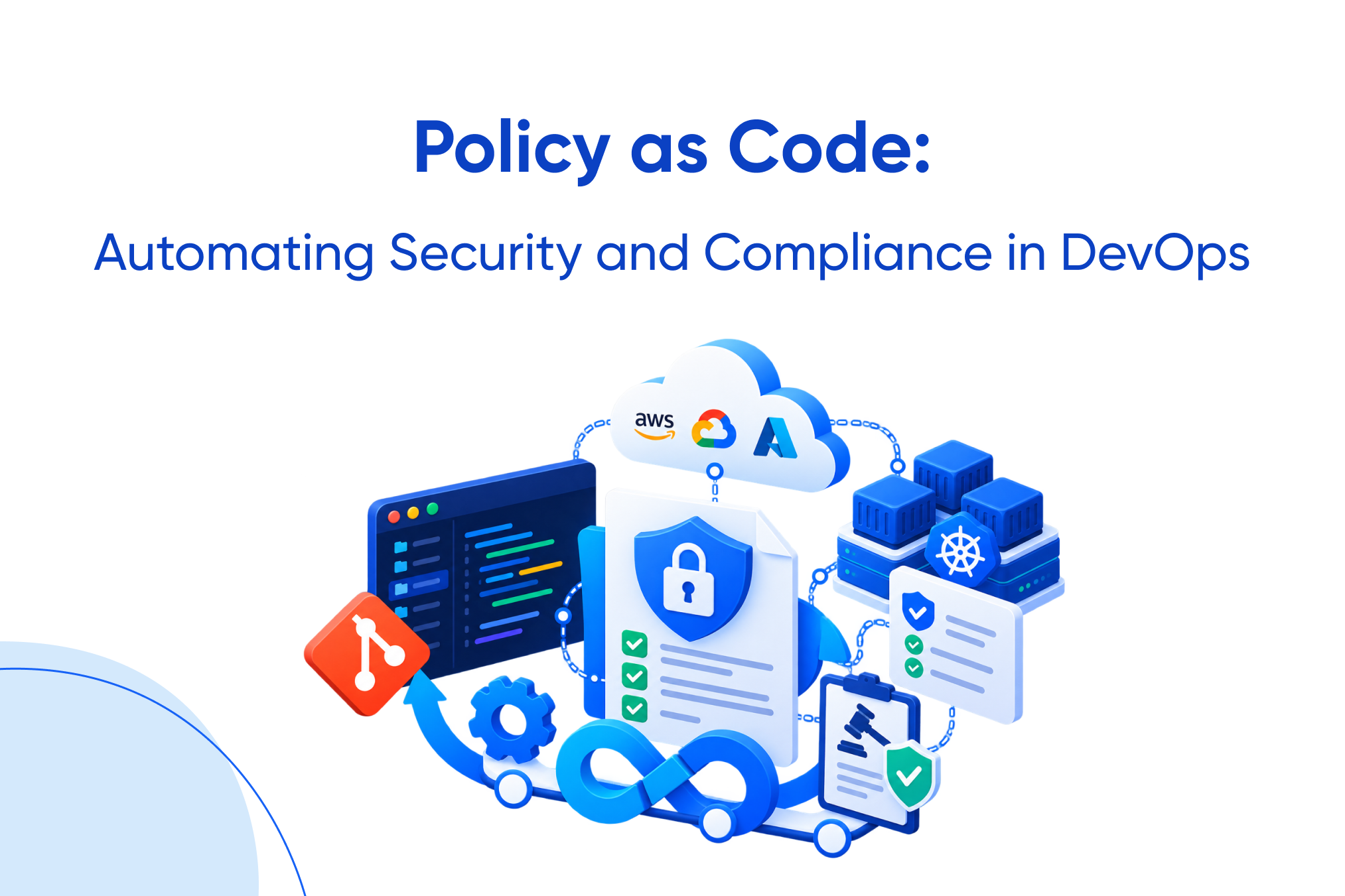
Modern DevOps teams manage infrastructure, applications, cloud resources, and deployments at a rapid pace. With frequent changes happening through automated workflows, checking every configuration manually can become difficult. A single overlooked setting can create a security gap or cause an environment to fall outside an organization's compliance requirements.
Policy as Code provides a way to address this challenge by turning security, governance, and compliance requirements into rules that can be managed and evaluated through code. Instead of depending entirely on manual reviews, organizations can apply defined policies automatically as part of development and deployment workflows.
This approach can help teams create more consistent controls while keeping security and governance closer to everyday DevOps operations.
Policy as Code is the practice of expressing organizational rules and security requirements in a machine-readable form so they can be automatically evaluated.
For example, an organization may require storage resources to use encryption or prevent publicly exposed databases. Instead of checking these requirements manually after deployment, a policy can identify configurations that do not meet the defined requirement.
Policies can be applied during development, infrastructure provisioning, deployment, and ongoing cloud management.
The exact rules depend on the organization's environment and security requirements, but the main objective is consistent and repeatable enforcement.
DevOps encourages frequent infrastructure and application changes. Developers may create cloud resources through infrastructure-as-code templates, while automated pipelines can deploy changes within minutes.
Manual security reviews may struggle to keep pace with this speed.
Automated security policies allow organizations to evaluate changes continuously. A policy can identify a configuration that violates a defined requirement before the change reaches production.
This helps reduce reliance on memory and manual checklists while giving development teams faster feedback.
One practical use of Policy as Code is within CI/CD workflows. Infrastructure and application changes can be evaluated before deployment.
For example, a pipeline can check whether a proposed infrastructure change creates an unrestricted network rule or attempts to deploy a resource without required security settings.
If a critical policy violation is detected, the workflow can prevent deployment or flag the issue for review.
This creates a security checkpoint without requiring a separate manual process for every infrastructure change.
Compliance requirements often involve specific controls around access, data protection, logging, encryption, and infrastructure configuration.
DevSecOps compliance becomes easier to manage when applicable requirements are translated into clear, testable policies.
Instead of reviewing compliance only before an audit, teams can evaluate relevant controls continuously. This can provide greater visibility into whether infrastructure and applications continue to meet defined requirements.
Policy checks do not replace formal audits or other compliance activities, but they can support ongoing control monitoring.
Cloud environments can grow quickly, with teams creating resources across multiple accounts, projects, regions, or environments.
Cloud governance provides rules for how these resources should be created and managed. Policy as Code can help enforce these rules consistently.
Organizations may create policies around approved regions, resource types, naming standards, access permissions, encryption, tagging, or network exposure.
Automated checks can identify resources that do not follow established requirements and provide teams with a clear way to address them.
Infrastructure changes can introduce security issues even when application code itself is secure.
Infrastructure configurations may control network access, storage permissions, identity policies, compute resources, and other important components.
Infrastructure compliance checks can evaluate these configurations before they are applied.
For example, a policy may require specific security settings for storage or prevent certain resources from being exposed publicly.
Finding these issues before deployment can reduce the chance of insecure configurations reaching production.
Policies should be managed with the same discipline used for application and infrastructure code.
Keeping policies in version control provides a history of changes and makes it easier to understand when and why a rule was modified.
Teams can review policy changes before they are introduced and test them against representative configurations.
This also creates greater consistency between security requirements and the actual rules being enforced in technical environments.
Automation is useful, but poorly designed policies can create unnecessary friction.
If every minor configuration difference results in a deployment failure, development teams may receive excessive interruptions. Over time, this can encourage teams to bypass security processes or create exceptions without proper review.
Policies should therefore be prioritized based on risk and business requirements.
Critical security controls may require strict enforcement, while lower-risk requirements may initially generate warnings for review.
Policy enforcement should not stop after infrastructure is deployed. Cloud environments can change after deployment through manual actions, automated processes, application updates, or configuration changes.
Continuous evaluation can help identify when an environment moves away from approved standards.
Teams can use policy results to investigate unexpected changes, correct configuration issues, and improve governance processes.
This makes Policy as Code useful not only for preventing problems but also for maintaining security and compliance over time.
Organizations should regularly review policies to ensure they still reflect current security requirements and cloud architecture.
Outdated rules can create unnecessary restrictions, while missing rules may leave important resources unprotected.
Security, compliance, cloud, and development teams should work together when defining policies. Clear ownership also helps determine who reviews, updates, and approves changes to important security rules.
Policy as Code gives DevOps teams a practical way to automate security, governance, and compliance requirements. By converting defined requirements into repeatable rules, organizations can evaluate infrastructure and application changes more consistently.
Integrating policy checks into CI/CD workflows, cloud environments, and infrastructure processes can help identify configuration issues earlier while reducing dependence on manual reviews.
The most effective approach is not to automate every possible rule. Instead, organizations should focus on meaningful policies that support security and compliance without creating unnecessary barriers for development teams.
What is Policy as Code?
Policy as Code means expressing security, governance, and compliance requirements as machine-readable rules that can be automatically evaluated during development, deployment, and cloud operations.
How does Policy as Code improve DevOps security?
It allows automated security policies to evaluate infrastructure and application changes consistently. This can help identify configuration issues before they reach production and reduce dependence on manual checks.
Can Policy as Code support compliance?
Yes. DevSecOps compliance can use policy rules to continuously evaluate selected security and configuration requirements. However, automated policy checks do not replace formal audits or broader compliance processes.
How is Policy as Code used in cloud governance?
Cloud governance policies can define requirements for resources, access, regions, encryption, networking, and other cloud configurations. Automated evaluation can identify resources that do not meet those requirements.
Does Policy as Code replace manual security reviews?
No. Policy as Code automates repeatable checks, while manual reviews remain useful for complex decisions, exceptions, new requirements, and situations where business context is needed.










 India
India

 Canada
 United Kingdom
 New Zealand
 USA
USA
 UAE
UAE
 SGP
SGP
 Australia
 CALL
NOW
CALL
NOW