
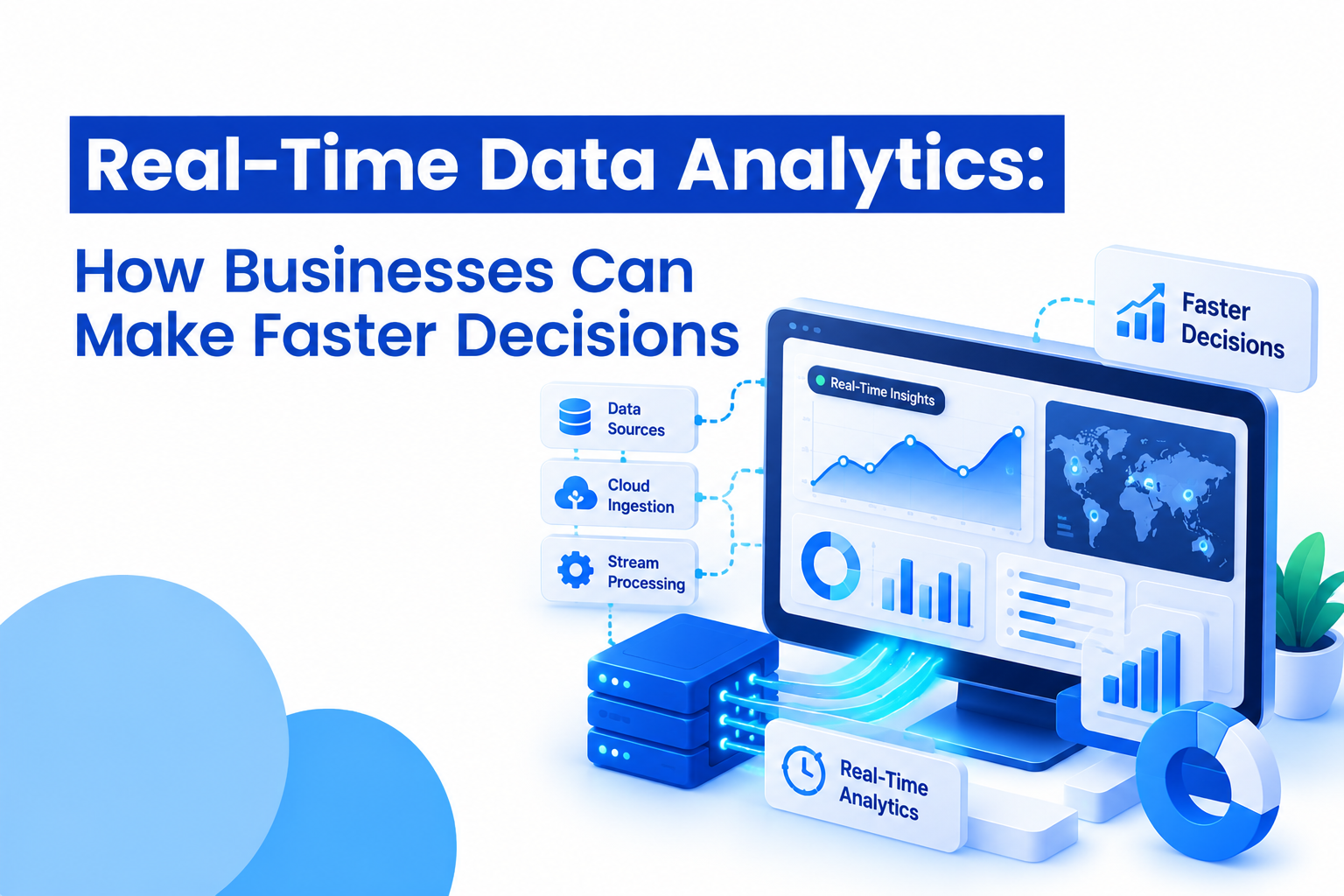
A sales report prepared at the end of the day can tell a business what happened. But what if the business could see a sudden drop in sales while it was happening? What if a bank could detect an unusual transaction within seconds, or an online retailer could respond to changing customer demand before the opportunity disappeared?
That is the idea behind Real-Time Data Analytics.
Instead of waiting for data to be collected, processed, and analyzed hours or days later, businesses can process information as it arrives. This gives teams a much more current view of operations and customer activity.
The result is not simply faster reporting. When the right data reaches the right people at the right time, organizations can respond to changing situations while they still matter.
Traditional analytics often follows a familiar process.
Data is collected from applications and databases, stored in a central system, transformed, and then used to create reports or dashboards. This works well when decisions do not depend on immediate information.
But some business situations change too quickly for this approach.
A retailer cannot always wait until tomorrow to understand why an online campaign is underperforming. A logistics company may need to react to vehicle delays immediately. A financial institution may need to investigate suspicious activity as soon as it appears.
This is where streaming data analytics becomes useful.
Instead of treating data as something that arrives in large batches, streaming systems process information continuously as events occur.
Real-time analytics may appear simple from a user's perspective—a dashboard updates, an alert appears, or an automated action takes place—but several steps happen underneath.
1. Data is generated
Information comes from websites, applications, sensors, transactions, connected devices, databases, and other sources.
2. Data is captured
A streaming platform collects events as they are generated instead of waiting for a scheduled batch process.
3. Data is processed
The system analyzes incoming information, applies business rules, calculates metrics, or identifies specific patterns.
4. Insights are delivered
The results can appear in dashboards, alerts, reports, applications, or automated workflows.
5. Someone or something responds
A business user may take action, or software may trigger an automated response based on the result.
This creates a continuous cycle:
Event → Data → Processing → Insight → Action
The value of real-time analytics becomes easier to understand through practical examples.
An online store can receive thousands of events every minute, including product searches, page views, cart additions, purchases, and abandoned carts.
Instead of waiting for a daily report, teams can monitor these activities as they happen.
A sudden increase in searches for a product may indicate growing demand. A spike in abandoned carts may point toward a checkout problem.
With timely information, teams can investigate the issue while customers are still experiencing it.
Banking: Detecting Suspicious Activity
Financial transactions can be analyzed as they occur.
A transaction that differs significantly from expected behavior can trigger an alert for further investigation.
Real-time processing does not eliminate the need for proper fraud controls, but it can reduce the delay between an event occurring and the organization responding to it.
Logistics: Tracking Moving Operations
Delivery companies deal with constantly changing information.
Vehicle locations, traffic conditions, delivery statuses, weather conditions, and customer updates can all affect operations.
Real-time analytics can bring these signals together so teams can identify delays and make operational adjustments sooner.
Manufacturing: Watching Equipment Performance
Connected machines can produce continuous streams of sensor data.
Temperature, vibration, pressure, and other readings can be monitored to identify unusual patterns.
Instead of discovering an equipment problem after production is affected, teams can receive earlier warnings and investigate potential issues.
Traditional business intelligence is often associated with historical reporting and dashboards. Real-time analytics adds another layer by providing information that reflects what is happening now.
The two approaches do not need to compete.
Historical analytics can answer questions such as:
Real-time analytics can answer questions such as:
Together, these approaches give businesses both historical context and current visibility.
Cloud platforms have made it easier for organizations to collect, process, store, and analyze large volumes of data without building every part of the infrastructure themselves.
A modern cloud analytics environment can connect streaming data sources with processing engines, storage systems, dashboards, machine learning tools, and business applications.
This can make it easier to scale analytics as data volumes change.
However, cloud analytics still requires careful architecture. Businesses need to consider processing costs, data storage, security, network usage, system reliability, and the amount of latency their applications can tolerate.
The term “real-time” can sometimes create unrealistic expectations.
Not every business process needs a response within milliseconds.
For some applications, a few seconds may be sufficient. For others, processing data every few minutes may provide all the value the business needs.
The right target depends on the decision being made.
For example, detecting a fraudulent payment may require very fast processing, while monitoring daily inventory movement may not need millisecond-level updates.
Businesses should therefore define their actual latency requirements before designing a real-time analytics system.
More data and faster processing do not automatically create better decisions.
If a business receives thousands of alerts without meaningful prioritization, teams can become overwhelmed. If dashboards contain too many metrics, users may struggle to identify what actually matters.
This is why successful real-time analytics depends on selecting the right signals.
Businesses should decide:
Which events matter?
Not every piece of incoming data needs immediate analysis.
Who needs the information?
An operations manager may need a different view from a data scientist or finance team.
What action should follow?
An insight becomes more useful when the organization knows what should happen next.
Businesses can start small rather than attempting to make every workload real-time.
Begin by identifying decisions where delayed information creates a measurable problem. Then determine which data sources influence those decisions.
From there, teams can define the required processing speed, build the necessary data pipelines, and create dashboards or automated responses.
Data quality should also be addressed early. Processing information quickly does not help if the underlying data is incomplete, duplicated, or inaccurate.
Security and governance are equally important, particularly when real-time systems process customer, financial, or operational information.
The biggest shift is not technical.
Data-driven decision-making becomes more practical when teams no longer have to rely solely on yesterday's reports to understand what is happening.
A sales manager can react to current demand. An operations team can investigate an emerging problem. A security team can respond to unusual activity. A product team can observe how users interact with a new feature.
The technology provides the information, but people still need context and judgment to decide what action makes sense.
Real-Time Data Analytics helps businesses move from simply reviewing what happened to understanding what is happening now.
Through streaming data analytics, cloud platforms, live dashboards, and automated processing, organizations can shorten the gap between an event and a business response.
The goal is not to make every decision instantaneous. It is to identify the decisions where timely information can make a meaningful difference.
When real-time analytics is built around clear business questions, reliable data, and actionable insights, it can become an important part of modern business intelligence and operational decision-making.
What is Real-Time Data Analytics?
Real-Time Data Analytics involves collecting and processing data as it is generated so businesses can monitor current activity, identify events, and respond without waiting for traditional batch reports.
What is streaming data analytics?
Streaming data analytics processes continuously arriving data rather than waiting for large batches. It can be used for transactions, sensor readings, application events, customer activity, and other ongoing data streams.
Is real-time analytics only useful for large companies?
No. Smaller businesses can also use real-time analytics when they have decisions that depend on timely information. The size of the system should match the volume and importance of the data being processed.
How does real-time analytics support business intelligence?
Traditional business intelligence often focuses on historical information, while real-time analytics provides current data. Combining both can give teams historical context alongside a live view of business activity.
What is the biggest challenge with real-time analytics?
A major challenge is building a system that delivers timely, accurate, and useful information without creating unnecessary complexity or alert overload. Data quality, infrastructure costs, security, and governance also need attention.







 India

 Canada
 United Kingdom
 New Zealand
 USA
 UAE
 SGP
 Australia
 CALL
NOW