
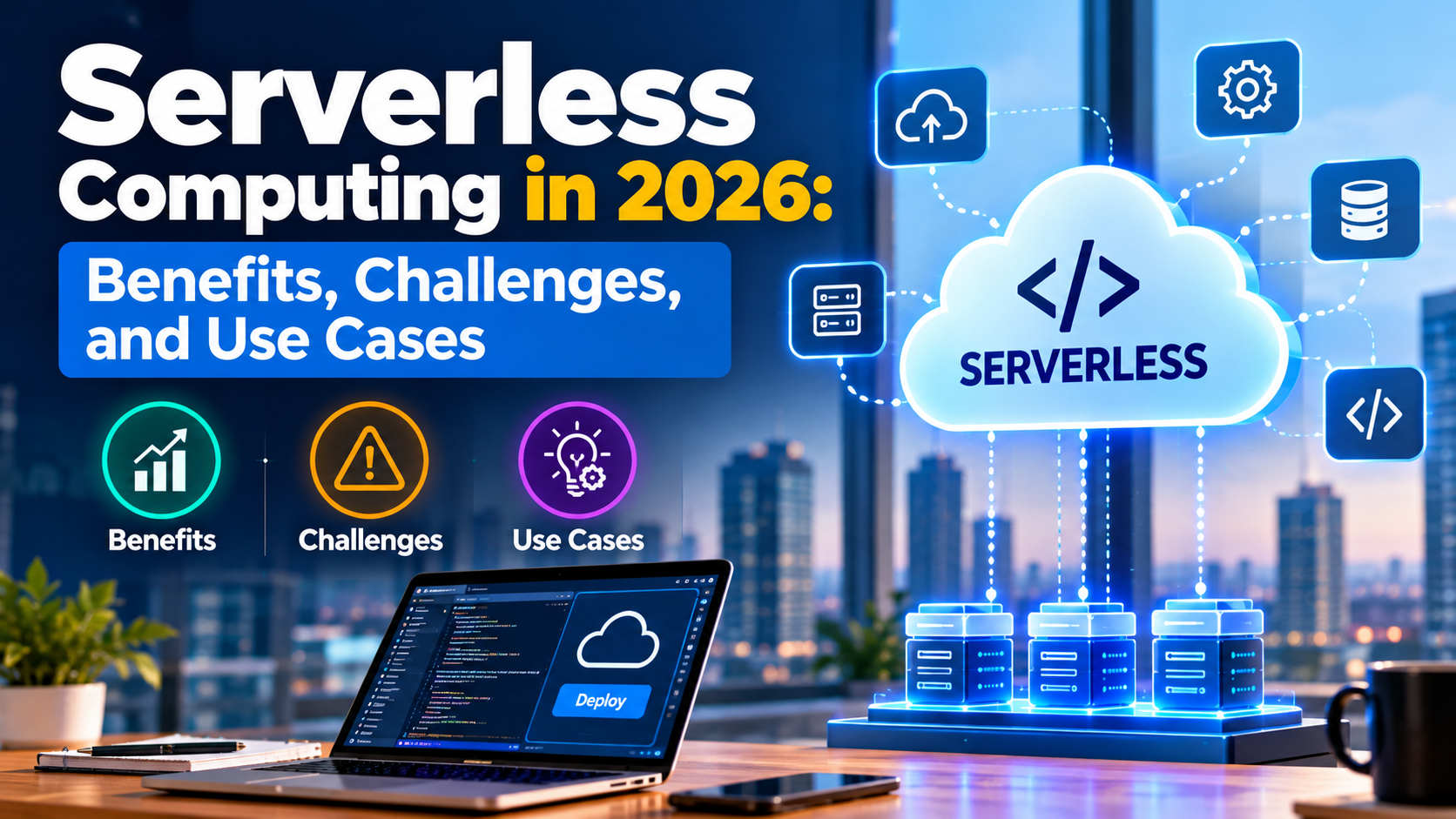
Building and running applications used to mean managing servers, operating systems, capacity, and infrastructure almost every step of the way. Cloud computing changed much of that, but developers still often had to think about provisioning and maintaining the resources behind their applications.
Serverless Computing takes this idea further.
With a serverless model, cloud providers manage much of the underlying infrastructure while development teams focus on writing and deploying application code. Servers still exist, but developers do not need to manage them directly for every workload.
This approach has become an important part of modern cloud-native applications, particularly for workloads that need flexible scaling or event-driven processing.
Serverless Computing is a cloud execution model where the cloud provider manages the underlying servers and infrastructure needed to run application workloads.
Developers typically deploy code or services without provisioning individual virtual machines. The provider handles tasks such as infrastructure management, capacity allocation, and much of the operational maintenance.
One of the most common forms of serverless is Function as a Service (FaaS).
With FaaS, developers create individual functions that execute when triggered by an event, request, message, file upload, database change, or another action.
Examples include AWS Lambda, Azure Functions, and Google Cloud Functions.
A typical serverless architecture is built around small, event-driven components.
For example, imagine an application where users upload images. Instead of keeping a server running continuously to process every upload, an event can trigger a serverless function whenever a new image arrives.
The function can process the file, store the result, and then stop running.
This model can be useful for workloads where activity varies throughout the day because resources can be allocated according to actual execution requirements.
Serverless applications can also use managed databases, storage services, APIs, queues, authentication systems, and other cloud services to create complete application workflows.
Reduced Infrastructure Management
Developers do not have to manage servers for every serverless workload. The cloud provider handles much of the infrastructure provisioning and maintenance.
This allows development teams to spend more time working on application features rather than routine server administration.
Automatic Scaling
Serverless platforms can automatically respond to changes in workload demand.
A function may execute a few times during a quiet period and handle many more requests when demand increases.
This makes serverless useful for applications with unpredictable or highly variable traffic.
Pay for Actual Usage
Traditional servers may continue running even when they are not being heavily used.
With serverless, pricing is generally based on factors such as function executions, execution duration, and associated services.
For workloads that run intermittently, this can provide a different cost structure than continuously running infrastructure.
Because infrastructure provisioning is reduced, teams can deploy individual application functions quickly.
Developers can focus on smaller units of functionality, which can make certain applications easier to build, test, and update.
This can support modern serverless application development practices.
Serverless is not suitable for every application. It also introduces technical and operational considerations that businesses need to understand.
Cold Starts
Some serverless platforms may take additional time to initialize a function when it has not been used recently.
This delay, commonly called a cold start, may matter for applications with strict response-time requirements.
The impact varies based on the runtime, workload, configuration, and platform.
Execution Limits
Serverless functions typically have limits related to execution duration, memory, package size, or other resources.
Long-running workloads may therefore be better suited to containers or traditional compute infrastructure.
Vendor Dependency
Serverless applications often make extensive use of provider-specific services.
For example, an application built around AWS Lambda may also depend on other AWS services. Moving that application to another provider may require architectural and code changes.
Teams should consider this dependency before designing a highly provider-specific architecture.
Monitoring Can Become More Complex
Traditional applications may have a smaller number of long-running services to monitor.
Serverless systems can contain many functions, events, queues, APIs, and managed services. Understanding how a request moves through all these components can require strong logging, tracing, and monitoring practices.
APIs and Web Applications
Serverless functions can process API requests without requiring dedicated application servers to run continuously.
They can be useful for lightweight APIs, backend services, and specific application features.
Data Processing
Businesses can use serverless functions to process files, transform data, trigger workflows, or perform automated tasks when new information arrives.
For example, uploading a file to cloud storage could automatically trigger a function that validates or transforms it.
Scheduled Tasks
Serverless functions can handle periodic jobs such as generating reports, cleaning temporary data, checking system conditions, or running automated maintenance tasks.
Event-Driven Applications
Event-driven systems are a natural fit for serverless architecture.
Functions can respond to events generated by databases, queues, storage systems, APIs, or other cloud services.
Automation and Integrations
Organizations can use serverless functions to connect different applications and services.
A function can receive an event from one system, process the information, and send the result to another service.
Serverless, containers, and virtual machines solve different infrastructure problems.
Virtual machines provide greater control over the operating environment but require more infrastructure management.
Containers package applications and their dependencies while giving teams more control over runtime environments.
Serverless reduces infrastructure responsibilities further by allowing developers to focus primarily on application code.
The choice depends on workload requirements.
A short-lived event-driven task may work well with serverless, while a long-running application requiring detailed operating-system control may be better suited to containers or virtual machines.
A successful serverless approach starts with choosing the right workloads.
Businesses should identify applications that are event-driven, intermittent, variable in demand, or easy to divide into independent functions.
Teams should also establish monitoring, logging, security controls, cost tracking, and deployment processes before moving critical workloads into production.
It is equally important to understand service limits and provider dependencies.
Rather than converting an entire application to serverless immediately, organizations can begin with individual workloads where the benefits are easier to measure.
Serverless continues to fit naturally into modern cloud-native development because businesses increasingly want development teams to focus on application functionality rather than infrastructure maintenance.
At the same time, serverless does not eliminate infrastructure concerns. Organizations still need to manage security, costs, application architecture, observability, permissions, and service dependencies.
The practical approach in 2026 is therefore not to treat serverless as the answer to every cloud workload. Instead, businesses can use it where its operating model matches the application's requirements.
Serverless Computing provides a way to build applications without directly managing traditional server infrastructure for every workload.
Its benefits include reduced infrastructure management, flexible scaling, usage-based pricing, and support for event-driven applications. However, cold starts, execution limits, monitoring complexity, and provider dependency can create challenges.
For businesses building cloud-native applications, serverless can be a valuable part of the architecture when used for the right workloads.
The key is to understand the application's requirements first and then decide whether serverless, containers, virtual machines, or a combination of these models makes the most sense.









 India
India

 Canada
 United Kingdom
 New Zealand
 USA
USA
 UAE
UAE
 SGP
SGP
 Australia
 CALL
NOW
CALL
NOW