
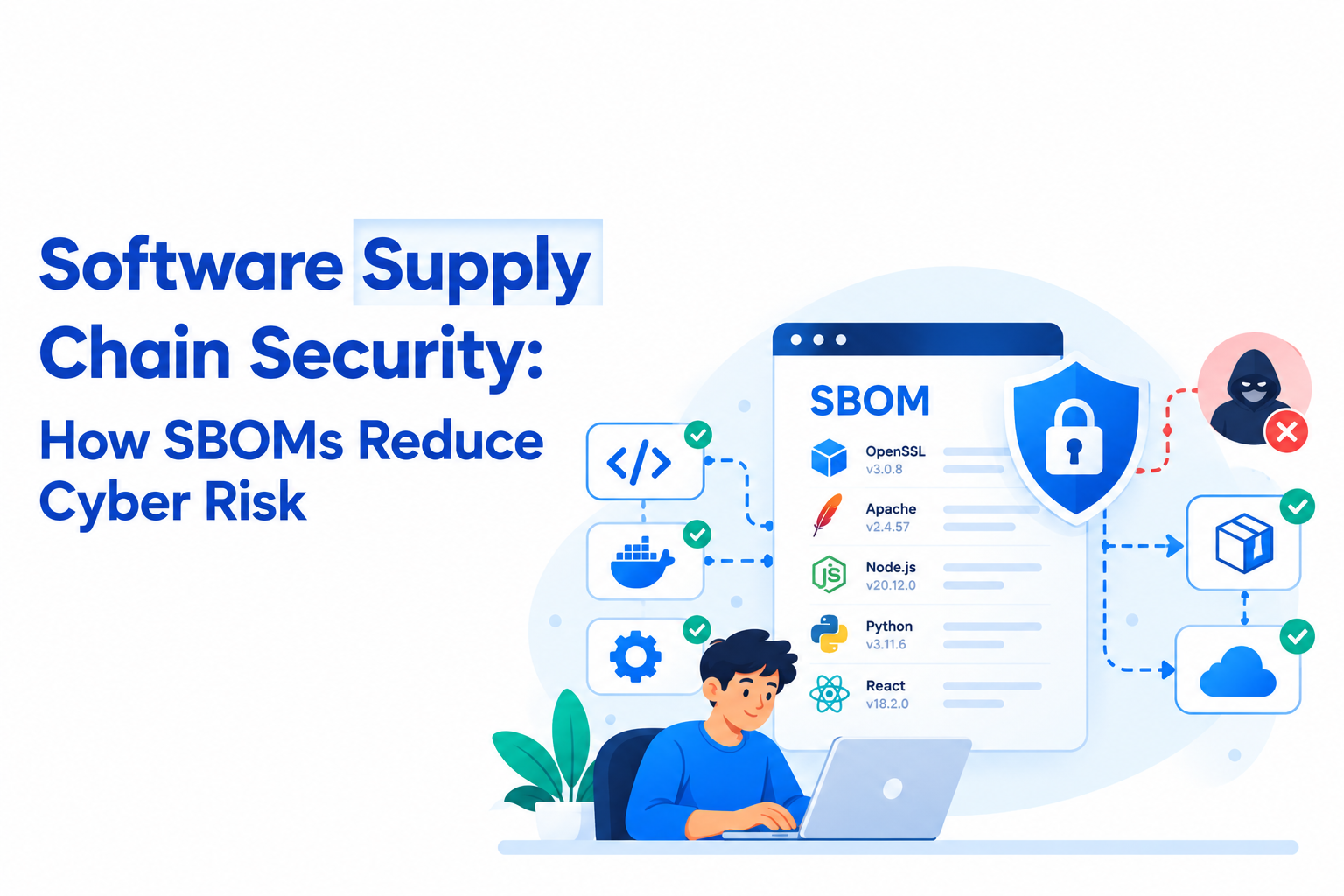
Modern applications are rarely built entirely from code written by one development team. They often depend on open-source libraries, third-party packages, frameworks, APIs, container images, and other external components. These dependencies help teams develop applications faster, but they can also introduce security risks that are difficult to identify without proper visibility.
This makes Software Supply Chain Security an important part of modern application security. Organizations need to understand what their software contains, where its components come from, and whether those components introduce known vulnerabilities.
A Software Bill of Materials (SBOM) can provide this visibility by creating a structured inventory of the components and dependencies used within an application. When combined with effective security practices, SBOMs can help organizations identify risks and respond to vulnerabilities more efficiently.
Software Supply Chain Security focuses on protecting the different components, tools, people, and processes involved in creating and delivering software.
The software supply chain can include source code repositories, developers, build systems, package managers, third-party dependencies, open-source libraries, deployment pipelines, and production environments.
A weakness in any of these areas can potentially affect the final application. For example, an application may depend on an outdated library containing a known vulnerability even though the organization's own code does not contain the vulnerability.
Understanding these dependencies is therefore an important starting point for managing software security.
External dependencies can change frequently. A library that is considered safe during development may later receive a security advisory because a vulnerability has been discovered.
Development teams may also have difficulty identifying every dependency used by an application, particularly when one package depends on several additional packages.
This creates a visibility problem. Security teams cannot effectively assess components they do not know are present.
An accurate inventory helps organizations understand their software composition and determine which components require attention.
A Software Bill of Materials is an inventory of software components used to build an application. It can include information about direct and indirect dependencies, package versions, licenses, and other component details.
An SBOM essentially provides a clearer view of what exists inside a software product.
For security teams, this information can become particularly useful when a vulnerability is discovered in a widely used software component. Instead of manually examining every application, teams can use their SBOM data to determine which applications contain the affected component.
This can make vulnerability identification and response more organized.
One of the main benefits of SBOM security is improved visibility into software components.
When a new vulnerability is reported, organizations can compare the affected package and version against their existing software inventories. If a vulnerable component is present, security and development teams can investigate the affected application.
Without an accurate inventory, teams may need to search repositories, deployment environments, or individual applications manually.
SBOMs do not remove vulnerabilities themselves. Their value comes from helping organizations understand where components are used so that security teams can make informed remediation decisions.
Open-source software is widely used in modern application development. It can provide useful functionality without requiring teams to build every component internally.
However, open-source components can have their own vulnerabilities, outdated versions, licensing considerations, and dependency relationships.
Open-source security requires organizations to know which packages they use and keep track of changes over time.
Regular dependency reviews and automated scanning can help identify outdated or vulnerable components. Teams should also establish a process for updating dependencies when security issues are discovered.
Supply chain attacks can target software components or development processes instead of directly attacking an organization's production systems.
An attacker may attempt to compromise a dependency, package repository, build process, or other part of the software delivery chain.
SBOMs cannot prevent every type of supply chain attack, but they can improve visibility into the software being delivered. When organizations know which components are present, they have a stronger foundation for investigating unexpected changes or newly discovered vulnerabilities.
SBOM information can therefore complement other security measures such as access controls, secure build processes, dependency verification, and code review.
SBOM generation should not be treated as a task that happens only after software reaches production. It can be incorporated into the development and build process.
Organizations can generate SBOMs during application builds and update them when dependencies change. Security teams can then review the resulting information alongside vulnerability scanning and other security checks.
Automated processes can also help flag components that require attention before an application is released.
This approach makes software security part of the development lifecycle rather than a separate activity performed at the end.
Software vulnerability management becomes more effective when teams have reliable information about their software components.
A practical process can include identifying dependencies, checking them against known vulnerabilities, determining whether affected components are actually used, prioritizing remediation, and tracking updates.
Not every vulnerability requires the same response. Teams should consider factors such as the affected component, application exposure, available fixes, and the role of the vulnerable software within the environment.
An SBOM provides useful information for making these decisions, but organizations still need appropriate security processes around it.
An outdated SBOM can provide an incomplete picture of an application's current dependencies.
Software changes continuously. Developers update packages, add new libraries, remove old components, and modify application architecture.
For this reason, organizations should generate or update SBOM information as part of regular software builds and release processes.
Ownership should also be clear. Development, security, and operations teams should know who is responsible for reviewing component risks and coordinating remediation.
SBOMs are one part of a wider Software Supply Chain Security strategy. Organizations should also protect source code repositories, build systems, package registries, credentials, and deployment pipelines.
Access should be restricted according to job responsibilities, and important changes should be traceable.
Build environments should also be monitored for unexpected modifications. Protecting these systems reduces the opportunity for attackers to introduce unauthorized software components or changes.
Software Supply Chain Security requires visibility into the components that make up modern applications. With applications depending on open-source libraries and third-party packages, organizations need reliable ways to understand what they are deploying.
A Software Bill of Materials can provide this component-level visibility and help security teams identify affected applications when vulnerabilities are discovered. However, SBOMs
work best when combined with dependency management, secure development practices, vulnerability monitoring, access controls, and protected build pipelines.
By maintaining accurate software inventories and establishing clear processes for responding to component risks, organizations can improve their ability to identify and manage software supply chain threats.
What is Software Supply Chain Security?
Software Supply Chain Security protects the components, tools, processes, and systems involved in developing and delivering software. It helps organizations identify and manage risks associated with dependencies and third-party components.
What is a Software Bill of Materials?
A Software Bill of Materials (SBOM) is an inventory that records the software components and dependencies included in an application. It helps organizations understand what their software contains.
Can an SBOM prevent supply chain attacks?
An SBOM does not directly prevent every supply chain attack. Instead, it provides visibility into software components, helping organizations identify affected applications and investigate component-related security risks.
How do SBOMs help with vulnerabilities?
SBOMs allow organizations to identify which applications contain specific software components. When a vulnerability is discovered, teams can use this information to locate affected applications and begin appropriate remediation.
Why is open-source security important?
Open-source security is important because applications may depend on numerous external packages. Tracking versions, monitoring vulnerabilities, and updating dependencies can help organizations manage risks associated with these components.









 India
India

 Canada
 United Kingdom
 New Zealand
 USA
USA
 UAE
UAE
 SGP
SGP
 Australia
 CALL
NOW
CALL
NOW