
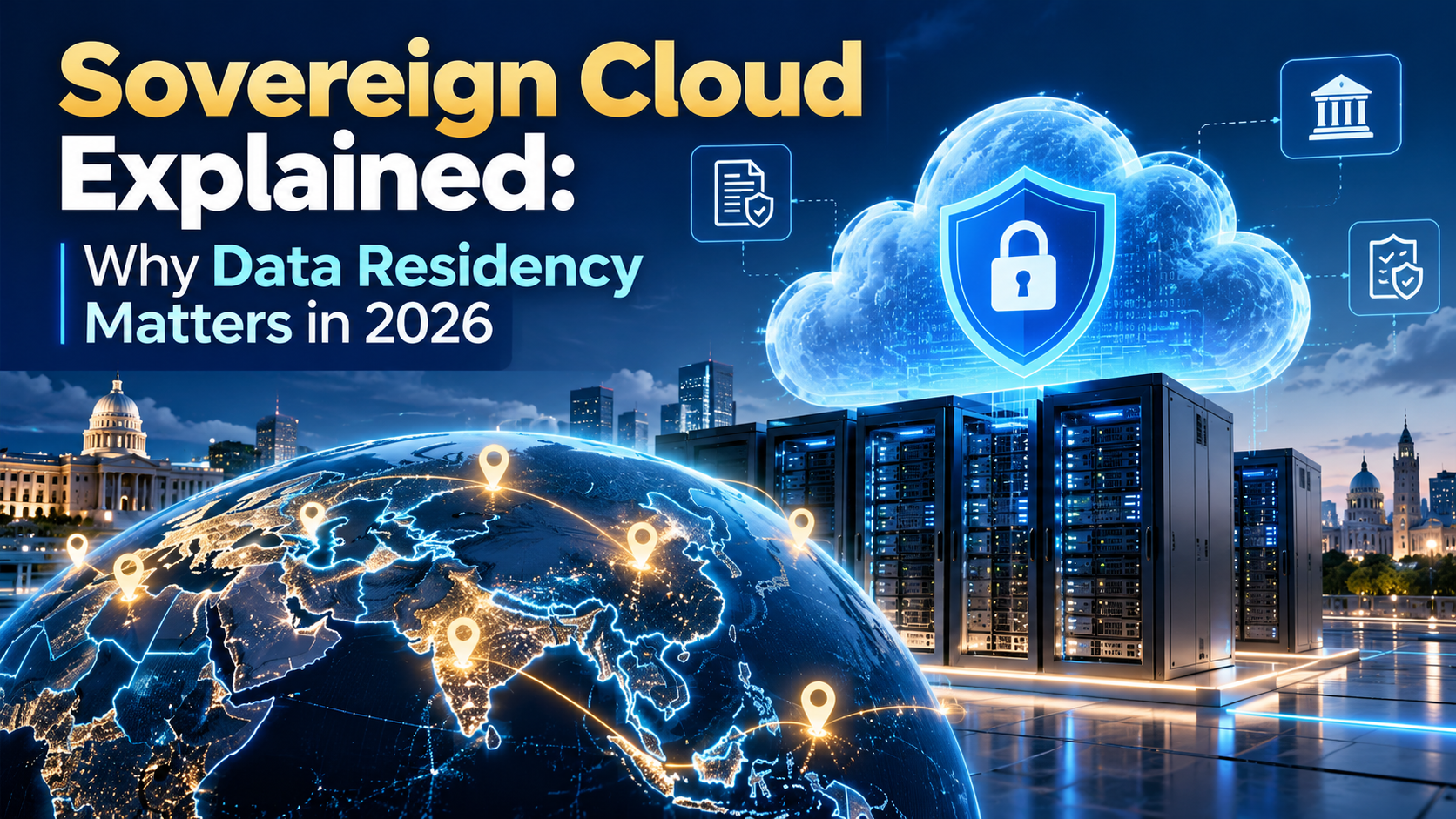
Cloud computing has made it easier for businesses to store data, run applications, and access infrastructure from almost anywhere. But for organizations handling sensitive information, one question has become increasingly important: Where is our data actually stored and processed?
Knowing the physical location of data is not always enough. Businesses also need to understand which laws apply to that data, who can access the underlying infrastructure, and how information is handled across borders.
This is where Sovereign Cloud environments come into the picture. They are designed to give organizations greater control over where data is stored, processed, and managed while addressing specific legal, regulatory, and sovereignty requirements.
A Sovereign Cloud is a cloud environment designed to meet the data sovereignty, security, operational, and regulatory requirements of a particular country or jurisdiction.
Unlike a standard cloud environment, a sovereign setup places greater emphasis on where data resides, who operates the infrastructure, where administrators are located, and which legal framework governs the environment.
The exact requirements can vary between countries and industries. However, the underlying goal is similar: organizations want greater control over sensitive data and the infrastructure supporting it.
Sovereign cloud environments can be particularly relevant to government organizations, financial institutions, healthcare providers, defense-related organizations, and businesses working with highly regulated information.
Data residency refers to the physical or geographic location where data is stored. For some organizations, the location of data is directly connected to regulatory and contractual obligations.
For example, a company may need certain information to remain within a particular country or region. Moving that data across borders without proper controls could create compliance concerns.
Data residency can also affect how organizations design backup systems, disaster recovery environments, analytics platforms, and data processing workflows.
As cloud architectures become more distributed, simply knowing where the primary database is located may not be enough. Organizations also need to understand where backups, logs, replicas, and other copies of data are stored.
A traditional public cloud can operate across multiple countries and regions. This provides flexibility and makes it easier for businesses to deploy workloads close to their customers.
However, organizations with strict regulatory requirements may need tighter control over infrastructure and data access.
A Sovereign Cloud focuses more heavily on jurisdictional control and compliance.
Key considerations can include:
This does not mean that sovereign cloud is automatically more secure than every public cloud environment. Security still depends on architecture, controls, configuration, monitoring, and operational practices.
The terms data residency and data sovereignty are often used interchangeably, but they describe different concepts.
Data residency focuses primarily on where data is physically stored.
Data sovereignty goes further. It concerns the laws and regulations that govern data based on its location and the jurisdiction involved.
For example, storing data within a country may satisfy a residency requirement, but an organization may still need to consider which entities can legally access or control the infrastructure.
This distinction is important when evaluating cloud providers and infrastructure models.
As businesses rely more heavily on cloud platforms, regulatory requirements are becoming an important part of infrastructure planning.
Organizations are managing larger volumes of customer information, financial records, employee data, intellectual property, and other sensitive information. At the same time, applications increasingly depend on distributed services and cross-border data flows.
This creates a need for clearer visibility into where information moves and who can access it.
In 2026, organizations evaluating cloud environments may therefore consider sovereignty alongside traditional factors such as cost, performance, availability, and security.
Not every organization needs a sovereign cloud environment. Its relevance depends on the type of data being handled and the regulations affecting the business.
Sovereign environments may be particularly useful for:
Government Organizations
Government agencies often manage sensitive citizen and administrative information. Local infrastructure and jurisdictional controls can be important requirements.
Financial Services
Banks, insurance companies, and financial institutions operate under strict regulatory frameworks. Data location, access, and security can become important parts of their cloud strategy.
Healthcare Organizations
Healthcare providers and related businesses handle highly sensitive patient information. They may need strong controls around data storage, access, and processing.
Critical Infrastructure
Organizations supporting energy, transportation, telecommunications, and other critical services may have additional requirements for infrastructure control and data protection.
Businesses With Cross-Border Operations
Companies operating in multiple countries may need to understand how different privacy and data protection laws affect their cloud architecture.
Regulated cloud infrastructure requires organizations to consider compliance throughout the infrastructure lifecycle.
This can affect everything from workload deployment and identity management to monitoring, backups, incident response, and administrator access.
Businesses should ask cloud providers detailed questions about:
These details help organizations determine whether a cloud environment actually matches their regulatory requirements.
Before adopting a sovereign cloud environment, businesses should first classify their data and workloads.
Not every application requires the same level of sovereignty. A public marketing website may have very different requirements from a financial database or government application.
Next, map where sensitive information is stored, processed, copied, and transferred. This can reveal hidden dependencies that are easy to overlook during a cloud migration.
Organizations should then review applicable regulations and contractual requirements with their legal, compliance, security, and infrastructure teams.
Finally, evaluate cloud providers based on actual sovereignty requirements rather than relying only on the term “sovereign cloud” in product descriptions.
Cloud adoption is unlikely to slow down, but organizations are becoming more conscious about where their data resides and which legal frameworks apply to it.
The future of cloud infrastructure will likely involve a mix of public cloud, private infrastructure, hybrid environments, and sovereign platforms.
The important change is that workload placement will increasingly involve more than performance and price. Data location, jurisdiction, access control, and regulatory requirements will also influence infrastructure decisions.
Sovereign Cloud gives organizations a way to approach cloud computing with stronger emphasis on jurisdictional control, data location, and regulatory requirements.
For businesses handling sensitive or regulated information, understanding data residency and data sovereignty can help prevent unexpected compliance and governance issues.
The right cloud environment depends on the organization's data, applications, regulations, and operational requirements. By mapping these factors before choosing an infrastructure model, businesses can build cloud environments that provide flexibility while maintaining appropriate control over sensitive information.
What is a Sovereign Cloud?
A Sovereign Cloud is a cloud environment designed to meet specific national or jurisdictional requirements around data storage, processing, access, and infrastructure control.
What is data residency?
Data residency refers to the geographic location where data is physically stored. Some regulations or contracts may require certain types of information to remain within specific countries or regions.
How is data sovereignty different from data residency?
Data residency focuses on where data is stored, while data sovereignty considers the laws and jurisdiction that govern the data based on its location and control.
Does every business need a Sovereign Cloud?
No. The need depends on the organization's industry, data sensitivity, applicable regulations, contractual obligations, and operating locations.
Is Sovereign Cloud more secure than public cloud?
Not automatically. Sovereign cloud focuses strongly on jurisdictional and control requirements. Security still depends on identity controls, encryption, monitoring, architecture, configuration, and operational practices.








 India
India

 Canada
 United Kingdom
 New Zealand
 USA
USA
 UAE
UAE
 SGP
SGP
 Australia
 CALL
NOW
CALL
NOW