
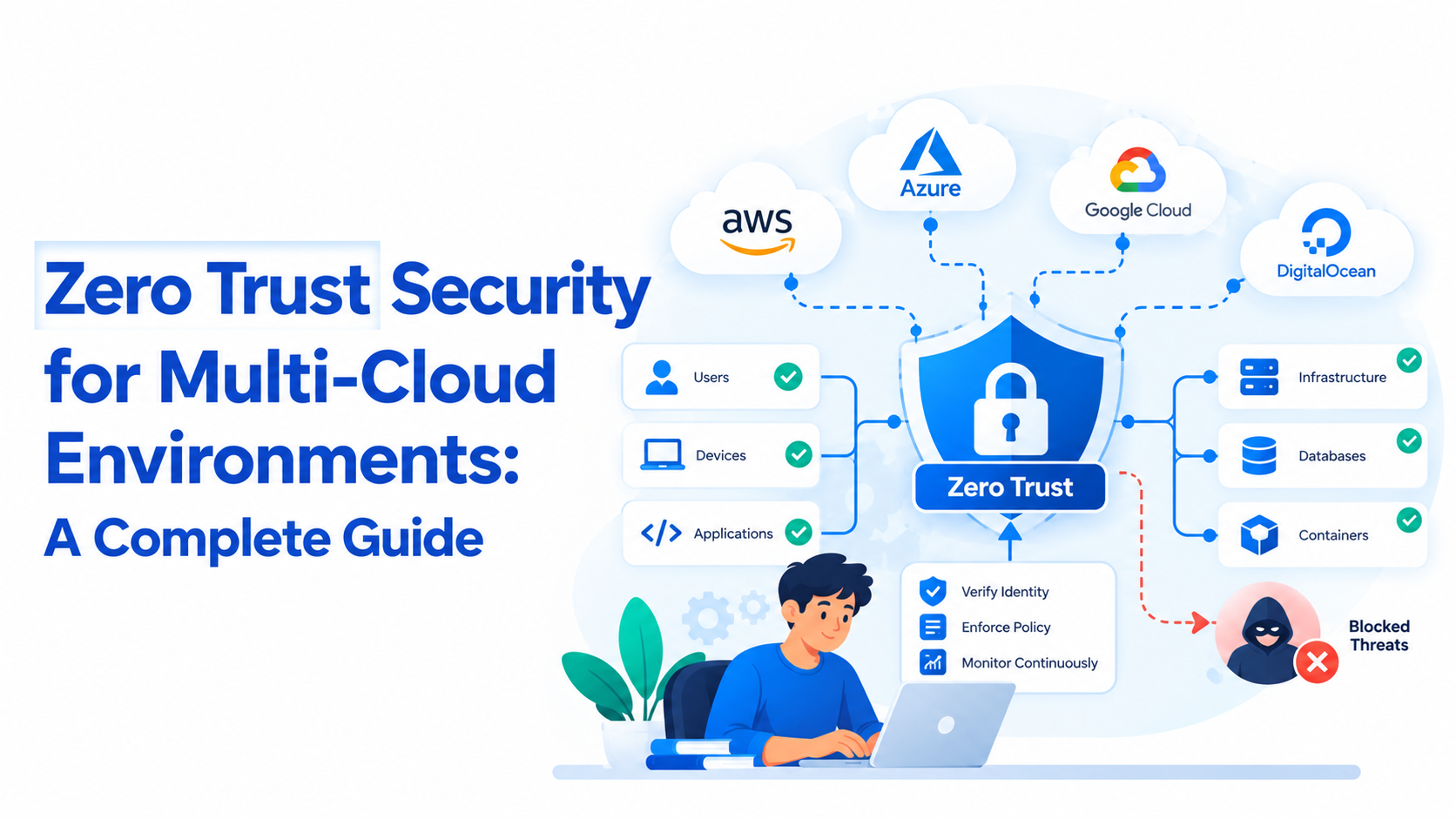
Using multiple cloud platforms gives businesses flexibility, but it also creates a more complex security environment. Applications, users, APIs, workloads, databases, and infrastructure may be distributed across different cloud providers, making traditional security approaches harder to manage.
This is where Zero Trust Multi-Cloud Security becomes important. Instead of assuming that users or systems are safe because they are inside a particular network, Zero Trust requires every access request to be verified according to identity, permissions, device conditions, and other security factors.
For businesses operating across multiple cloud environments, this approach can provide a more controlled way to manage access and protect sensitive resources.
Zero Trust Multi-Cloud Security applies Zero Trust principles to environments that use two or more cloud platforms. The central idea is simple: access should be granted based on verified requirements rather than location or network membership.
A user working from an office, for example, should not automatically receive access to cloud resources simply because they are connected to a trusted corporate network. Their identity, permissions, and requested resource should still be evaluated.
The same principle applies to applications, service accounts, APIs, and workloads communicating across different cloud environments.
A multi-cloud environment can contain different identity systems, security controls, network configurations, monitoring tools, and access policies. Managing these elements consistently can become difficult as the environment grows.
A permission that is appropriate in one cloud may not be configured in the same way in another. Similarly, security teams may have limited visibility when activity is distributed across different platforms.
A Zero Trust approach helps organizations establish consistent security principles around identity, authorization, monitoring, and access regardless of where a resource is hosted.
Identity is a central component of zero trust architecture. Every user and workload should have a clearly defined identity before accessing cloud resources.
Organizations should maintain centralized visibility into users, service accounts, applications, and privileged identities wherever practical. Strong authentication should be required for sensitive resources, with additional verification for administrative activities.
Access permissions should also be reviewed regularly. Employees changing roles, temporary accounts, inactive users, and unused service identities can otherwise retain permissions that they no longer need.
A well-managed identity system gives security teams greater control over who can access specific resources and under what conditions.
The principle of least privilege access means providing only the permissions necessary to complete a specific task.
For example, a developer who needs to view application logs does not necessarily need administrative access to the entire cloud environment. Similarly, an application should not automatically receive permission to access every database or storage resource.
Least privilege should apply to human users as well as machine identities and workloads.
Regular permission reviews can identify excessive access and help organizations remove privileges that are no longer required.
Traditional network security often focuses on creating a trusted internal network and keeping unauthorized users outside it. Multi-cloud environments make this model more complicated because resources may communicate across cloud platforms, private networks, remote locations, and third-party services.
Cloud network security should therefore focus on controlling communication based on specific requirements.
Organizations can define which workloads, applications, and services are allowed to communicate. Unnecessary connections should be restricted, while sensitive systems should have additional network controls.
Network monitoring can also help identify unusual traffic patterns and unexpected communication between resources.
Zero Trust should extend beyond users and networks. Applications and workloads also need appropriate identities and permissions.
Service accounts should receive only the permissions required by their applications. Credentials should be protected and rotated according to organizational requirements.
Applications should also be reviewed for unnecessary exposed services, weak authentication, and excessive access to cloud resources.
In a multi-cloud environment, consistent workload security becomes particularly important because the same application may depend on services hosted across different platforms.
A Zero Trust model depends on visibility. Organizations need to understand who is accessing resources, what they are accessing, and whether that activity matches expected behavior.
Security monitoring should collect relevant authentication, authorization, API, network, and resource activity from different cloud environments.
Centralizing important security information can make investigations easier and help teams identify patterns that may not be obvious when each cloud platform is monitored separately.
Alerts should focus on meaningful events, such as unexpected privilege changes, unusual login activity, access to sensitive resources, or suspicious communication between workloads.
Access should not always be treated as a simple yes-or-no decision based only on a username and password.
Organizations can consider additional context when protecting sensitive resources. Depending on their security requirements, this may include device status, authentication strength, user role, resource sensitivity, location, or unusual activity.
For example, an administrative request involving a critical production system may require stronger verification than access to a low-risk internal application.
Context-based controls allow organizations to apply stronger protection where the potential impact is greater.
One of the challenges of multi-cloud security is maintaining consistent security requirements across different platforms.
Each cloud provider may offer different tools and configuration methods. However, organizations can establish common internal policies for identity management, privileged access, encryption, logging, network controls, and security monitoring.
The implementation may differ between platforms, but the underlying security requirements should remain clear.
Regular security reviews can help identify differences between environments and determine whether they create unnecessary risks.
Data may move between applications and cloud platforms as part of normal business operations. This makes data protection an important part of a Zero Trust strategy.
Organizations should identify sensitive information and determine which users, applications, and services actually need access to it.
Encryption, access controls, logging, and appropriate data-handling policies can help reduce unnecessary exposure. Data access should also be reviewed when applications or business processes change.
Zero Trust is not a single product or configuration that can be implemented once and left unchanged. Users change roles, applications are updated, new cloud resources are created, and workloads move between environments.
Security teams should regularly review identities, permissions, network connections, policies, and access activity.
Automation can assist with repetitive security checks, while periodic human reviews can address changes that automated controls may not fully understand.
Zero Trust Multi-Cloud Security provides a structured approach to protecting environments where applications and infrastructure are distributed across multiple cloud platforms.
Strong identity controls, least privilege access, workload protection, network restrictions, continuous monitoring, and consistent security policies can help organizations reduce unnecessary access and improve visibility.
The most effective approach is to treat every access request according to its identity, permissions, context, and resource requirements rather than relying on network location alone.
As multi-cloud environments continue to evolve, regular security reviews will remain essential for maintaining effective protection.
What is Zero Trust Multi-Cloud Security?
Zero Trust Multi-Cloud Security applies Zero Trust principles across multiple cloud environments. It verifies users, workloads, and access requests instead of automatically trusting resources based on their network location.
Why is Zero Trust important for multi-cloud environments?
Multi-cloud environments can contain different platforms, identities, networks, and security controls. Zero Trust helps organizations apply consistent principles for authentication, authorization, monitoring, and resource access.
How does least privilege support Zero Trust?
Least privilege access ensures that users, applications, and workloads receive only the permissions they require. This limits unnecessary access and can reduce the potential impact of compromised identities.
What role does identity management play in Zero Trust?
Identity access management establishes who users, applications, and services are before they receive access to cloud resources. Strong authentication and regular permission reviews are important parts of this process.
How can businesses improve multi-cloud security?
Businesses can improve multi-cloud security by strengthening identity controls, applying least privilege, restricting unnecessary network communication, monitoring access activity, protecting sensitive data, and reviewing security policies across cloud environments regularly.









 India
India

 Canada
 United Kingdom
 New Zealand
 USA
USA
 UAE
UAE
 SGP
SGP
 Australia
 CALL
NOW
CALL
NOW