
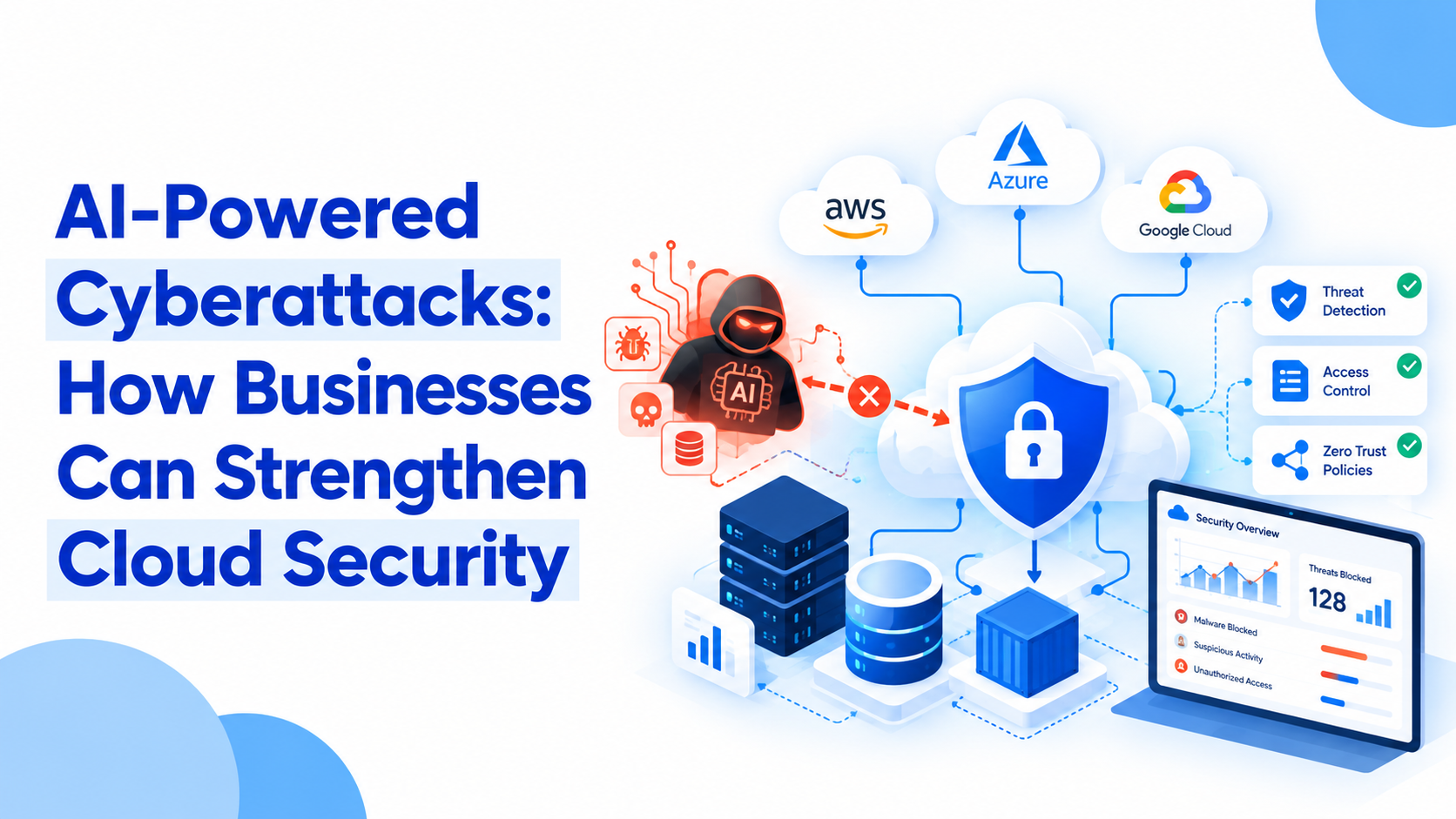
Artificial intelligence is changing how businesses build, manage, and secure digital environments. The same technology that helps organizations automate tasks and analyze large amounts of data can also be used by attackers to improve the speed and scale of cyber threats. This has made AI-Powered Cyberattacks an important concern for businesses operating cloud-based applications and services.
Cloud environments already involve applications, identities, APIs, databases, virtual machines, containers, and third-party services. When automated attacks are added to this complex environment, security teams need better visibility and faster ways to identify unusual activity.
Strengthening cloud security requires more than adding another security tool. Businesses need a combination of access controls, continuous monitoring, employee awareness, threat detection, and well-defined response processes.
Traditional attacks can require significant manual effort to identify targets, create messages, or adapt techniques. AI can help attackers automate parts of these activities and produce more convincing content at greater speed.
This does not mean every cyberattack uses advanced AI. However, the increasing availability of AI tools can lower the effort required to create certain types of malicious activity.
Businesses should therefore focus on reducing opportunities for unauthorized access and improving their ability to detect unusual behavior.
Phishing remains a common security concern, but AI can help create convincing messages that appear more personalized. Attackers may use publicly available information to make emails or messages look relevant to specific employees, departments, or business processes.
Traditional warning signs such as obvious spelling mistakes may not always be present in AI-generated messages.
Organizations should strengthen email security, encourage employees to verify unusual requests, and use multi-factor authentication for important accounts. Security awareness training should also explain how convincing phishing attempts can appear and why employees should verify sensitive requests independently.
Cloud environments generate large volumes of activity from users, applications, services, and automated processes. Identifying suspicious behavior requires visibility across these different sources.
Effective cloud threat detection should monitor authentication events, API activity, unusual access patterns, privilege changes, network behavior, and unexpected changes to cloud resources.
Security teams can establish baselines for normal activity and investigate significant deviations. For example, an account that normally accesses a limited set of resources but suddenly attempts to access sensitive systems may require additional investigation.
Centralized logging can also help security teams connect activity across different cloud services instead of examining isolated events.
Cloud security is closely connected to identity management. A compromised account can provide attackers with access to applications, data, and infrastructure without requiring direct access to physical systems.
Organizations should apply least-privilege access and provide users with only the permissions required for their responsibilities. Privileged accounts should receive additional protection, including strong authentication and careful monitoring.
Unused accounts and excessive permissions should be reviewed regularly. Service accounts also need attention because long-lived credentials can become a security weakness when they are not properly managed.
Multi-factor authentication adds another layer of protection when passwords are compromised. It is particularly important for administrative accounts, cloud consoles, remote access, and other systems containing sensitive information.
Organizations should also establish strong password practices and avoid sharing credentials between users or systems.
Authentication policies should be reviewed as cloud environments evolve. New applications, integrations, and employees can introduce additional access requirements that need to be reflected in security controls.
Fast detection is valuable, but security teams also need a clear process for responding to suspicious activity.
An automated security response can help perform predefined actions when specific conditions are detected. Depending on the situation, automation may assist with disabling
compromised credentials, isolating workloads, blocking suspicious connections, or generating alerts for investigation.
Automation should be carefully designed. Not every unusual event represents an attack, and aggressive automated actions can disrupt legitimate business activity.
For this reason, organizations should define which events can trigger automatic actions and which require human review.
Modern cloud applications frequently depend on APIs to connect services and exchange information. Poorly protected APIs can expose sensitive functionality or data.
Businesses should authenticate API requests, apply authorization controls, monitor unusual API activity, and avoid exposing unnecessary endpoints.
Application security testing should also be included throughout the development lifecycle. Reviewing dependencies, configurations, authentication mechanisms, and exposed services can help identify weaknesses before applications reach production.
Configuration management tools can help identify changes that do not match approved security requirements. Security teams should also maintain clear ownership for cloud resources so that configuration issues can be addressed quickly.
Enterprise cybersecurity should bring together technology, people, and processes rather than depending on a single security product.
Organizations should establish clear security policies, conduct regular employee training, maintain incident response procedures, and review security controls as their cloud environment changes.
Security teams should also understand which business systems are most critical. This helps prioritize monitoring and response efforts around sensitive applications, customer information, financial systems, and other important resources.
The emergence of AI-assisted attacks does not make established security practices irrelevant. Strong identity controls, secure configurations, vulnerability management, network protection, logging, employee awareness, and incident response remain important.
AI can increase the speed or scale of certain threats, but organizations can also use automation to improve defensive operations. The focus should be on improving visibility, reducing unnecessary access, detecting abnormal activity, and responding consistently.
AI-Powered Cyberattacks are adding another dimension to an already complex cybersecurity environment. Businesses operating in the cloud need to consider how automated and
AI-assisted threats could affect identities, applications, APIs, employees, and infrastructure.
A stronger defense combines cloud threat detection, identity protection, secure configurations, employee awareness, application security, and carefully controlled automated responses.
Rather than relying on one defensive measure, businesses should continuously review their cloud security practices and adapt them as applications, infrastructure, and threats change.
What are AI-Powered Cyberattacks?
AI-Powered Cyberattacks are cyber threats in which artificial intelligence or automated technologies assist with activities such as creating phishing content, analyzing information, identifying targets, or automating parts of an attack.
How can AI improve phishing attacks?
AI can help attackers create convincing and personalized messages at scale. Businesses can reduce risk through email security, employee awareness training, multi-factor authentication, and verification of unusual requests.
How does cloud threat detection help businesses?
Cloud threat detection monitors activity across cloud users, applications, APIs, and infrastructure to identify unusual behavior that may indicate unauthorized access or other security issues.
What is automated security response?
Automated security response uses predefined rules or workflows to perform security actions after specific events are detected. Examples may include alert generation, access restriction, or workload isolation.
How can businesses strengthen cloud security?
Businesses can strengthen cloud security through strong identity controls, least-privilege access, multi-factor authentication, secure configurations, continuous monitoring, application security, employee training, and tested incident response procedures.









 India
India

 Canada
 United Kingdom
 New Zealand
 USA
USA
 UAE
UAE
 SGP
SGP
 Australia
 CALL
NOW
CALL
NOW