

Every year, someone declares that DevOps has changed forever. Most years, that's an exaggeration. This year, it might actually be true.
Teams that were comfortable with a solid CI/CD pipeline and a decent monitoring dashboard are now facing AI powered workloads, security requirements that get stricter every quarter, and infrastructure that spans multiple clouds at once. Keeping up with the DevOps trends 2026 is no longer optional if you want your team to stay fast, stable, and sane.
Instead of just listing buzzwords, this blog answers the real questions cloud teams are asking right now, and what to actually do about them.
Why Do DevOps Look So Different This Year?
For a long time, DevOps was mostly about speed. Ship code faster, automate the boring parts, reduce the gap between developers and operations. That focus hasn't disappeared, but it's no longer the whole picture.
Today's systems are more complex. A single application might run across containers, serverless functions, and multiple cloud providers at the same time. Add AI features into the mix, and suddenly your team is managing model versions, GPU costs, and unpredictable usage patterns on top of everything else.
This complexity is exactly why the conversation has shifted from "how do we move fast" to "how do we move fast without things quietly falling apart." That shift is the thread running through almost every trend on this list.
Can AI Actually Make Your DevOps Team Faster?
This is probably the question every engineering leader is asking right now, and the honest answer is yes, but only if it's used carefully.
AI is showing up in DevOps in a few practical ways. It can scan through logs and alerts to spot unusual patterns before they turn into an outage, a practice often called AIOps. It can suggest fixes for common pipeline failures. It can even help write and review infrastructure code, catching mistakes before they reach production.
The mistake many teams make is treating AI tools as a replacement for good judgment rather than a support system. AI can flag a strange spike in error rates, but a human still needs to decide what caused it and how to respond. Used this way, AI genuinely reduces the manual grunt work that used to eat up so much of a DevOps team's day.
Is Platform Engineering the Fix for Developer Burnout?
Here's a problem almost every growing engineering team runs into. As the number of developers grows, so does the number of tickets asking for a new environment, a database, or help debugging a deployment. Eventually, this slows everyone down, including the platform and infrastructure teams stuck answering the same requests over and over.
Platform engineering solves this by building what's often called an internal developer platform. Instead of filing a ticket and waiting, developers can request what they need through a self service system that already has security, compliance, and best practices built in.
This doesn't mean removing developer freedom. It means removing the repetitive complexity that doesn't need to be solved from scratch every single time. For teams struggling with slow onboarding or constant infrastructure requests, this is one of the most practical DevOps trends 2026 has to offer.
Should Security Really Be a DevOps Job Now?
For years, security was treated as a final checkpoint, something that happened right before a release, often causing last minute delays. That approach simply doesn't hold up anymore.
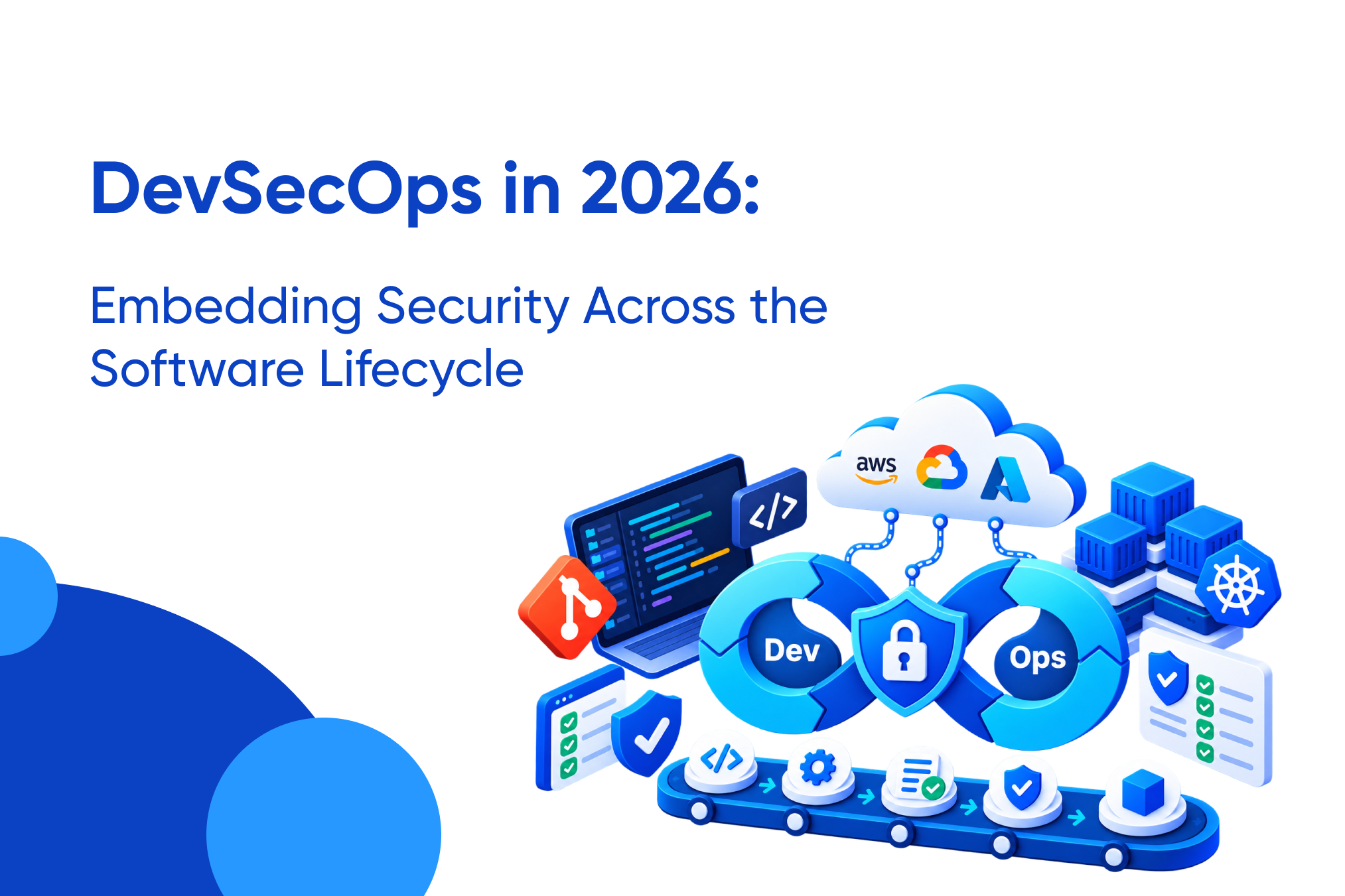
The shift toward what's called DevSecOps means security checks happen throughout the entire pipeline, not just at the end. Vulnerability scans run automatically when code is committed. Compliance checks happen before a deployment goes out, not after something breaks.
This matters even more with AI features in the mix. New risks like prompt injection or overly permissive data access didn't exist a few years ago, and they need the same kind of automated, repeatable checks as any other security concern. Bolting on a security review at the last minute simply won't catch these issues in time.
How Do You Know Something Broke Before Your Customers Do?
This is where observability comes in, and in 2026 it means a lot more than just checking a dashboard for red numbers.
Modern systems are distributed across services, clouds, and third party tools, which makes it much harder to trace exactly where a problem started. Good observability pulls together metrics, logs, and traces, and increasingly connects this data to deployment history and actual user impact. This way, when something goes wrong, your team isn't just told that an error occurred, they can see what changed right before it happened and how many users were affected.
Teams that invest in this are able to catch and fix issues before customers even notice, instead of finding out through complaints or support tickets.
Is Managing Infrastructure by Hand Still Worth It?
Short answer, not really, not anymore. Infrastructure as code, meaning managing your servers and cloud resources through version controlled configuration files instead of manual setup, has become close to a baseline expectation rather than a nice to have.
Tools like Terraform and Ansible let teams define their infrastructure the same way they manage application code, complete with version history and repeatable deployments. This becomes especially valuable as teams manage infrastructure across more than one cloud provider, since it removes the guesswork and manual errors that come with clicking through different consoles for each one.
If your team is still setting up servers manually or keeping configuration knowledge in someone's head instead of in code, this is one of the fastest wins available.
What Tools Should Your Team Actually Be Using?
There's no shortage of tools competing for attention, but a few categories consistently show up across strong DevOps setups this year.
Kubernetes remains the standard for managing containerized applications at scale. GitOps workflows, where infrastructure changes are managed through version controlled repositories, are becoming the preferred way to handle deployments with more visibility and control. Centralized secrets management tools, rather than scattered config files, are increasingly treated as a basic requirement rather than an extra step.
The goal isn't to adopt every trending tool. It's to pick the ones that actually solve a real problem your team is facing right now.
Is Your Cloud Bill Part of Your DevOps Strategy?
It should be. As teams adopt AI workloads, container based architectures, and multi cloud setups, cloud spending has become harder to predict and easier to lose track of.
Smart teams are building cost awareness directly into their DevOps practices, reviewing spend regularly, tagging resources clearly, and treating cost the same way they treat performance or reliability, as something to actively manage rather than notice only when the bill arrives.
Where Should Your Team Actually Start?
With so many DevOps trends 2026 to consider, it's tempting to try adopting everything at once. That usually backfires. Instead, look honestly at where your current setup is struggling the most.
If your team spends most of its time answering repetitive infrastructure requests, start with platform engineering. If security reviews are causing delays or getting skipped under pressure, start with DevSecOps practices. If outages take too long to diagnose, invest in better observability first.
Final Thoughts
DevOps in 2026 isn't about chasing every new tool or trend that shows up in your feed. It's about building systems that are fast, but also resilient, secure, and manageable as they grow. AI, platform engineering, DevSecOps, and strong observability all solve real, specific problems that cloud teams are facing right now.
Pick the trend that matches your team's biggest pain point, start there, and build from a foundation that actually works, rather than trying to do everything at once.