
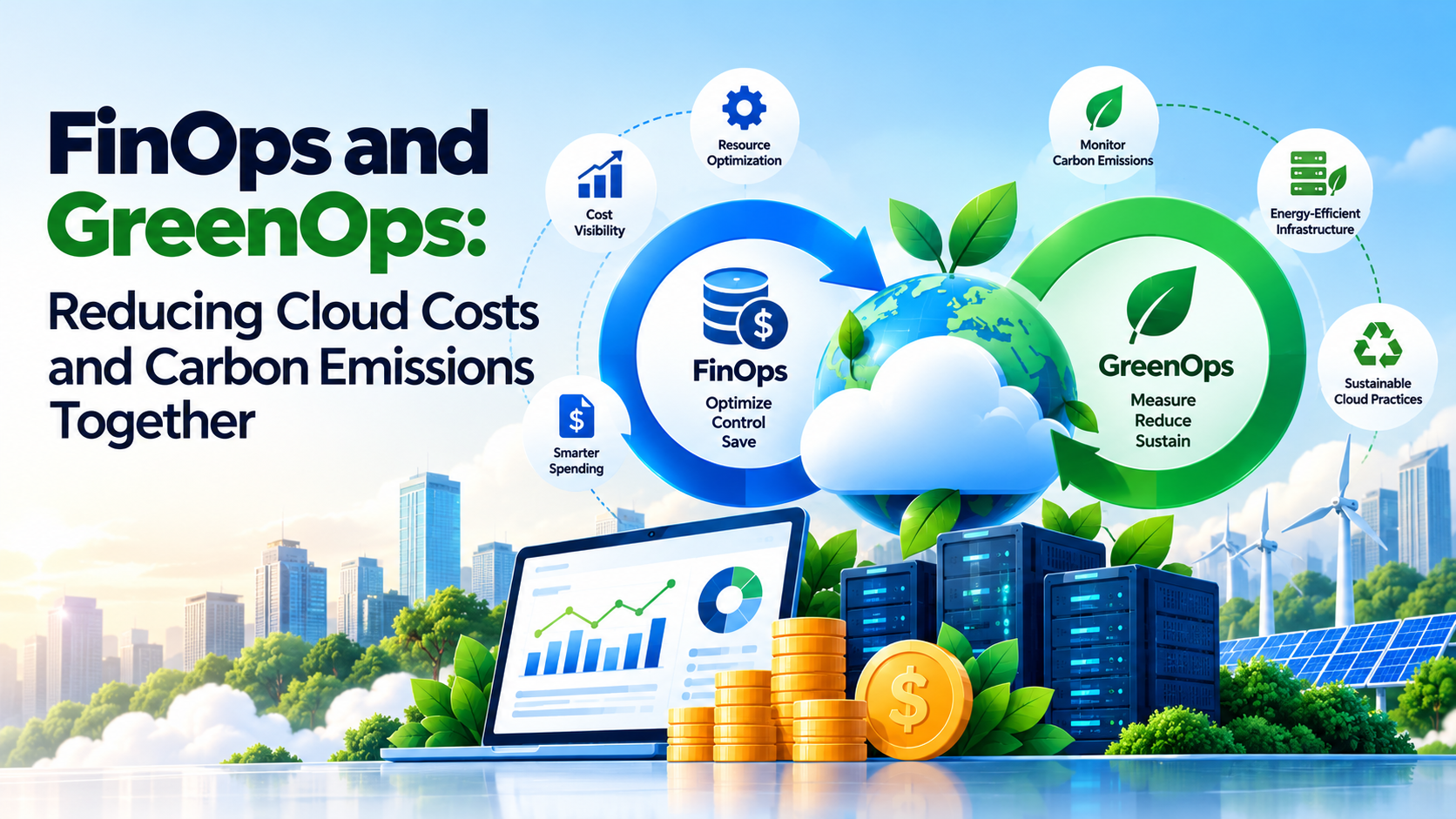
Cloud infrastructure gives businesses the flexibility to run applications, store data, and support growing workloads without maintaining large physical data centers. But as cloud usage increases, two concerns are becoming harder to ignore: rising infrastructure costs and the environmental impact of running digital services.
This is where FinOps and GreenOps come together. FinOps helps organizations understand and control cloud spending, while GreenOps focuses on using cloud resources in a more environmentally responsible way. When these practices work together, companies can make better infrastructure decisions based on both financial and environmental impact.
Every cloud workload consumes computing resources. Virtual machines, databases, storage systems, containers, networking services, and other infrastructure all require physical data-center resources to operate.
When resources remain underused, the business may continue paying for capacity that provides little value. At the same time, those unused resources still consume energy.
For example, an oversized virtual machine running at low utilization can increase the monthly cloud bill while using more infrastructure than the workload actually needs. Reducing that waste can therefore support both cloud cost optimization and lower resource consumption.
This connection makes GreenOps a natural extension of a strong FinOps practice.
FinOps is a way of managing cloud spending by bringing financial awareness into everyday technology decisions. Instead of treating cloud bills as something reviewed only at the end of the month, teams continuously monitor usage, allocation, and business value.
A practical FinOps strategy can help teams:
FinOps does not simply mean cutting cloud spending. The goal is to understand where money is being spent and whether that spending supports business requirements.
GreenOps applies similar thinking to environmental impact. It encourages organizations to understand how their technology decisions affect energy consumption and emissions.
GreenOps can involve monitoring infrastructure utilization, reducing unnecessary workloads, improving resource efficiency, and considering sustainability when selecting cloud architecture.
A sustainable cloud computing approach may include:
GreenOps is not about stopping cloud usage. It is about making cloud infrastructure more efficient and intentional.
The strongest connection between the two approaches is resource efficiency.
Suppose a development environment runs continuously even though developers only use it during working hours. From a FinOps perspective, the organization is paying for unnecessary runtime. From a GreenOps perspective, infrastructure is consuming energy when it provides little value.
Automating the environment to shut down during unused hours can address both problems.
The same principle applies to oversized servers, idle databases, unused storage, and unnecessary data transfers. Once teams start measuring utilization and understanding the impact of their infrastructure choices, they can identify opportunities that improve both financial and environmental efficiency.
Right-Size Cloud Resources
Review CPU, memory, storage, and other resource usage regularly. If infrastructure consistently operates far below its allocated capacity, consider moving to a more appropriate configuration.
Right-sizing can reduce unnecessary cloud spending while lowering the amount of infrastructure required to support the workload.
Automate Non-Production Resources
Testing and development environments often do not need to run 24/7. Scheduling these resources to start and stop according to working patterns can reduce unnecessary usage.
This is one of the simplest ways to connect FinOps strategy with GreenOps practices.
Improve Workload Utilization
Low utilization is often a sign that infrastructure needs closer attention. Teams can consolidate workloads, adjust capacity, or use automated scaling where appropriate.
Better utilization means organizations can get more value from the infrastructure they already pay for.
Monitor the Cloud Carbon Footprint
Organizations should look beyond the monthly cloud bill and consider their cloud carbon footprint. Carbon measurements can help teams identify workloads and infrastructure patterns that deserve further investigation.
Combining financial and environmental dashboards can make these discussions part of regular infrastructure planning.
Include Sustainability in Architecture Decisions
Cost should not be the only consideration when selecting infrastructure. Teams can also evaluate workload efficiency, resource utilization, data movement, and other environmental factors.
This makes sustainability part of engineering decisions rather than a separate initiative handled by another department.
Successful FinOps and GreenOps programs depend on cooperation between finance, engineering, operations, security, and leadership teams.
Finance teams need visibility into spending. Engineers need practical usage data. Operations teams can automate resource management, while leadership can establish measurable financial and sustainability goals.
The key is to avoid treating cost and sustainability as completely separate objectives. Many forms of cloud waste affect both.
When organizations regularly review utilization, automate unnecessary resources, and connect infrastructure decisions with measurable outcomes, they can build a more efficient green cloud infrastructure without compromising the performance their applications require.
Cloud environments will continue to become more complex as organizations adopt containers, serverless services, AI workloads, multi-cloud environments, and data-intensive applications.
FinOps can help businesses understand the financial side of this growth, while GreenOps adds an environmental perspective. Together, they provide a broader way to evaluate cloud infrastructure decisions.
The goal is not simply to spend less or use fewer resources. It is to make sure every unit of infrastructure delivers meaningful value while avoiding unnecessary consumption.
FinOps and GreenOps share a simple principle: reduce waste by making better use of technology resources.
FinOps provides visibility into cloud spending, while GreenOps brings energy efficiency and environmental impact into the conversation. Practices such as right-sizing, automated shutdowns, workload optimization, and carbon monitoring can support both goals at the same time.
For organizations looking to build more responsible cloud environments, combining financial and sustainability thinking can be a practical step toward better infrastructure management.
What is the difference between FinOps and GreenOps?
FinOps focuses mainly on managing and optimizing cloud spending, while GreenOps focuses on reducing the environmental impact of technology infrastructure. Both encourage better resource utilization.
How does FinOps support sustainability?
FinOps identifies waste such as idle resources, overprovisioned infrastructure, and unnecessary workloads. Reducing this waste can also reduce the infrastructure and energy required to run cloud services.
What is a cloud carbon footprint?
A cloud carbon footprint represents the greenhouse gas emissions associated with cloud infrastructure and workloads. It can be influenced by factors such as resource usage, workload efficiency, and energy sources.
Can GreenOps reduce cloud costs?
Yes. Many GreenOps practices focus on improving resource efficiency. Removing unused resources, reducing unnecessary runtime, and improving utilization can also lower cloud spending.
Why should businesses combine FinOps and GreenOps?
Combining both approaches allows organizations to consider financial and environmental impact together. This can help teams make more informed infrastructure decisions while reducing waste and improving resource efficiency.










 India
India

 Canada
 United Kingdom
 New Zealand
 USA
USA
 UAE
UAE
 SGP
SGP
 Australia
 CALL
NOW
CALL
NOW