
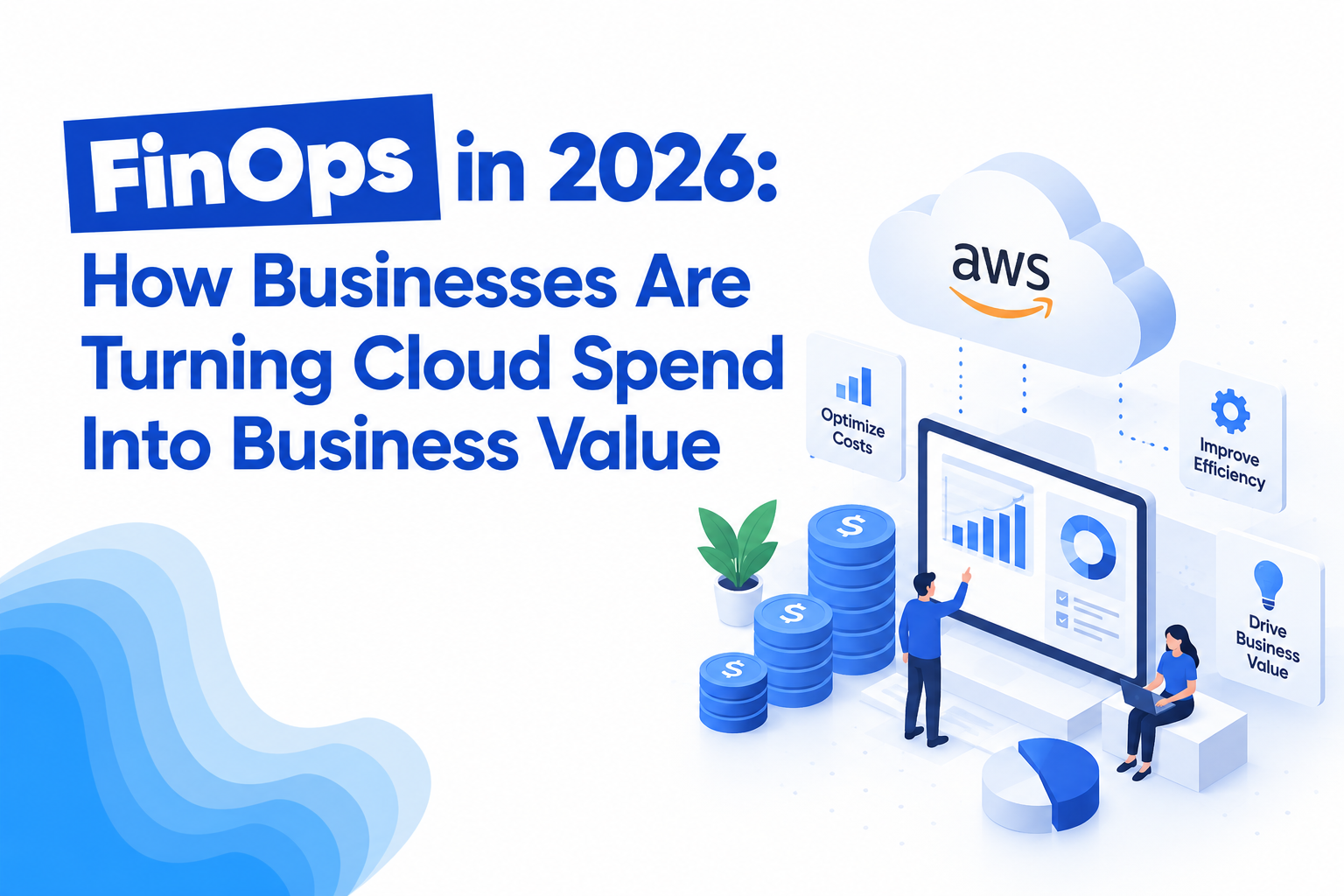
Cloud computing has changed the way businesses build, manage, and grow their technology. Companies can now access computing power, storage, databases, artificial intelligence tools, and many other services without purchasing and maintaining all the physical infrastructure themselves.
However, the flexibility of the cloud also creates a major challenge: managing cloud spending.
When businesses can quickly create new cloud resources, costs can also increase quickly. Different teams may use different services, workloads may consume more resources than expected, and unused infrastructure may continue generating costs.
This is why FinOps 2026 is becoming an important topic for businesses using cloud technology.
FinOps is changing from a simple approach to cloud cost reduction into a broader business practice focused on understanding cloud spending and improving the value received from cloud investments. Instead of asking only, "How can we reduce cloud costs?" businesses are increasingly asking, "Are we getting enough business value from what we spend on the cloud?"
In 2026, FinOps is expected to play an even bigger role as companies increase their use of cloud services, artificial intelligence, data platforms, and advanced infrastructure.
FinOps brings together finance, technology, and business teams to improve how cloud spending is managed.
In traditional IT environments, infrastructure costs were often planned in advance. Businesses purchased servers, storage systems, and other equipment before using them.
Cloud computing works differently.
Organizations can create and use resources whenever needed. This flexibility provides many benefits, but it can also make spending more difficult to predict and manage.
FinOps helps organizations understand where cloud money is going and why.
In FinOps 2026, the focus is not limited to reducing bills. Businesses are becoming more interested in making informed decisions about cloud investments.
For example, spending more on a cloud service may be valuable if it improves customer experience, supports faster application development, or helps a company launch a new product.
At the same time, spending money on unused resources provides little value.
This difference is central to modern FinOps.
The goal is to make sure cloud spending supports real business requirements.
Cost optimization remains an important part of FinOps, but it is no longer the only priority.
Earlier cloud cost management discussions often focused on finding ways to spend less.
Businesses looked for unused virtual machines, unnecessary storage, and other resources that could be removed.
These practices remain useful. However, FinOps 2026 is focused on a larger question: how can cloud investments create better business results?
A company should not reduce cloud spending if doing so negatively affects an important application or customer service.
For example, reducing infrastructure resources might lower costs temporarily, but it could also slow down an application and create a poor customer experience.
Modern FinOps helps businesses balance three important areas:
The best decision is not always the cheapest option.
Instead, businesses need to understand whether the resources they are paying for are helping them achieve important goals.
This approach makes FinOps more connected to overall business planning.
One of the biggest changes in FinOps 2026 is the growing understanding that cloud cost management cannot be handled by one department alone.
Finance teams understand budgets and spending.
Engineering teams understand applications and infrastructure.
Business teams understand customer needs and company goals.
All these groups need to work together.
For example, an engineering team may choose a particular cloud resource because it provides better performance. A finance team may notice that the resource is expensive.
Without communication, the finance team may only see the cost while the engineering team only sees the technical benefit.
FinOps helps create a common understanding.
Teams can discuss why resources are being used and whether the spending provides enough value.
This shared responsibility can improve decision-making and reduce unnecessary conflict between finance and technology teams.
Cloud spending becomes easier to manage when everyone understands their role.
Businesses cannot manage what they cannot see.
Cloud environments can include hundreds or even thousands of resources. Different teams may use different cloud accounts, applications, databases, storage services, and infrastructure.
Without proper visibility, organizations may struggle to understand where their cloud budget is going.
This is why visibility remains a major part of FinOps 2026.
Businesses need to know:
Clear reporting helps organizations make better decisions.
However, collecting cost data is only the first step.
Businesses also need to understand the information.
A large cloud bill does not automatically indicate a problem. Higher spending may be connected to increased customer demand, business growth, or new technology projects.
FinOps helps organizations connect cost information with actual business activity.
When businesses use many cloud services, it can become difficult to determine which team or application is responsible for specific costs.
Cost allocation helps solve this problem.
Organizations can assign cloud spending to teams, projects, departments, products, or business units.
This provides better accountability.
For example, if a company knows the cloud cost of each application, it can better understand whether that application is providing enough value.
Cost allocation can also support more accurate budgeting.
Instead of managing one large cloud bill, organizations can understand how different parts of the business contribute to overall spending.
In FinOps 2026, better cost allocation will continue to help businesses make cloud spending more transparent.
However, organizations need consistent processes.
If teams use different methods for organizing resources, cost reporting can become confusing.
Clear standards for cloud accounts, projects, and resource identification can make FinOps easier to manage.
Artificial intelligence is changing cloud spending.
AI workloads can require significant computing power, storage, and data processing. As more businesses adopt generative AI and machine learning, cloud costs may become more difficult to predict.
A traditional application may have relatively stable infrastructure requirements.
AI workloads can be different.
Training models, processing large amounts of data, and running AI applications may create changing infrastructure demands.
This makes FinOps 2026 especially important for organizations investing in AI.
Businesses need to understand the cost of their AI initiatives.
Important questions include:
AI adoption should include financial planning from the beginning.
Businesses should not wait until cloud costs become a problem before reviewing their AI infrastructure.
FinOps can help organizations monitor spending while supporting responsible AI growth.
Managing cloud costs manually can become difficult as environments grow.
Businesses may have thousands of resources across different applications and teams.
Automation can help organizations monitor and manage cloud spending more efficiently.
For example, automated systems can identify unused resources or detect unexpected changes in spending.
Automation can also help teams receive alerts when cloud costs exceed expected levels.
This does not mean businesses should rely completely on automated decisions.
Technology can identify potential issues, but people still need to understand the reason behind the data.
A sudden increase in cloud spending may indicate waste. However, it could also be the result of increased customer activity or an important business project.
In FinOps 2026, automation is expected to play a larger role in helping teams identify opportunities and make faster decisions.
The combination of automation and human understanding can provide better results than either approach alone.
Cloud cost is increasingly becoming an engineering consideration.
In the past, developers may have focused mainly on application performance and functionality.
Today, infrastructure choices can directly affect cloud spending.
For example, selecting a larger computing resource may improve performance but also increase costs.
Choosing a smaller resource may save money but affect application speed.
Engineering teams therefore need better awareness of cloud economics.
This does not mean developers should focus only on reducing costs.
Instead, they should understand the financial impact of technical decisions.
This is an important part of FinOps 2026.
Engineering, finance, and operations teams need access to information that helps them make balanced decisions.
When cost awareness becomes part of the development process, businesses can avoid some unnecessary expenses before they occur.
One of the most important FinOps trends is the focus on business value.
A company may spend a significant amount on cloud infrastructure and still receive strong value if that infrastructure supports important business outcomes.
For example, cloud investment may help a business:
The challenge is measuring the connection between cloud costs and business results.
FinOps 2026 encourages businesses to look beyond technical metrics.
Organizations should understand how cloud investments support their wider goals.
This can change the conversation around cloud spending.
Instead of asking why a particular application costs a certain amount, businesses can also ask what the application delivers.
This provides a more complete view of cloud economics.
Sustainability is also becoming a consideration in cloud strategy.
Cloud resources consume energy, and businesses are becoming more aware of the environmental impact of technology.
Efficient cloud usage can support both cost management and sustainability goals.
For example, removing unused resources can reduce unnecessary spending and avoid wasting computing capacity.
Using the right infrastructure for each workload can also improve resource efficiency.
In FinOps 2026, businesses may increasingly consider cost, performance, and resource efficiency together.
Organizations do not need to treat financial and sustainability goals as completely separate areas.
In many cases, better resource management can support both.
Technology alone cannot create a successful FinOps practice.
Businesses also need the right culture.
Teams should understand that cloud resources have financial value.
Employees should have access to relevant information about the cost of the infrastructure they manage.
Organizations should also encourage communication between finance, engineering, and business teams.
A strong FinOps culture focuses on responsibility rather than blame.
The purpose is not to punish teams for spending money.
Instead, it is to help everyone make better decisions.
Businesses can build this culture by:
When cloud spending becomes a shared responsibility, organizations can respond to changes more effectively.
Businesses looking to improve their FinOps strategy should begin with visibility.
They need to understand where cloud money is being spent and which workloads are creating the highest costs.
The next step is to connect cloud spending with business activity.
Organizations should identify whether increased costs are supporting useful outcomes or whether they are caused by inefficient resource usage.
Companies should also prepare for growing AI-related cloud spending.
AI can provide significant benefits, but it can also create new infrastructure requirements.
Regular reviews can help businesses understand whether their cloud investments continue to support their goals.
FinOps should also be treated as an ongoing process.
Cloud environments change regularly. New applications are deployed, workloads grow, and business priorities change.
Cost management strategies need to change along with them.
FinOps 2026 represents an important shift in how businesses think about cloud spending.
The focus is moving beyond simply reducing costs. Organizations are now looking at how cloud investments contribute to performance, innovation, customer experience, and overall business value.
Cloud spending is becoming a shared responsibility between finance, engineering, and business teams. Better visibility, cost allocation, automation, and communication can help organizations make more informed decisions.
The growing use of AI is also making FinOps more important. Businesses need to understand how new workloads affect cloud budgets and whether those investments provide meaningful results.
The future of FinOps is not about spending as little as possible. It is about spending wisely.
Businesses that understand the connection between cloud costs and business outcomes will be better prepared to manage changing technology requirements. By building a strong FinOps culture, improving visibility, and focusing on value, organizations can turn cloud spending from a simple expense into an investment that supports real business growth.









 India
India

 Canada
 United Kingdom
 New Zealand
 USA
USA
 UAE
UAE
 SGP
SGP
 Australia
 CALL
NOW
CALL
NOW