
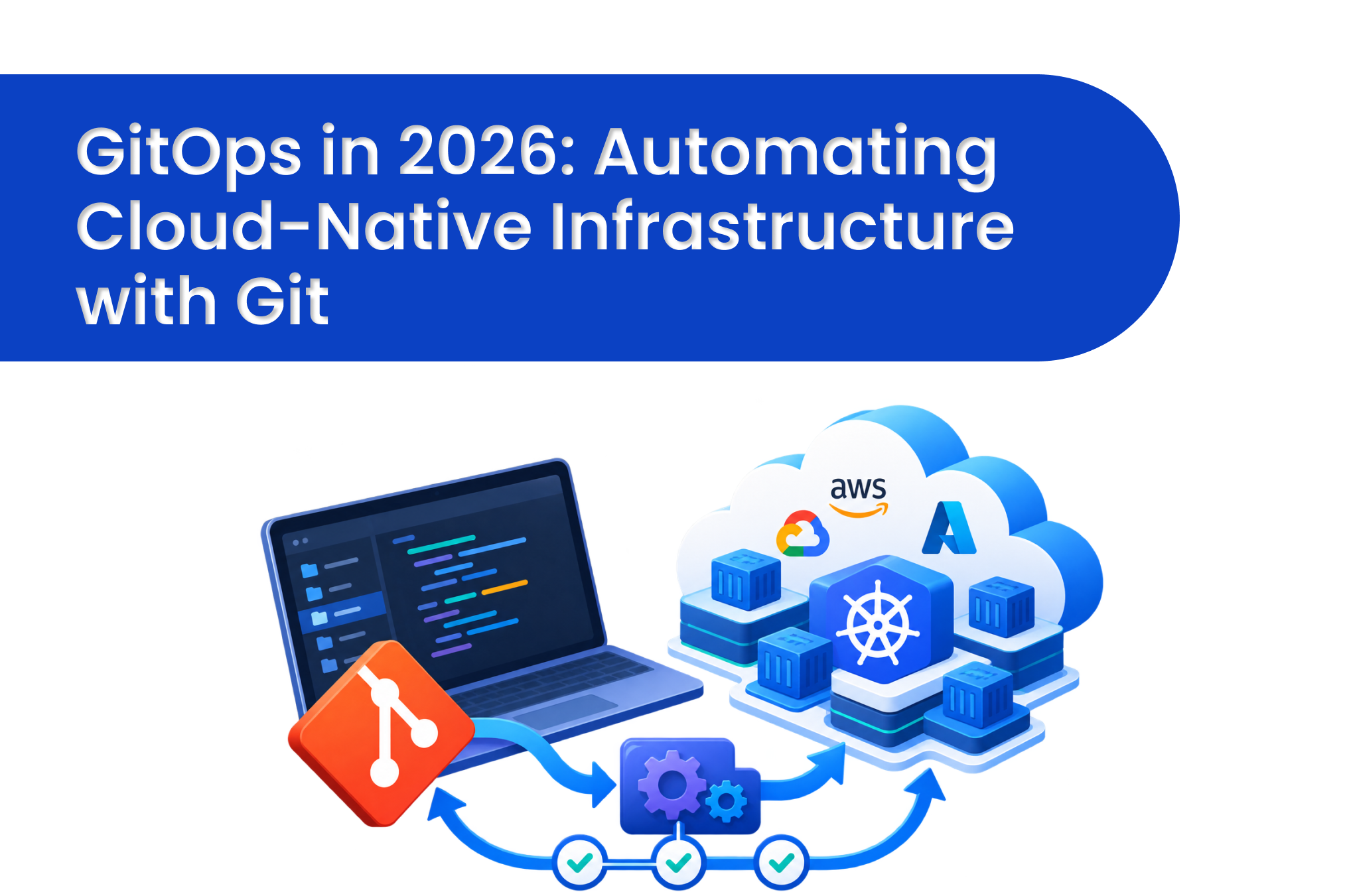
Managing cloud infrastructure manually can create delays, configuration errors, and difficulties when teams need to track changes. As businesses adopt cloud-native applications, they need a more reliable way to manage infrastructure and application deployments.
GitOps offers a practical approach by using Git as the central source of truth for infrastructure and application configurations. Instead of making frequent manual changes to cloud environments, teams manage updates through code, version control, and automated processes.
In 2026, GitOps is becoming an important part of modern cloud operations because it connects infrastructure management with familiar development practices. It helps teams improve visibility, maintain consistency, and manage deployments with greater control.
Traditional infrastructure management often depends on manual commands, direct access, and separate tools. While these methods may work for smaller environments, they can become difficult to manage when infrastructure grows.
GitOps brings infrastructure changes into a version-controlled workflow. Configuration files are stored in a Git repository, and approved changes are used to update the target environment.
This approach creates a clear record of what changed, who approved it, and when it was introduced. If an issue occurs, teams can review previous versions and restore an earlier configuration when required.
The main difference is that infrastructure management becomes more consistent, traceable, and closely connected to the development process.
A GitOps workflow generally follows a sequence that connects developers, Git repositories, and cloud environments.
A developer or infrastructure engineer first creates a change in a configuration file. The change is submitted to the Git repository, where it can go through review, testing, and approval.
After approval, an automated GitOps tool detects the updated configuration and applies it to the target environment. The tool continues checking whether the actual environment matches the desired state defined in Git.
If the environment moves away from the approved configuration, the system can identify the difference and, depending on its settings, restore the expected state.
This process reduces unnecessary manual intervention and provides teams with a consistent method for managing infrastructure changes.
Infrastructure automation helps organizations manage cloud resources without repeating the same manual tasks. However, automation needs proper control to prevent incorrect configurations from being applied.
GitOps combines automation with version control. Teams can review infrastructure changes before they reach production, while automated tools handle approved updates.
Some important benefits include:
Automation does not remove the need for careful planning. It makes proper reviews and clearly defined permissions even more important.
Kubernetes environments often contain many configuration files, services, deployments, policies, and supporting resources. Managing these components manually can become complicated, particularly when applications run across multiple clusters.
Kubernetes GitOps uses Git-based practices to manage Kubernetes resources. Teams store desired configurations in repositories, while GitOps tools help apply and monitor those configurations in Kubernetes environments.
This model can support several tasks, including:
Kubernetes GitOps is especially useful when teams need a repeatable deployment process. It allows developers to submit configuration changes through familiar Git workflows while operations teams maintain control over approvals and production access.
Continuous deployment allows approved application changes to move into target environments through automated processes. GitOps supports this approach by treating Git repositories as the source of approved deployment configurations.
When a change is merged, automation can detect the update and begin the deployment process. Teams can then monitor whether the new configuration has been applied successfully.
This creates a clear connection between code changes and infrastructure updates. Instead of relying on undocumented manual actions, teams can review the repository history and deployment status.
However, continuous deployment should not mean that every change is released without review. Businesses can introduce approval requirements, security checks, automated testing, and separate deployment policies for high-risk environments.
The level of automation should match the application’s importance, operational requirements, and risk profile.
GitOps can improve control over infrastructure, but it also introduces security responsibilities. A compromised repository, exposed credentials, or excessive permissions can affect the entire deployment process.
Organizations should protect Git repositories through strong access controls, multi-factor authentication, and regular permission reviews. Sensitive credentials should not be stored directly in configuration files.
Security checks can also be included in the deployment workflow to identify misconfigurations, vulnerable images, or unauthorized changes before they reach production.
Teams should clearly define who can approve changes, who can modify repositories, and which systems can apply updates. Audit records and monitoring can help identify unusual activity.
A secure GitOps approach connects infrastructure automation with identity management, secrets protection, and continuous monitoring.
As organizations expand their cloud environments, they may manage resources across different regions, accounts, clusters, or cloud providers. Maintaining consistent configurations across these environments can become challenging.
GitOps provides a shared process for defining and reviewing infrastructure changes. Teams can use separate repositories, branches, or configuration structures based on their environment requirements.
This does not mean every environment must use exactly the same settings. Instead, teams can maintain common standards while allowing approved differences where necessary.
Git-based management also supports collaboration between distributed teams. Developers and infrastructure engineers can work with documented configurations rather than depending only on individual knowledge or manual instructions.
Moving to GitOps requires more than connecting a repository to a deployment tool. Organizations need to review their existing infrastructure, deployment practices, security requirements, and team responsibilities.
GitOps consulting can help businesses plan and implement a suitable operating model. The process may include assessing the current environment, selecting appropriate tools, designing repository structures, and defining deployment policies.
Consulting support may also help organizations establish:
The right approach depends on the organization’s technology stack, application requirements, and level of cloud maturity.
GitOps is becoming more relevant as businesses look for better ways to manage cloud-native infrastructure and application delivery. Its value comes from combining automation, version control, collaboration, and operational visibility.
In the future, GitOps practices may become more closely connected with security checks, policy enforcement, observability, and infrastructure intelligence. These integrations can help teams identify problems earlier and maintain stronger control over automated changes.
Still, successful GitOps adoption depends on more than tools. Organizations need clear processes, trained teams, secure repositories, and realistic deployment policies.
By treating infrastructure as code and managing changes through Git, businesses can create a more consistent foundation for cloud operations. GitOps gives teams a structured way to automate infrastructure while keeping changes visible, reviewable, and accountable.









 India
India

 Canada
 United Kingdom
 New Zealand
 USA
USA
 UAE
UAE
 SGP
SGP
 Australia
 CALL
NOW
CALL
NOW