


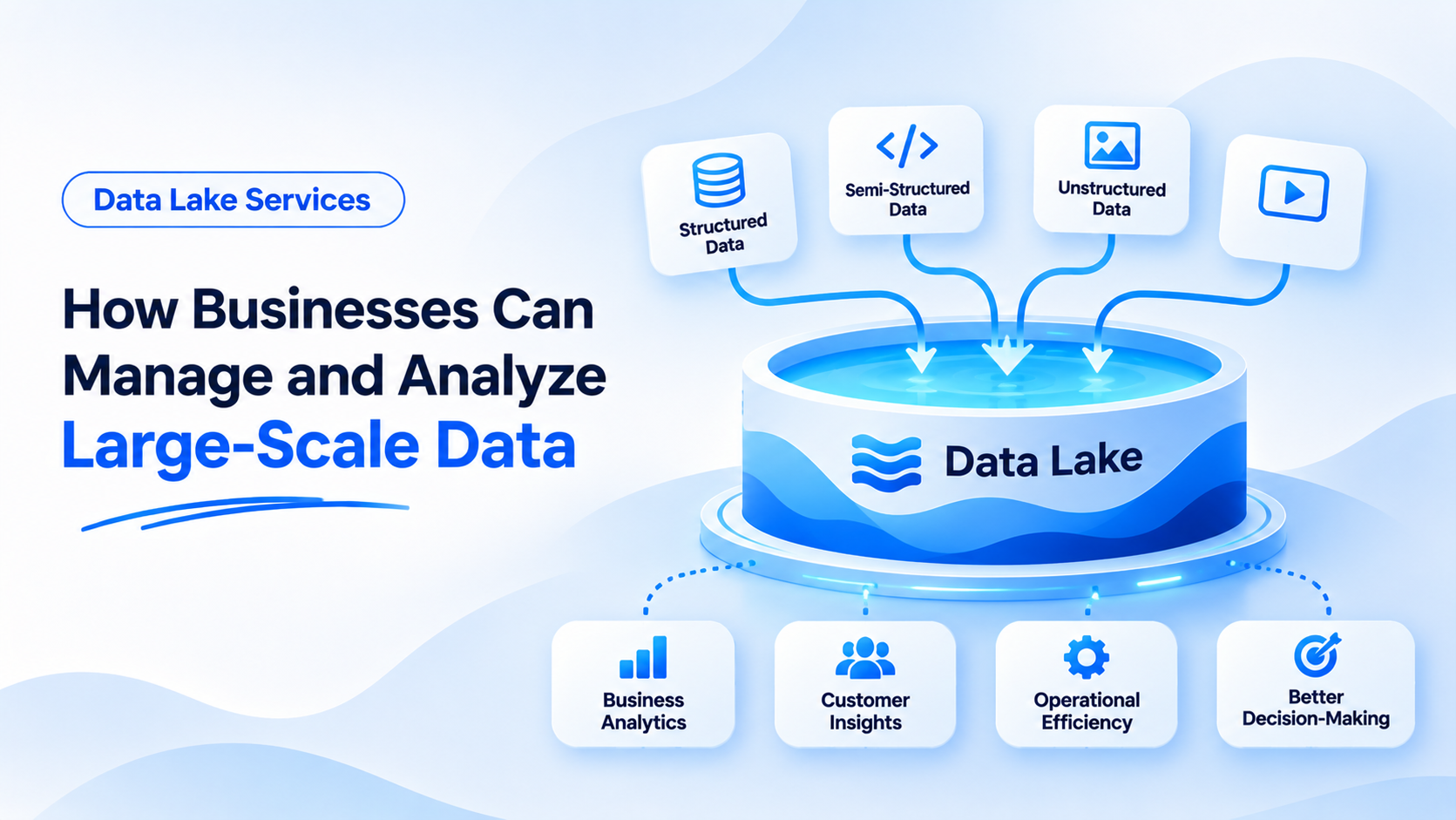
Businesses collect information from many sources, including websites, mobile applications, customer platforms, business software, sensors, and cloud systems. As this information grows, storing and managing it becomes more difficult. Traditional databases may not be suitable for every type of data, especially when businesses need to handle large volumes of structured, semi-structured, and unstructured information.
A data lake provides a central place to store different types of data in their original format. It allows teams to prepare information for reporting, analytics, machine learning, and other business needs. With the right Data Lake Services, organisations can make better use of their data without managing separate storage systems for every source.
What Is a Data Lake, and Why Do Businesses Need One?
A data lake is a storage system that keeps large amounts of raw data in one central location. Unlike a traditional database, it does not require all information to follow a fixed structure before storage.
For example, a retail company may collect customer details, product images, website activity, sales records, and customer feedback. A data lake can store these different formats together, making them available for future analysis.
Businesses use data lakes because they offer:
Centralised Storage: Keep information from multiple business systems in one place instead of managing separate storage locations.
Flexible Data Handling: Store structured records, documents, images, videos, and machine-generated information.
Support for Analytics: Prepare stored data for business intelligence, reporting, and advanced analysis.
Future Data Use: Retain raw information that may become useful for future projects and business questions.
A data lake also helps organisations avoid losing useful information simply because it does not fit into a traditional database structure.
How Do Data Lake Services Help Manage Large Amounts of Data?
Storing large volumes of information is only one part of data management. Businesses also need ways to collect, organise, process, secure, and access that information.
Professional data lake services help organisations build and manage these activities through a planned approach.
Data Collection and Integration
Data can come from applications, databases, cloud platforms, APIs, and connected devices. Data lake solutions bring these sources together so teams can work with information from different systems.
Storage Management
Cloud-based storage allows businesses to keep large datasets without maintaining all the required physical infrastructure. Storage can be organised according to data type, source, access needs, and business requirements.
Data Processing
Raw information often needs cleaning, transformation, and preparation before analysis. Processing tools help remove duplicate records, correct errors, and convert data into useful formats.
Access and Security
Not every employee needs access to every dataset. Access controls, encryption, and monitoring help protect sensitive information while allowing authorised teams to use the data they need.
What Types of Data Can a Data Lake Store?
One of the main benefits of a data lake is its ability to store different types of information. Businesses do not need to convert every file into a standard format before storing it.
Here are three common data categories:
Structured Data: Information arranged in rows and columns, such as customer records, sales transactions, financial details, and inventory information.
Semi-Structured Data: Information with some organisation but no fixed table structure, such as JSON files, XML documents, and application logs.
Unstructured Data: Content without a predefined data model, including images, videos, audio recordings, emails, and documents.
Consider a healthcare technology company that collects appointment records, patient feedback, medical images, and application logs. A data lake can store these different formats in one environment. Teams can then process the information according to their specific requirements and access permissions.
How Does a Data Lake Support Business Analytics?
A data lake becomes valuable when businesses can turn stored information into useful findings. It gives analysts and data teams access to large datasets that can support different types of analysis.
Some important use cases include:
Customer Behaviour Analysis
Businesses can study website visits, purchase records, feedback, and customer interactions to understand what people need and how they make buying decisions.
Sales and Revenue Planning
Combining sales information from different locations and channels helps teams identify revenue patterns, compare performance, and prepare better forecasts.
Operational Monitoring
Manufacturing and logistics companies can analyse equipment readings, delivery records, and system logs to identify delays or unusual activity.
Machine Learning Projects
Data scientists can use stored datasets to train machine learning models, test predictions, and improve existing models.
Business Reporting
Teams can prepare reports using information from multiple departments, giving decision-makers a clearer view of business performance.
These use cases show why Data Lake Services are useful for organisations that want to make decisions based on more than isolated reports or individual databases.
What Is the Difference Between a Data Lake and a Data Warehouse?
Data lakes and data warehouses both support data management and analytics, but they serve different purposes.
A data lake stores raw information in different formats. It is useful when businesses need flexibility and want to retain large datasets for future processing.
A data warehouse stores processed and structured information that is prepared for reporting and business analysis. It is often used for dashboards, financial reports, and performance tracking.
The choice depends on the organisation's needs. A business that works with application logs, images, and customer activity may benefit from a data lake. A company focused on standardised financial reporting may need a data warehouse.
Many organisations use both systems together. A data lake can hold raw information, while a data warehouse can store selected, processed datasets for regular reporting.
What Should Businesses Consider Before Choosing a Data Lake Solution?
Selecting a data lake platform requires more than comparing storage capacity. Businesses should understand how the system will support their current and future data requirements.
Consider these factors before making a decision:
Business Requirements: Identify the types of information the organisation collects and how different teams plan to use it.
Cloud Platform: Select a suitable environment based on existing infrastructure, workload requirements, and technical preferences.
Data Governance: Define rules for data ownership, quality, access, retention, and responsible usage.
Security Measures: Apply encryption, access permissions, monitoring, and backup policies to protect business information.
Integration Needs: Check whether the platform can connect with existing applications, databases, analytics tools, and business systems.
Operating Costs: Review storage, processing, data transfer, and maintenance expenses before selecting an architecture.
Planning these areas early helps prevent common problems such as poor data quality, uncontrolled storage growth, and unauthorised access.
How Can Goognu Help With Data Lake Management?
Building a useful data lake requires a clear understanding of data sources, storage requirements, processing needs, and business goals. Organisations also need to consider how the platform will connect with their existing cloud infrastructure.
Goognu helps businesses explore cloud and data infrastructure requirements through its technology services. With the right planning and implementation approach, organisations can create a data environment that supports information storage, processing, and analytics.
Businesses can visit Goognu to explore its technology services and understand how suitable infrastructure solutions can support their data requirements.
Conclusion
Large-scale data becomes more useful when businesses have the right systems to store, organise, and analyse it. A data lake provides a central environment for handling structured, semi-structured, and unstructured information.
With well-planned data lake services, organisations can improve data access, support analytics, prepare information for machine learning, and make better business decisions. Choosing the right architecture, security controls, and management approach helps ensure that the data lake remains useful as business needs change.
Frequently Asked Questions
- What are Data Lake Services?
Data Lake Services help businesses build, manage, and maintain systems that store large volumes of structured, semi-structured, and unstructured data for processing and analysis.
- Can a data lake store unstructured data?
Yes. A data lake can store images, videos, audio files, documents, emails, application logs, and other information that does not follow a fixed database structure.
- Are data lakes suitable for small businesses?
Yes. Small businesses can use cloud-based data lakes when they need to combine information from different sources or prepare for future analytics requirements.
- How do data lakes support artificial intelligence?
Data lakes provide datasets that data scientists can use to train, test, and improve machine learning models. They can also store information generated by AI applications.
- What is the main purpose of data lake management?
The main purpose is to keep data organised, secure, accessible, and useful. Proper management also helps maintain data quality and control storage and processing costs.