
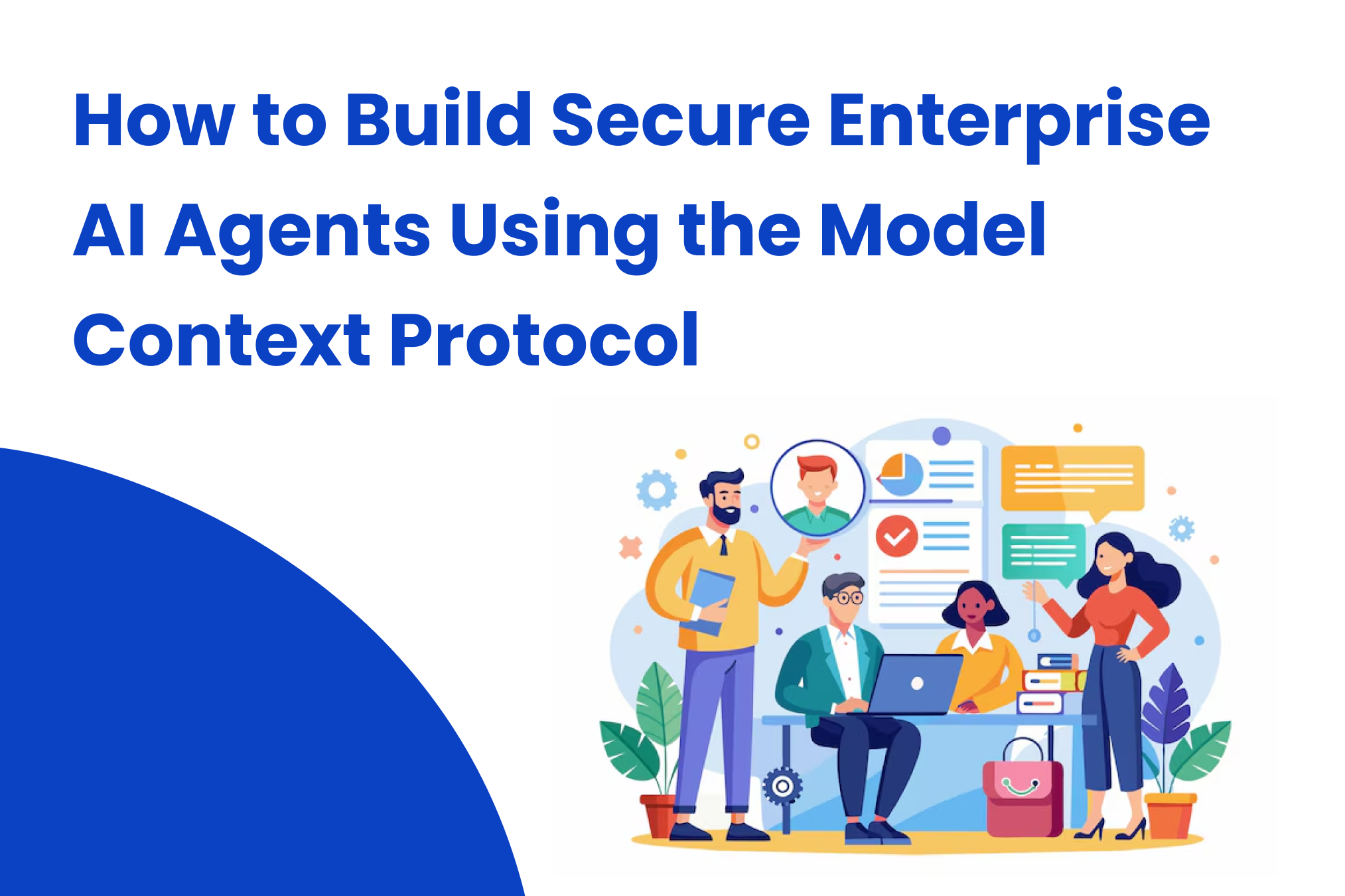
AI agents are becoming more useful in business because they can do more than generate answers. They can access information, work with software tools, complete tasks, and support employees across different departments. But for an AI agent to work properly inside an enterprise, it needs a safe and reliable way to connect with business systems.
This is where the Model Context Protocol (MCP) becomes important. MCP provides a common way for AI applications to connect with external tools and data sources. Instead of creating a separate connection for every AI application and business system, organizations can use a common structure for communication.
For enterprises, however, connecting an AI agent to business systems is not only a technical task. Security, permissions, data access, monitoring, and human approval must be considered from the beginning.
Most organizations already use several systems for daily operations. These may include CRM platforms, databases, cloud services, internal knowledge bases, project management software, HR systems, and financial applications.
An AI agent may need information from more than one of these systems to complete a task. Without a common connection method, developers may have to build and maintain separate integrations for different tools.
This can make AI projects harder to manage as the number of systems grows.
The Model Context Protocol provides a structured approach for connecting AI applications with external tools and information. It can help developers create reusable connections instead of designing every integration from scratch.
For enterprises, this can make AI systems easier to organize while giving teams a clearer way to control how agents interact with company resources.
At a basic level, MCP creates a standard way for an AI application to communicate with external capabilities. An AI client can connect to an MCP server that provides access to specific tools, resources, or information.
For example, an enterprise AI agent may need to:
Instead of giving the AI direct and unrestricted access to every system, organizations can expose selected functions through controlled connections.
This distinction is important for security. The agent should only receive access to the information and actions it actually needs.
Good MCP development begins with security planning rather than adding security after the integration is complete.
The first step is to identify what the AI agent needs to do. A customer support agent may need to read customer records and create support tickets, but it may not need access to payroll or financial systems.
This principle can be applied to every tool connection.
Developers should define:
Keeping permissions limited reduces the damage that could occur if an agent behaves unexpectedly or an account is compromised.
One of the most important rules for building secure AI agents is limiting access.
An AI agent should not receive broad access simply because it may need information in the future. Permissions should be based on the specific job the agent performs.
For example, an HR assistant may need to retrieve an employee's leave balance. It does not necessarily need permission to modify salary records.
Similarly, a sales agent may need to read customer information and update a CRM record but should not automatically receive permission to delete customer data.
Using separate permissions for different tools and actions makes the system easier to control and review.
Enterprise AI agents may work with confidential information such as customer records, employee data, contracts, financial details, and internal documents.
Data protection therefore needs to be part of the architecture.
Organizations should decide what information can be shared with an AI model and what information should remain restricted. Sensitive data should only be exposed when it is necessary for the requested task.
Access controls should also be applied at the tool level. An agent that can search a database should not automatically be allowed to retrieve every table or record.
Data handling policies should be clear, especially when AI agents are used across departments with different levels of access.
AI tool connectivity is one of the biggest benefits of MCP, but every connection can also create a security risk if it is not managed correctly.
Each tool should have a clearly defined purpose and permission set. Developers should validate requests before allowing an agent to perform an action.
For example, an agent might be allowed to create a support ticket but not close a high-priority incident without human approval.
Tool inputs should also be checked carefully. Unexpected or incorrect input should not automatically be passed to business systems.
This approach creates a controlled boundary between the AI agent and the applications it can access.
Not every task should be fully automated.
Some actions can be performed automatically with relatively low risk, such as retrieving information, creating a draft, or generating a report. Other actions can have significant consequences.
Sending money, deleting records, changing employee information, modifying production systems, or sending sensitive communications may require human approval.
A well-designed enterprise agent can pause before such an action and request confirmation.
This creates a useful balance between automation and control. The AI can handle routine work while people remain responsible for important decisions.
Building secure AI agents also requires visibility into their activity.
Organizations should maintain logs showing important information such as:
Monitoring helps security and IT teams identify unusual behavior. It also makes troubleshooting easier when an agent produces an unexpected result.
Regular reviews can reveal unnecessary permissions or tools that are no longer required.
An AI agent should be tested in realistic conditions before it is given access to important business systems.
Testing should include normal requests as well as unexpected situations. Teams should check how the agent responds to incomplete information, conflicting instructions, unavailable tools, incorrect inputs, and attempts to access restricted information.
Security testing should also examine whether an agent can be manipulated into performing actions outside its intended role.
This is particularly important because an AI agent can interpret natural language and interact with several systems. Testing helps organizations understand where additional restrictions are needed.
Enterprise AI integration does not have to happen across the entire organization at once.
A better approach is to begin with one well-defined use case. For example, a company could start with an internal IT assistant that can search approved documentation and create support tickets.
Once the system has been tested, the organization can expand its capabilities carefully.
The next stage might involve additional tools, more data sources, or other departments. At every stage, permissions and security controls should be reviewed.
This gradual approach also gives employees time to understand how the system works and where human involvement remains necessary.
As companies adopt more AI agents, the number of tools and systems those agents need to access is likely to increase. A common protocol can help reduce the complexity of connecting AI applications with different resources.
The Model Context Protocol can provide a structured foundation for these connections, while security controls determine what agents are actually allowed to do.
The important point is that MCP itself should not be treated as a complete security solution. Secure enterprise AI requires several layers, including identity management, access controls, data protection, monitoring, testing, and human oversight.
Building enterprise AI agents is about more than giving an AI model access to company tools. Businesses need a controlled architecture that allows agents to work with information and applications without creating unnecessary security risks.
The Model Context Protocol can help provide a common approach to connecting AI applications with external tools and data. With careful MCP development, limited permissions, strong monitoring, and clear approval rules, organizations can build secure AI agents that are useful in real business environments.
As enterprise AI integration expands, reliable AI tool connectivity will become increasingly important. Companies that treat security as part of the design from the beginning will be better positioned to use AI agents responsibly while keeping their business systems and data protected.








 India
India

 Canada
 United Kingdom
 New Zealand
 USA
USA
 UAE
UAE
 SGP
SGP
 Australia
 CALL
NOW
CALL
NOW