
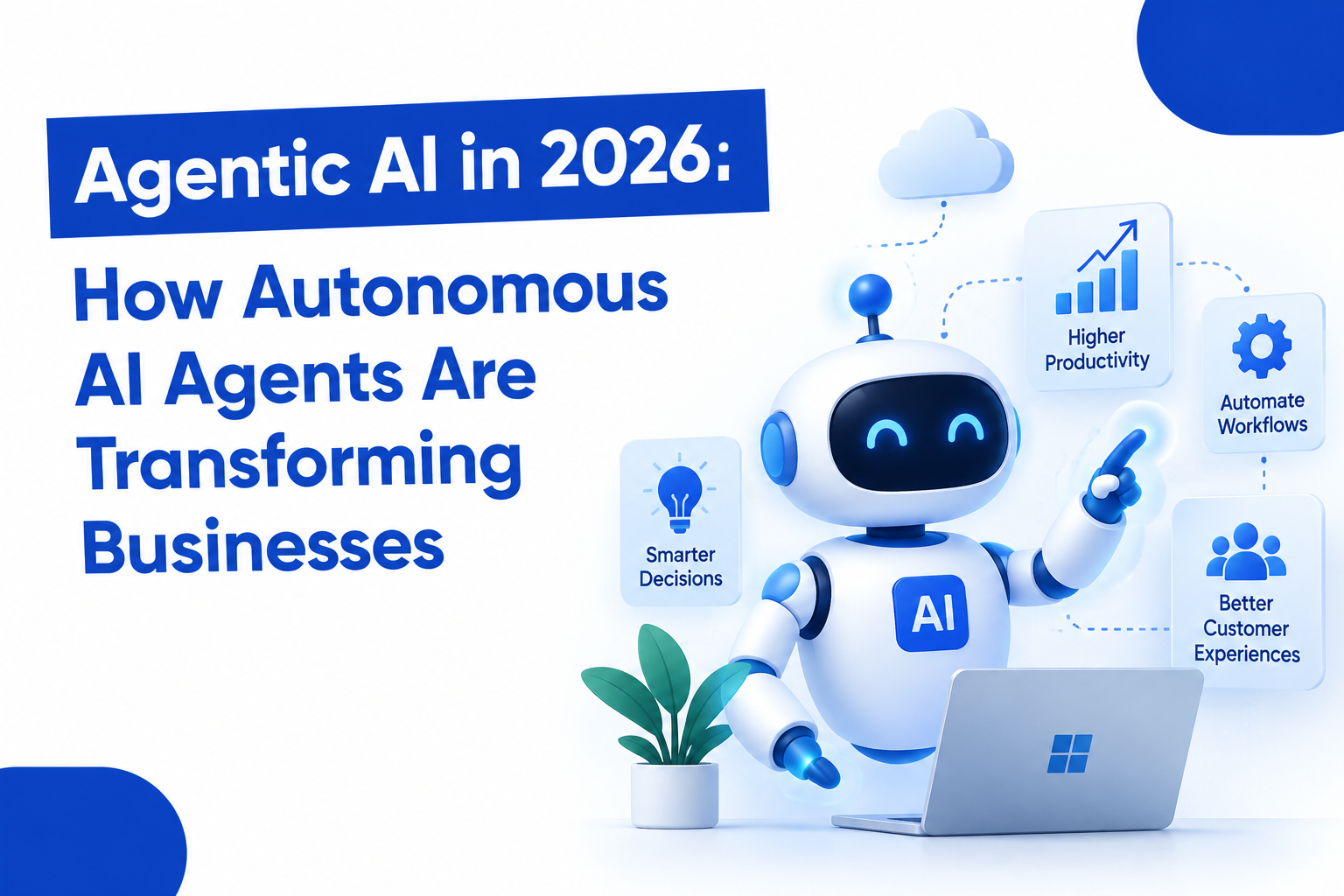
Artificial intelligence is moving beyond systems that simply answer questions or follow fixed instructions. In 2026, businesses are exploring systems that can understand a goal, plan steps, use digital tools, make decisions, and complete tasks with limited human involvement. These systems are known as autonomous AI agents.
Their growth is changing how companies approach automation. Instead of automating one repetitive action at a time, organizations can build systems that manage complete tasks across several applications. Customer support, sales, finance, IT, and human resources are among the areas where AI agents are becoming useful.
Traditional AI usually responds to a specific request. A person provides information, the system processes it, and a result is returned. Agentic AI works with a broader objective and can decide how to reach it.
For example, a traditional system may classify a customer email as a complaint. An AI agent can read the complaint, check the customer record, identify the issue, review company policy, prepare a response, update the support system, and send the case to a human when necessary.
Planning across multiple steps makes agentic systems useful for complex work. They can use connected software, evaluate results, and adjust their approach when needed.
Why Autonomous AI Agents Matter in 2026
Businesses handle large amounts of information and repetitive digital tasks. Employees may spend hours checking records, moving information between systems, preparing reports, and responding to routine requests.
Autonomous AI agents can take over parts of this workload while employees focus on decisions that need experience, judgment, and creativity. The goal is to give employees digital support for routine work while they focus on more complex decisions.
Agents can also connect with CRM platforms, databases, communication tools, project systems, cloud services, and other applications, creating more opportunities for practical automation.
One major change is the move from task automation to agentic workflows. A traditional automated workflow follows predefined rules. If an event occurs, the system performs a set of actions. This works well when every situation is predictable.
Agentic workflows can handle situations that require interpretation. An agent may receive a goal, decide which information it needs, select the right tools, perform several actions, and check the outcome.
Consider an IT support example. Instead of simply creating a ticket when a system reports an error, an AI agent could examine the alert, review recent activity, compare it with known problems, suggest a likely cause, perform an approved diagnostic action, and create a detailed ticket if human support is required.
This makes automation more flexible when conditions change.
Agentic AI is expanding across departments. Common applications include:
Customer service: Agents can answer routine questions, review account information, suggest solutions, and transfer unusual cases to human representatives.
Sales: Agents can research prospects, update customer records, prepare meeting summaries, identify follow-up opportunities, and support routine communication.
Finance: Agents can review invoices, match records, identify unusual transactions, prepare payment information, and support financial reporting.
Human resources: Agents can help with employee questions, document requests, interview scheduling, onboarding tasks, and routine HR administration.
IT operations: Agents can monitor alerts, investigate common issues, collect technical information, and perform approved support actions.
Marketing: Agents can assist with research, campaign analysis, content planning, audience segmentation, and performance reporting.
The value depends on whether a process involves repeated decisions, multiple systems, and clear rules for when human approval is required.
Enterprise AI automation is moving toward systems that work across complete business processes rather than isolated tasks. This matters because many business activities involve several teams and applications.
For example, processing a new customer may involve collecting information, checking records, creating an account, sending documents, updating a CRM, and notifying an internal team. Separate automations can handle individual steps, but an AI agent can coordinate the broader process and respond when something unexpected occurs.
This does not mean every process should become fully autonomous. Businesses still need controls, approval steps, access limits, and monitoring. Actions involving financial transfers, employment decisions, or critical systems may require human approval.
Strong deployments will combine AI decision-making with business rules and human oversight.
Successful AI agent development requires more than connecting an AI model to business applications. Companies need to define what an agent can do, what information it can access, which tools it can use, and when it must ask a person for approval.
Developers also need to consider security, data quality, reliability, monitoring, and error handling. An agent that can take action needs stronger controls than a chatbot that only provides information.
Testing is equally important. Agents should be evaluated against normal cases, unusual requests, incomplete information, and tool failures. Companies should track outcomes and improve the system over time.
Agentic AI is giving business process automation a new direction. Earlier automation focused mainly on repetitive, rule-based tasks. The next stage is about handling processes where some level of reasoning is required.
Imagine an agent managing a supplier issue. It could identify a delayed order, check the purchase record, review communication history, contact the supplier using an approved message, update the internal system, and notify the relevant employee. If the supplier gives an unexpected response, the agent could pause and request human guidance.
This can reduce manual coordination and help work move faster, without employees monitoring every routine step.
Agentic AI also brings new risks. An agent can make an incorrect decision, misunderstand information, use the wrong tool, or take an unintended action. Giving an AI system access to business applications therefore requires careful planning.
Data privacy and security are important concerns. Companies need to control what agents can access and ensure sensitive information is handled properly. Clear permissions can reduce the impact of unexpected behavior.
Accountability also matters. Businesses need to know why an agent took an action, what information it used, and whether a person approved important decisions. Logs, monitoring, approval controls, and regular testing can provide this visibility.
In 2026, agentic AI is becoming a practical business capability. Companies are looking beyond assistants toward systems that complete meaningful work.
A sensible starting point is a process where the desired outcome is already clear. Teams can identify repetitive steps, decide which actions an agent can handle, establish approval points, and measure results before expanding its role.
Over time, businesses may use multiple specialized agents that work together. One could handle customer requests, another could manage data tasks, and another could support internal operations. Together, they could create connected digital teams that work alongside employees.
Agentic AI will not remove the need for human judgment. Its bigger impact may be changing how people spend their working time. When routine coordination and repetitive digital work are handled by intelligent systems, employees can spend more time solving problems, building relationships, and making important decisions.
The growth of autonomous AI agents marks a new stage in business automation. Their ability to understand goals, plan actions, use tools, and respond to changing situations can help automate work that was difficult to manage with traditional systems.
For businesses, the opportunity is not simply to adopt AI because it is new. The real value comes from choosing the right processes, setting clear controls, and measuring results. As enterprise AI automation, agentic workflows, AI agent development, and business process automation continue to mature, agentic AI is likely to become an important part of how modern organizations operate.









 India
India

 Canada
 United Kingdom
 New Zealand
 USA
USA
 UAE
UAE
 SGP
SGP
 Australia
 CALL
NOW
CALL
NOW