

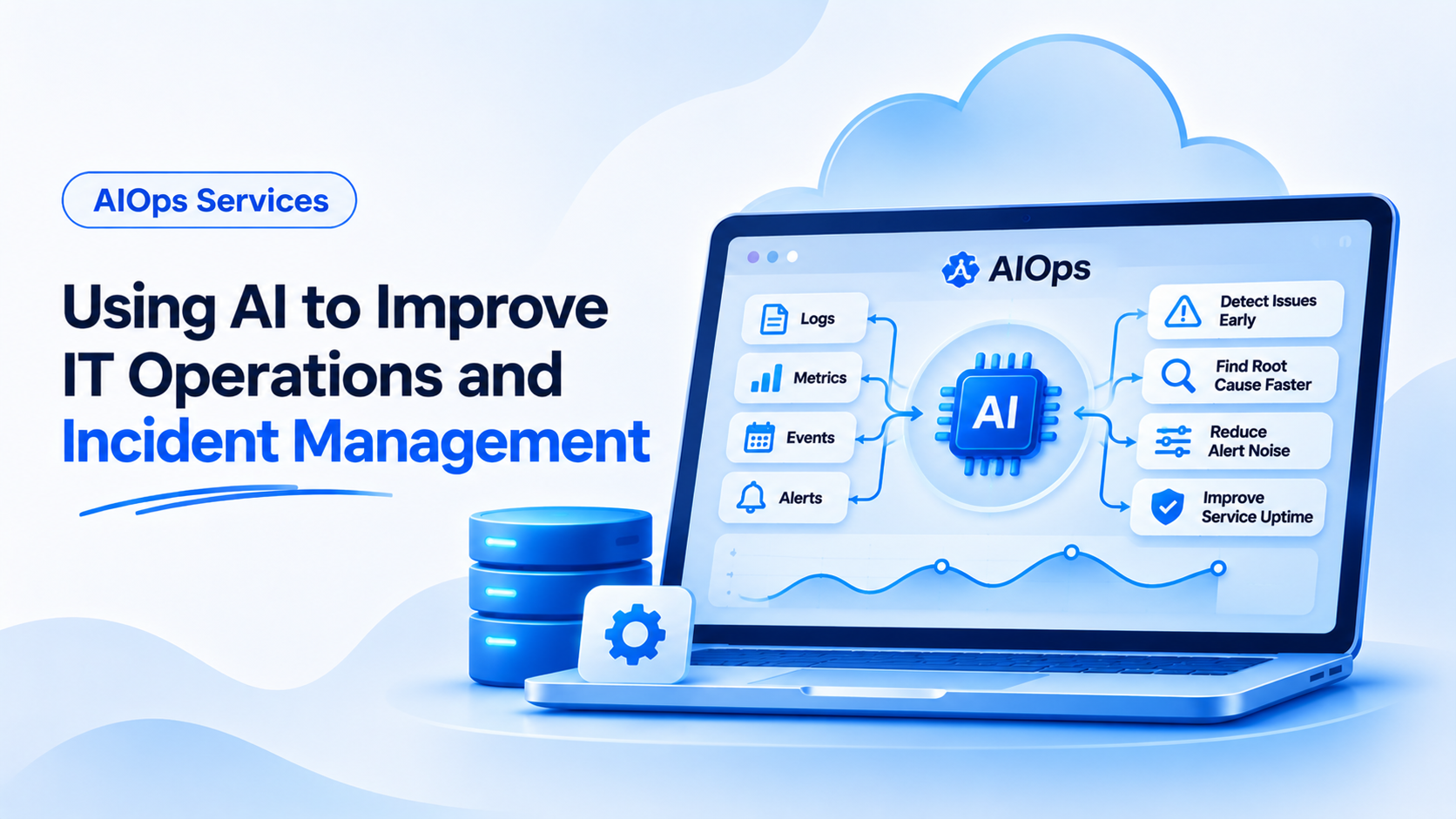
IT teams manage a growing number of applications, servers, cloud platforms, networks, and databases. Each system produces alerts, logs, and performance data. When problems occur across several systems at once, identifying the actual cause can take hours. During this time, applications may become slow, services may stop working, and users may face disruptions.
Artificial Intelligence for IT Operations, commonly known as AIOps, helps teams handle these challenges by analysing operational data and identifying unusual patterns. With AIOps Services, businesses can detect potential issues earlier, investigate incidents faster, and make IT operations easier to manage.
What Are AIOps Services, and How Do They Work?
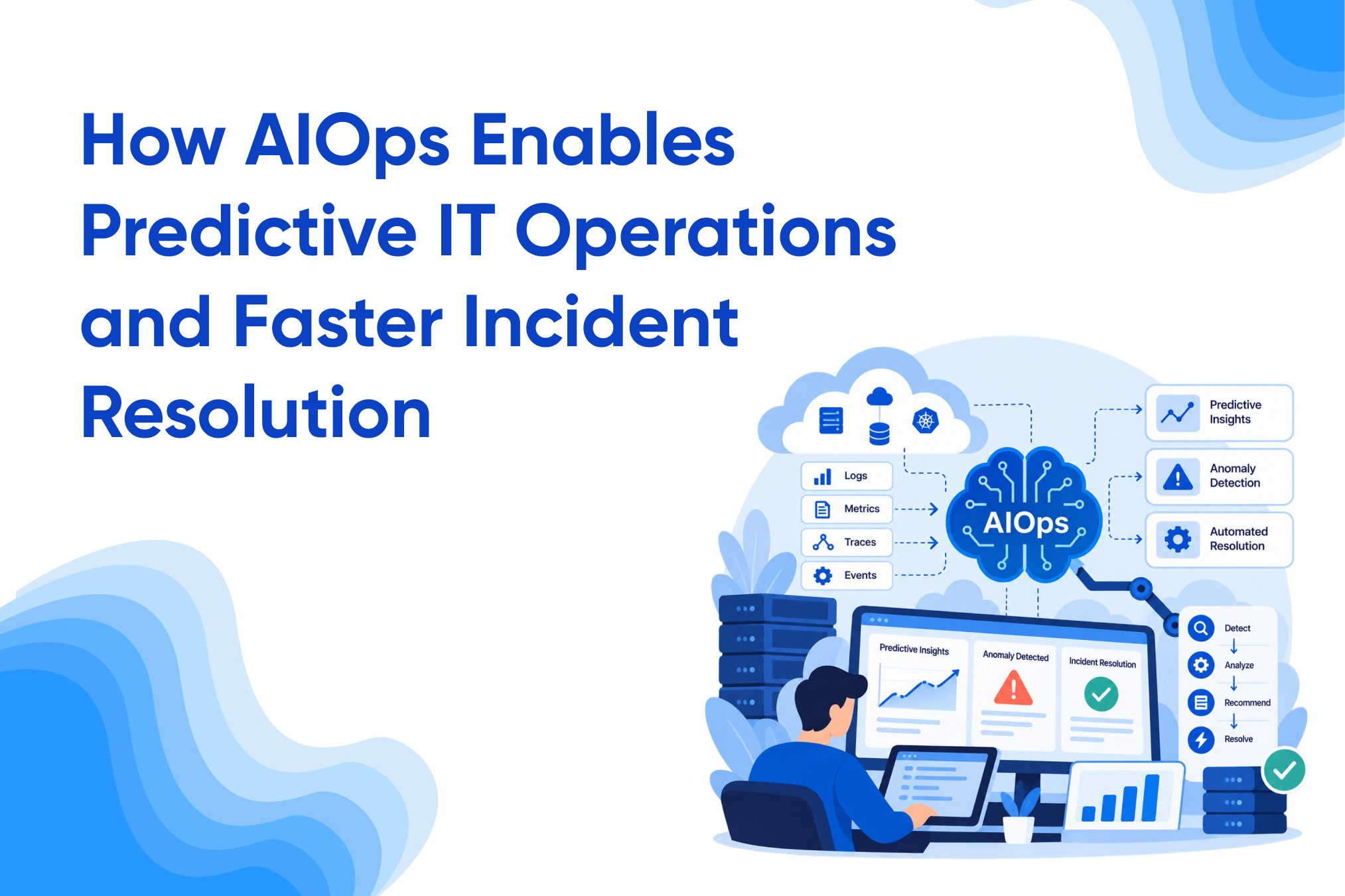
AIOps uses artificial intelligence, machine learning, and data analytics to support IT operations. It collects information from different IT systems, studies normal performance patterns, and identifies activities that may indicate a problem.
For example, if an application starts responding slowly, an AIOps platform can examine server metrics, network activity, application logs, and recent alerts. It may identify a rise in memory usage or an unusual database response time that could be contributing to the issue.
The process generally involves four activities:
Data Collection: Gather logs, metrics, events, and alerts from different IT environments.
Pattern Analysis: Use machine learning to understand normal system behaviour and recognise unusual activity.
Incident Detection: Identify performance changes, service disruptions, and possible infrastructure failures.
Action and Response: Help IT teams investigate issues, prioritise alerts, and take suitable corrective steps.
The goal is not to remove IT professionals from operations. Instead, AIOps gives them better information so they can focus on important problems rather than manually reviewing thousands of alerts.
Why Are Businesses Adopting AIOps for IT Operations?
Traditional IT monitoring tools usually track specific systems or predefined conditions. They can generate alerts when a threshold is crossed, but understanding how different events are connected may require manual investigation.
AIOps adds another layer of analysis by examining information across multiple systems.
Here is how it helps businesses:
Faster Problem Identification
AIOps can identify unusual behaviour before it develops into a major incident. Teams can investigate warning signs instead of waiting for users to report a problem.
Fewer Unnecessary Alerts
IT environments can produce several alerts for a single underlying issue. AIOps can group related events and help teams focus on the most important incidents.
Better System Visibility
Information from servers, applications, networks, and cloud platforms can be analysed together. This gives IT teams a clearer understanding of overall system health.
Improved Operational Decisions
Historical data and performance patterns help teams understand recurring problems and decide where infrastructure improvements are needed.
How Does AIOps Improve Incident Management?
Incident management involves detecting, investigating, resolving, and reviewing IT problems. When multiple systems are involved, these activities can become difficult to coordinate.
AIOps supports different stages of the incident management process.
1. Incident Detection
The platform continuously examines system activity to identify unusual performance, errors, and service interruptions.
2. Alert Correlation
Related alerts are grouped to help teams understand whether several warnings are connected to one underlying issue.
3. Root Cause Investigation
AIOps analyses logs, metrics, events, and system relationships to identify possible reasons behind an incident. It helps narrow down the investigation, although complex issues may still require expert review.
4. Incident Prioritisation
Not every alert needs immediate attention. AIOps can help rank incidents based on their potential impact on applications, services, and users.
5. Resolution Support
Depending on the platform and configured workflows, AIOps can recommend corrective actions or trigger approved automated responses.
This approach helps reduce investigation time and gives support teams more time to handle incidents that require human judgement.
Which IT Operations Can Benefit From AIOps?
AIOps can support several areas of IT management. Its usefulness depends on the quality of available data and how well monitoring tools are connected.
Cloud Infrastructure Monitoring: Analyse resource usage, service performance, and unusual activity across cloud environments.
Application Performance Monitoring: Identify slow response times, application errors, and performance changes that affect users.
Network Operations: Detect unusual traffic patterns, connectivity problems, and network performance issues.
Server and Database Monitoring: Track CPU, memory, storage, database activity, and other infrastructure metrics.
IT Service Management: Support incident prioritisation, alert analysis, and coordination between IT support teams.
For example, an online business may experience slow checkout operations during a busy sales period. AIOps can examine application response times, database performance, and infrastructure metrics together. This helps the IT team investigate the problem with a clearer view of what is happening across the environment.
What Is the Role of Machine Learning in AIOps?
Machine learning allows AIOps platforms to analyse large amounts of operational data and recognise patterns that may be difficult to identify manually.
Its role includes:
Anomaly Detection: Machine learning models learn typical system behaviour and flag unusual changes, such as unexpected CPU usage or sudden increases in application errors.
Predictive Analysis: Historical performance information can help identify conditions that may lead to future failures or capacity problems.
Event Correlation: Models can identify relationships between alerts and events from different systems, helping teams investigate connected problems.
Pattern Recognition: Repeated incidents can be analysed to identify common causes and recurring performance issues.
Machine learning results depend on the quality and quantity of available data. Teams should regularly review model performance and adjust monitoring rules when infrastructure or application behaviour changes.
What Challenges Should Businesses Consider Before Implementing AIOps?
Although AIOps can improve IT operations, successful implementation requires preparation. Businesses should understand the challenges before introducing it into their existing environment.
Poor Data Quality: Incomplete or inconsistent logs and metrics can affect analysis and produce unreliable alerts.
Tool Integration: Connecting monitoring platforms, cloud systems, applications, and ticketing tools may require technical planning.
Initial Complexity: Teams need time to configure data sources, establish baselines, and understand platform recommendations.
Security Requirements: Operational data may contain sensitive information, so access controls and data protection policies are important.
Team Readiness: IT professionals need to understand how to interpret insights and work with automated workflows.
Starting with a few important applications or infrastructure components can make adoption easier. Businesses can review the results, improve configurations, and expand AIOps to other areas over time.
How Can Businesses Choose the Right AIOps Solution?
The right platform should match the organisation's infrastructure, operational goals, and existing technology.
Before selecting a solution, businesses should consider:
Monitoring Coverage: Check whether the platform supports the applications, servers, networks, databases, and cloud environments being used.
Integration Options: Make sure it can collect information from existing monitoring and IT service management tools.
Analytics Capabilities: Review its ability to detect anomalies, correlate events, and support incident investigation.
Automation Controls: Understand which tasks can be automated and whether approval is required before actions are performed.
Reporting and Visibility: Look for clear dashboards and reports that help teams understand system health and incident trends.
A useful AIOps solution should fit into existing IT operations rather than create another disconnected system for teams to manage.
How Can Goognu Support Better IT Operations?
AIOps implementation involves more than choosing an AI platform. Businesses need to understand their infrastructure, identify monitoring gaps, connect relevant data sources, and define how incidents should be handled.
Goognu works with cloud and infrastructure-related technology requirements. Businesses exploring improvements to their IT environment can visit Goognu to learn more about its technology services and identify solutions that align with their operational needs.
Conclusion
AIOps helps businesses manage complex IT environments by using AI and machine learning to analyse operational data, detect unusual behaviour, and support incident investigation. It can reduce alert noise, improve visibility, and help IT teams respond to problems more effectively.
With the right AIOps services, organisations can move towards more informed and proactive IT operations. Careful planning, reliable data, suitable integrations, and regular monitoring are essential to getting meaningful results.
Frequently Asked Questions
- What are AIOps Services used for?
AIOps Services help businesses monitor IT environments, analyse operational data, detect unusual activity, correlate alerts, and support faster incident management.
- How does AIOps reduce alert fatigue?
AIOps analyses related events and groups alerts that may come from the same underlying issue. This helps IT teams focus on incidents that need attention.
- Can AIOps predict IT infrastructure failures?
AIOps can analyse historical data and identify patterns that may indicate potential failures. However, predictions depend on data quality and the capabilities of the platform.
- Is AIOps suitable for cloud environments?
Yes. AIOps can monitor cloud infrastructure, applications, networks, and services by analysing metrics, logs, and events from connected systems.
- Does AIOps replace IT operations teams?
No. AIOps supports IT professionals by providing useful insights and automation. Human expertise remains important for complex investigations, decisions, and incident resolution.