

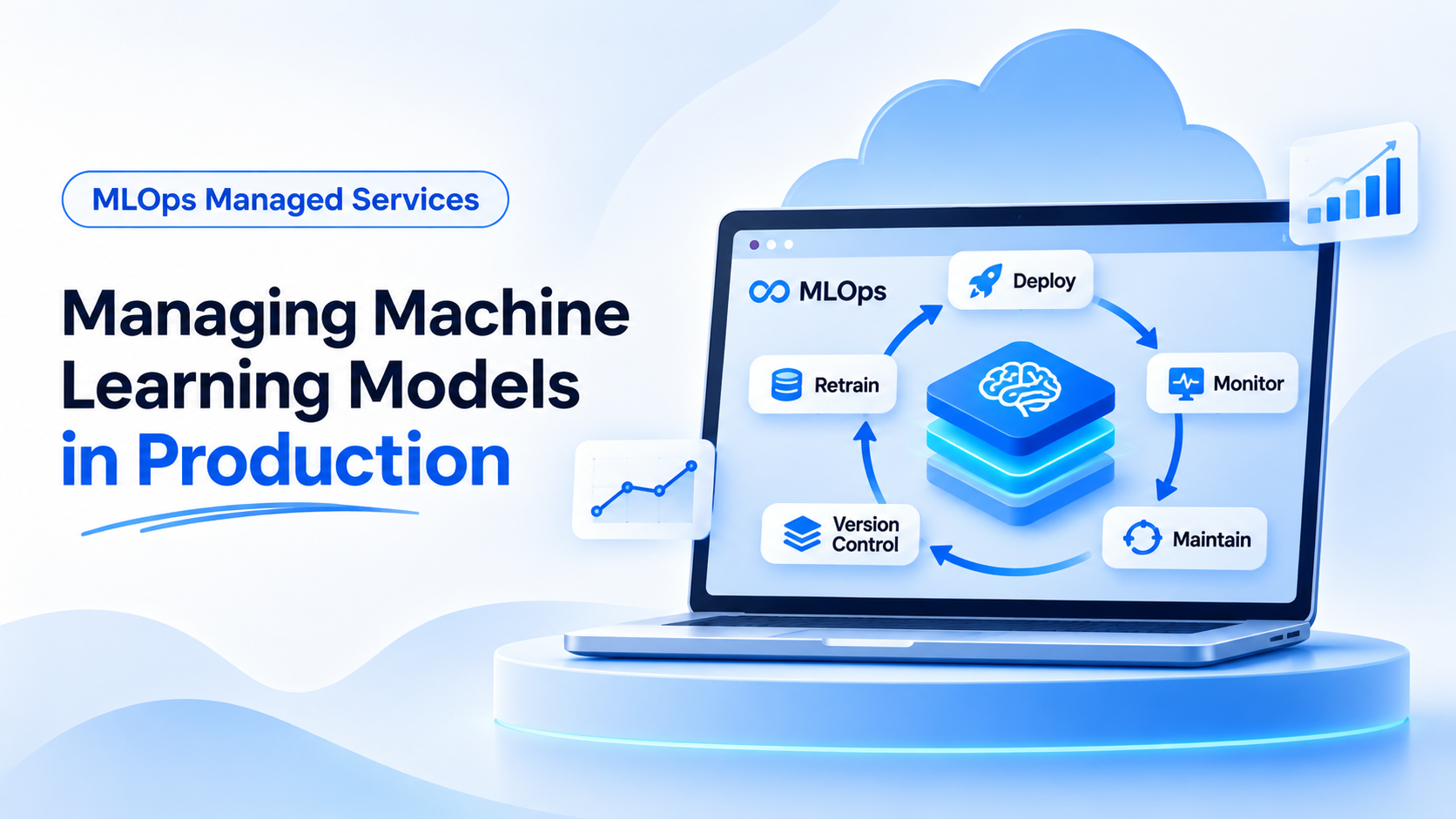
Developing a machine learning model is only one part of a successful AI project. Once a model enters production, it needs regular attention to ensure it continues to deliver useful results. New data, changing business needs, software updates, and infrastructure issues can all affect how a model performs.
Managing these changes can become difficult when internal teams already have several responsibilities. MLOps managed services help businesses handle the ongoing work involved in running machine learning models in production. They provide support for model deployment, monitoring, maintenance, and lifecycle management, allowing internal teams to focus on improving their products and business processes.
Why Does Managing Models in Production Require Ongoing Attention?
A machine learning model does not remain accurate forever. It learns patterns from historical data, but those patterns may change over time. For example, a retail recommendation model may produce less relevant suggestions when customer preferences shift. Similarly, a fraud detection model may need updates when new types of suspicious activity appear.
Production environments also involve technical responsibilities. Models depend on applications, data pipelines, computing resources, and other systems. A problem in one area can affect the entire workflow.
Businesses may face several challenges after deployment:
- Performance changes: Model predictions may become less accurate as data patterns change.
- Deployment issues: Updates can introduce errors if they are not tested properly.
- Infrastructure requirements: Production models need suitable computing resources and stable environments.
- Version management: Teams must know which model version is active and when changes were introduced.
- Maintenance workload: Regular checks and updates require time from data science and engineering teams.
These responsibilities make production management an ongoing activity rather than a one-time task.
What Do MLOps Managed Services Cover?
Managed MLOps support focuses on the operational side of machine learning. The exact responsibilities depend on the agreement, technology environment, and business requirements. However, several activities commonly form part of the service.
Model Deployment Management
Moving a model from development into production requires proper preparation. Teams need to check dependencies, configurations, infrastructure, and application requirements before release.
Managed support can help organise deployment workflows and ensure that updates follow an agreed process. This reduces reliance on informal manual steps and makes releases easier to manage.
Production Monitoring
After deployment, models need regular checks. Monitoring helps teams understand whether models are responding as expected and whether technical problems are affecting their availability or output.
It can also help identify changes in data patterns and model behaviour. When an issue appears, teams can investigate its possible cause and decide what action is needed.
Model Version Control
Machine learning projects often involve multiple experiments and updates. Without proper version tracking, teams may find it difficult to identify which model is running in production or compare it with earlier versions.
Version management maintains a record of changes and supports more controlled updates. It also helps teams return to an earlier version when a new release causes problems.
Maintenance and Updates
Models may need retraining, configuration changes, or deployment updates as business requirements evolve. Managed services help establish a regular maintenance process so these activities are planned instead of handled only when something goes wrong.
The frequency of updates should depend on the model's purpose, data patterns, and performance requirements.
How Are MLOps Managed Services Different from MLOps Consulting?
Both services support machine learning operations, but their main responsibilities are different.
MLOps consulting generally focuses on planning and improving the machine learning lifecycle. Consultants assess existing workflows, recommend suitable tools, and help businesses define an operational strategy.
MLOps managed services focus more on ongoing operational responsibilities after the required processes and environment are established. This may include monitoring, deployment support, maintenance, and coordination of model updates.
For example, a business may first work with consultants to design its MLOps workflow. Once the setup is ready, it may choose managed support to handle regular production activities.
Some organisations need both. Others may only require one, depending on the maturity of their machine learning operations and the availability of internal expertise.
What Should Businesses Look for in an MLOps Management Approach?
Selecting a managed service provider requires more than comparing tools or service descriptions. Businesses should understand how the provider will work with their existing teams and systems.
Here are some important points to consider.
- Clear responsibilities: Define who will handle deployment, monitoring, troubleshooting, model updates, and infrastructure-related tasks. This avoids confusion when an issue occurs.
- Suitable monitoring practices: Understand what will be monitored, how frequently checks will happen, and how the team will respond to unusual results or technical problems.
- Defined update process: Model changes should follow a clear process that includes testing, approval, deployment, and version tracking.
- Technology compatibility: The service approach should fit the organisation's existing cloud environment, data platforms, and machine learning tools.
- Reporting and communication: Regular updates help business and technical teams understand model status, reported issues, and completed maintenance activities.
A good managed approach should make responsibilities easier to understand rather than introduce another layer of complexity.
When Should a Business Consider MLOps Managed Services?
Not every organisation needs external management from the beginning. However, managed support can become useful as production workloads increase.
Consider it when:
- Your team manages several machine learning models across different applications.
- Production monitoring and maintenance take time away from development work.
- Model updates are difficult to coordinate.
- Your organisation lacks dedicated resources for ongoing MLOps operations.
- You need a more consistent process for managing model versions and deployments.
- Production issues take too long to investigate or resolve.
These situations indicate that machine learning operations may need more structured support. The right service arrangement can help businesses manage recurring responsibilities without building every operational function internally.
How Can Goognu Help Businesses Manage Machine Learning Operations?
Managing machine learning in production requires an understanding of models, data workflows, and the infrastructure that supports them. Goognu works with businesses on cloud and modern technology requirements, helping them assess their needs and identify suitable approaches.
Through its MLOps Services, businesses can explore support for organising machine learning operations and managing the technical requirements of their environment. The right approach should reflect the number of models in use, the complexity of deployments, and the level of operational support required.
For organisations planning to expand their machine learning use, it is important to establish clear responsibilities for monitoring, maintenance, and updates. Goognu can help businesses evaluate their requirements and plan an approach that fits their existing technology setup.
Visit Goognu to learn more about its technology services and discuss your business requirements.
Conclusion
Putting a machine learning model into production is the beginning of its operational journey. It needs monitoring, maintenance, version management, and regular reviews to remain useful as data and business requirements change.
MLOps managed services help businesses manage these responsibilities through a more organised approach. By defining operational tasks and establishing reliable workflows, organisations can reduce the pressure on internal teams and maintain better control over production models.
The goal is not simply to keep models running. It is to make sure they continue to serve their intended purpose and remain manageable as business needs develop.
Frequently Asked Questions
1. What are MLOps managed services?
MLOps managed services provide ongoing support for operating machine learning models in production. Depending on the service scope, this can include deployment management, monitoring, maintenance, version control, and support for model updates.
2. Why do machine learning models need production monitoring?
Models can become less reliable when data patterns or business conditions change. Production monitoring helps teams identify unusual behaviour, performance changes, and technical issues so they can investigate and take appropriate action.
3. Can small businesses use managed MLOps services?
Yes. Small businesses can use managed support when they have production machine learning workloads but limited internal resources. The service scope can be based on the number of models, technical requirements, and available budget.
4. Do MLOps managed services include model development?
Not necessarily. Managed MLOps services generally focus on operating and maintaining models. Model development may be a separate responsibility, so businesses should confirm the exact scope before choosing a provider.
5. How often should production machine learning models be updated?
There is no fixed schedule for every model. Updates depend on model performance, changes in incoming data, business requirements, and the risks associated with incorrect predictions. Regular monitoring helps teams decide when an update is needed.
6. What is the main benefit of MLOps managed services?
The main benefit is having a structured approach to ongoing machine learning operations. Businesses can assign recurring production responsibilities to a managed team while allowing internal specialists to focus on model development and other priorities.