
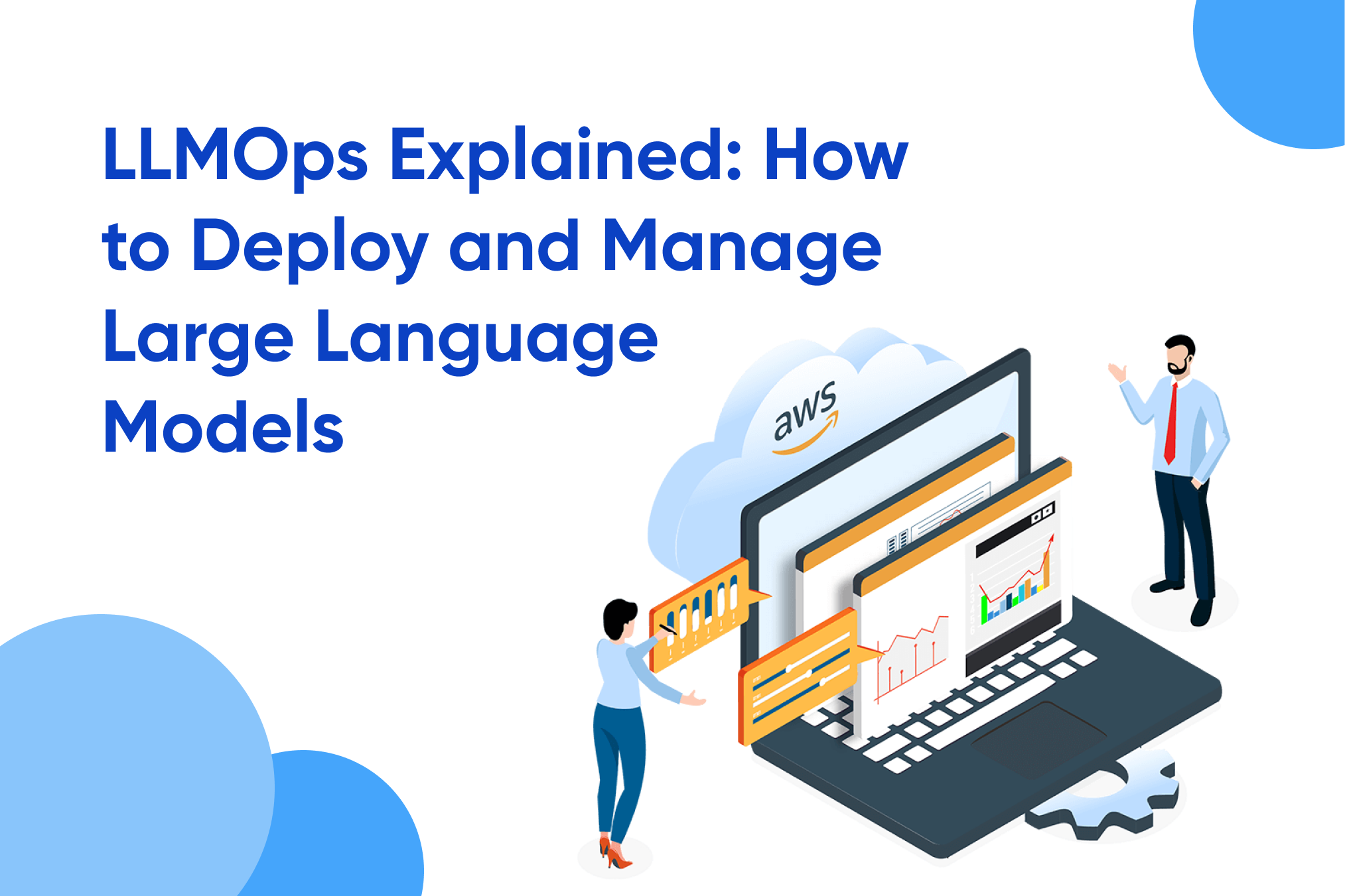
Large language models have moved from experimental projects to practical tools used across businesses. Companies now use them for customer support, content creation, software development, document analysis, search, research, and internal knowledge systems. But building an LLM application is only one part of the process.
Once a model is ready for real users, businesses need to deploy it, monitor its performance, manage updates, control costs, and keep its responses reliable. This is where LLMOps becomes important.
LLMOps refers to the practices, tools, and processes used to manage large language models throughout their working life. It brings together model development, deployment, monitoring, security, data management, and ongoing improvement.
LLMOps stands for Large Language Model Operations. It extends ideas from traditional MLOps to address the specific challenges of working with large language models.
A normal machine learning model may produce a prediction based on structured data. An LLM can generate text, answer questions, summarize documents, write code, and interact with users in more flexible ways. This creates additional challenges around response quality, prompts, context, latency, and model behavior.
LLMOps helps organizations manage these challenges through a structured operational process.
Instead of treating an LLM as a one-time development project, businesses can manage it as a system that needs regular testing, monitoring, updates, and improvement.
A model may perform well during development but behave differently when thousands of users start interacting with it.
Real-world usage can introduce unexpected questions, larger workloads, new data, higher costs, and performance issues. A model can also become less useful when business information changes.
This makes LLM deployment an ongoing responsibility rather than a single technical activity.
Before putting an LLM application into production, teams need to consider factors such as:
A good deployment process prepares the system for actual business conditions rather than only successful testing scenarios.
LLMOps covers several connected stages. Each stage has a role in keeping an AI application useful and dependable.
1. Model Selection
Businesses can choose from different language models based on their use case. The decision may depend on accuracy, speed, cost, context length, privacy requirements, and the type of tasks the model needs to perform.
A model that works well for content generation may not be the best option for a technical support application.
2. Prompt and Application Testing
The model itself is only one part of an LLM application. Prompts, system instructions, retrieved information, tools, and application logic can all affect the final response.
Teams need to test different inputs and check whether the system produces useful and appropriate results.
3. Deployment
Once the application has passed testing, it can be made available to users. Deployment may involve cloud infrastructure, APIs, databases, vector stores, application servers, and security systems.
The setup needs to support expected traffic while keeping response times and operating costs under control.
4. Monitoring
After deployment, businesses need visibility into how the application is performing. This is where AI model monitoring becomes especially important.
Monitoring an LLM application involves more than checking whether the system is online.
Organizations may need to track response time, usage levels, errors, token consumption, costs, user feedback, and response quality.
Teams can also review whether the model is giving irrelevant, incomplete, or incorrect answers.
For applications that use company documents, monitoring should also examine whether the system is retrieving the right information before generating a response.
Regular monitoring helps teams identify problems early instead of waiting for users to report them.
A reliable LLM application needs more than a language model. It requires infrastructure that supports the complete application.
Generative AI infrastructure can include model APIs, cloud computing resources, databases, data pipelines, vector databases, application servers, security controls, monitoring tools, and storage systems.
The right setup depends on how the AI application is being used.
For example, a small internal assistant may require a relatively simple architecture. A customer-facing AI application serving a large number of users may require stronger availability, traffic management, data protection, and monitoring.
Infrastructure decisions should therefore be based on actual workload requirements rather than choosing the most complex setup available.
LLMs can create new operating costs because many providers charge based on usage. Large prompts, long conversations, frequent requests, and high traffic can increase expenses.
LLMOps helps businesses understand where these costs are coming from.
Teams can monitor token usage, compare models, identify unnecessary requests, and optimize prompts. In some cases, a smaller model may be sufficient for simple tasks, while a more advanced model can be reserved for complex requests.
Caching repeated results and controlling unnecessary context can also help reduce usage.
Cost management should be treated as part of the system design rather than something considered after deployment.
Large organizations have additional requirements when using AI. Their models may interact with confidential documents, customer information, internal systems, and business processes.
This makes enterprise LLM management an important part of an LLMOps strategy.
Organizations need clear rules for data access, model usage, user permissions, and system monitoring. They should also decide how model updates will be tested before reaching production.
For example, if an AI assistant uses internal company documents, the system should ensure that users only receive information they are authorized to access.
Reliability also depends on keeping the underlying knowledge current. If business policies or product information change, the AI system may need updated data or retrieval sources.
AI applications are rarely finished forever. Businesses may change models to improve performance, reduce costs, or support new requirements.
However, replacing a model without testing can create unexpected results.
An LLMOps process can include controlled testing before a new model or prompt reaches production. Teams can compare the new version with the existing system and review response quality, speed, cost, and other important measures.
Version control is also useful for prompts, model configurations, datasets, and application changes. It allows teams to understand what changed when system behavior changes.
LLM applications can introduce security concerns at several levels.
Users may enter sensitive information into an AI application. Retrieved documents may contain confidential data. Connected tools may allow the AI system to perform actions.
Security controls should therefore cover authentication, authorization, data access, API protection, logging, and secure handling of information.
Businesses should also test how the system responds to harmful or unexpected instructions. Limiting tool permissions and controlling access to sensitive resources can reduce risk.
A secure LLM application needs protection around both the model and the systems connected to it.
One of the biggest advantages of LLMOps is that it creates a feedback cycle.
A typical cycle may look like this:
Develop → Test → Deploy → Monitor → Review → Improve → Deploy again
User feedback and monitoring data can show where the application needs improvement. Teams may adjust prompts, update knowledge sources, change models, improve application logic, or introduce additional safeguards.
This continuous process is important because AI applications operate in changing environments. New user requirements, business information, models, and security concerns can all affect performance.
Companies building serious AI applications may benefit from LLMOps services when they need help managing the full operational side of their LLM systems.
These services can support areas such as deployment planning, infrastructure setup, model monitoring, performance management, security, evaluation, and ongoing optimization.
For businesses moving from an AI prototype to a production application, having a clear operational process can make the transition easier to manage.
The goal is not simply to run a language model. It is to build an AI application that remains useful, secure, measurable, and manageable as usage grows.
Large language models will continue to become part of everyday business applications. As adoption increases, managing these systems properly will become just as important as developing them.
LLMOps provides a practical framework for handling this responsibility. From LLM deployment and AI model monitoring to generative AI infrastructure and enterprise LLM management, each part contributes to a reliable AI environment.
Businesses that approach LLMs as long-term systems rather than one-time projects can respond more effectively to changing models, users, costs, and requirements.
LLMOps ultimately helps turn a powerful language model into a dependable business application that can be monitored, improved, and managed over time.









 India
India

 Canada
 United Kingdom
 New Zealand
 USA
USA
 UAE
UAE
 SGP
SGP
 Australia
 CALL
NOW
CALL
NOW