
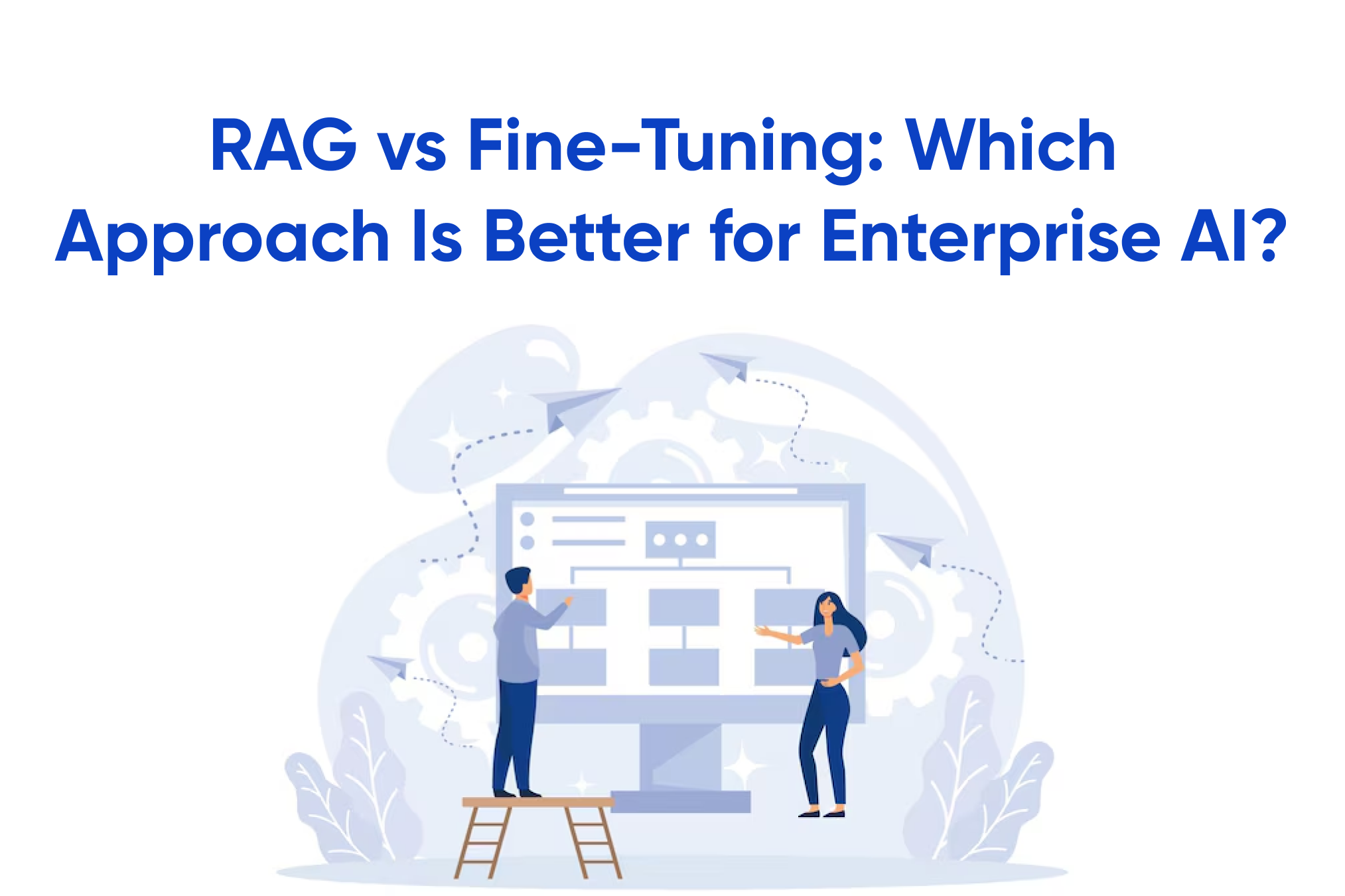
Enterprise AI is moving beyond simple chatbots and general-purpose assistants. Companies now want AI systems that can understand business information, answer questions accurately, follow specific instructions, and support real workplace tasks. Two approaches often come up when building these systems: retrieval-augmented generation and LLM fine-tuning.
Both approaches can improve the usefulness of a large language model, but they solve different problems. Choosing between them depends on the type of information the AI needs, how often that information changes, the level of control required, and the business goal.
Understanding the difference can help companies choose the right technology instead of spending time and money on an approach that does not match their needs.
At a basic level, retrieval-augmented generation gives an AI model access to relevant information when a user asks a question. Instead of depending only on information learned during model training, the system searches a connected knowledge source and provides useful information to the model before it generates an answer.
LLM fine-tuning, on the other hand, changes how a model behaves by training it further on a selected dataset. This can help the model learn a particular writing style, response pattern, task, or domain-specific behavior.
A simple way to look at the difference is:
RAG connects an AI model with external business information. This information may come from company documents, product catalogs, knowledge bases, policies, websites, support records, or other approved sources.
When an employee asks a question, the system searches for relevant information and passes the selected content to the language model. The model then uses that context to create its response.
A typical RAG workflow looks like this:
Business Data → Data Processing → Vector Database → Relevant Information → LLM → Final Answer
A vector database plays an important role in this process. Business content is converted into numerical representations called embeddings. These representations allow the system to identify content that is semantically related to a user's question.
For example, an employee could ask, “What is our current work-from-home policy?” The RAG system can retrieve the latest approved policy document and give that information to the model.
This makes RAG particularly useful when companies need AI to work with information that changes frequently.
RAG is often a strong choice when the AI needs access to private or frequently updated information.
Common examples include:
One major advantage is that companies do not necessarily need to retrain the underlying model every time their information changes. Updating the connected knowledge source can be enough.
Fine-tuning takes a different route. A company starts with an existing language model and trains it further using carefully selected examples.
The goal is not simply to give the model more information. Instead, the goal is to improve how it performs a particular task.
For example, a company may fine-tune a model to:
Consider a customer service company that wants every support response to follow a specific structure. Fine-tuning may help the model consistently follow that structure across thousands of interactions.
This makes LLM fine-tuning useful when behavior, format, or task performance matters more than providing constantly changing facts.
| Factor | RAG | Fine-Tuning |
|---|---|---|
| Main purpose | Provide relevant external information | Improve model behavior or task performance |
| Updating information | Usually easier | Requires additional training |
| Private company data | Strong use case | Possible, but requires careful training |
| Frequently changing information | Very suitable | Less suitable |
| Specific response style | Limited compared with fine-tuning | Strong use case |
| Implementation | Requires retrieval system and data source | Requires training dataset and model training |
| Ongoing maintenance | Knowledge sources need updating | Model may need retraining |
| Best for | Knowledge-based AI | Specialized tasks and behavior |
Neither approach is automatically better. The right choice depends on what the business expects the AI system to do.
A RAG system needs an effective way to locate useful information. This is where a vector database becomes important.
Traditional keyword search looks for matching words. Vector search focuses more on meaning. This allows an AI application to find information that is relevant even when the user's wording does not exactly match the wording in the source document.
For example, an employee might ask:
“Can I work remotely for two weeks?”
The company policy might use the phrase “temporary remote work arrangement.” A vector search system can recognize the relationship between the two concepts and retrieve the relevant policy.
The quality of the final answer depends heavily on the quality of the information retrieval process. Poor document preparation, outdated content, weak search results, or irrelevant context can reduce the quality of a RAG application.
Fine-tuning can make sense when a company has a clear task and enough high-quality examples to train the model.
For example, imagine an organization processing thousands of customer emails. The company wants AI to classify every message into categories such as billing, technical support, cancellation, complaint, or general inquiry.
If the desired output follows a consistent pattern, fine-tuning may improve task performance.
It can also help when an organization wants a particular tone or output structure that is difficult to achieve consistently through prompts alone.
However, fine-tuning should not be treated as a replacement for a knowledge system. If the AI needs the latest company information, fine-tuning alone may not be the best solution.
The choice does not always have to be RAG or fine-tuning. In many cases, combining both approaches can produce a stronger solution.
For example, a company could fine-tune a model to follow a specific customer support format while using RAG to retrieve the latest product and policy information.
The process could look like this:
Fine-Tuned Model + RAG + Business Knowledge = More Specialized Enterprise AI
Here, fine-tuning controls how the model responds, while RAG provides current information.
This combination can be useful for custom AI solutions where companies need both consistent behavior and access to changing business data.
Before selecting an approach, companies should answer a few practical questions.
1. Does the information change often?
If product details, policies, prices, or internal documents change regularly, RAG is usually more practical.
2. Is the main challenge knowledge or behavior?
If the AI needs access to specific information, consider RAG. If it needs to perform a task in a very specific way, fine-tuning may be more useful.
3. How much quality training data is available?
Fine-tuning depends on good examples. If a company does not have enough reliable training data, building a fine-tuning pipeline may not produce the expected results.
4. How quickly will the system need updates?
RAG generally makes knowledge updates easier because information can be changed in the connected data source rather than retraining the model.
5. What level of control is required?
Businesses should also consider security, access permissions, monitoring, data quality, cost, and long-term maintenance before selecting their approach.
There is no universal winner in the RAG vs fine-tuning discussion.
Retrieval-augmented generation is usually better when an AI system needs access to current, private, or frequently changing information. LLM fine-tuning is more suitable when the goal is to improve a model's behavior, response style, classification ability, or performance on a specific task.
For many enterprise projects, the most practical strategy may be to use both.
Companies can use RAG to connect enterprise AI models with trusted business knowledge and fine-tuning to make the model better suited to specific workflows. With the right architecture, a vector database and well-managed data sources can support reliable information retrieval, while fine-tuning can add task-specific behavior.
The best custom AI solutions are not built by choosing technology simply because it is popular. They are built by first understanding the business problem and then selecting the approach that fits the data, users, workflow, security requirements, and long-term goals.








 India
India

 Canada
 United Kingdom
 New Zealand
 USA
USA
 UAE
UAE
 SGP
SGP
 Australia
 CALL
NOW
CALL
NOW