
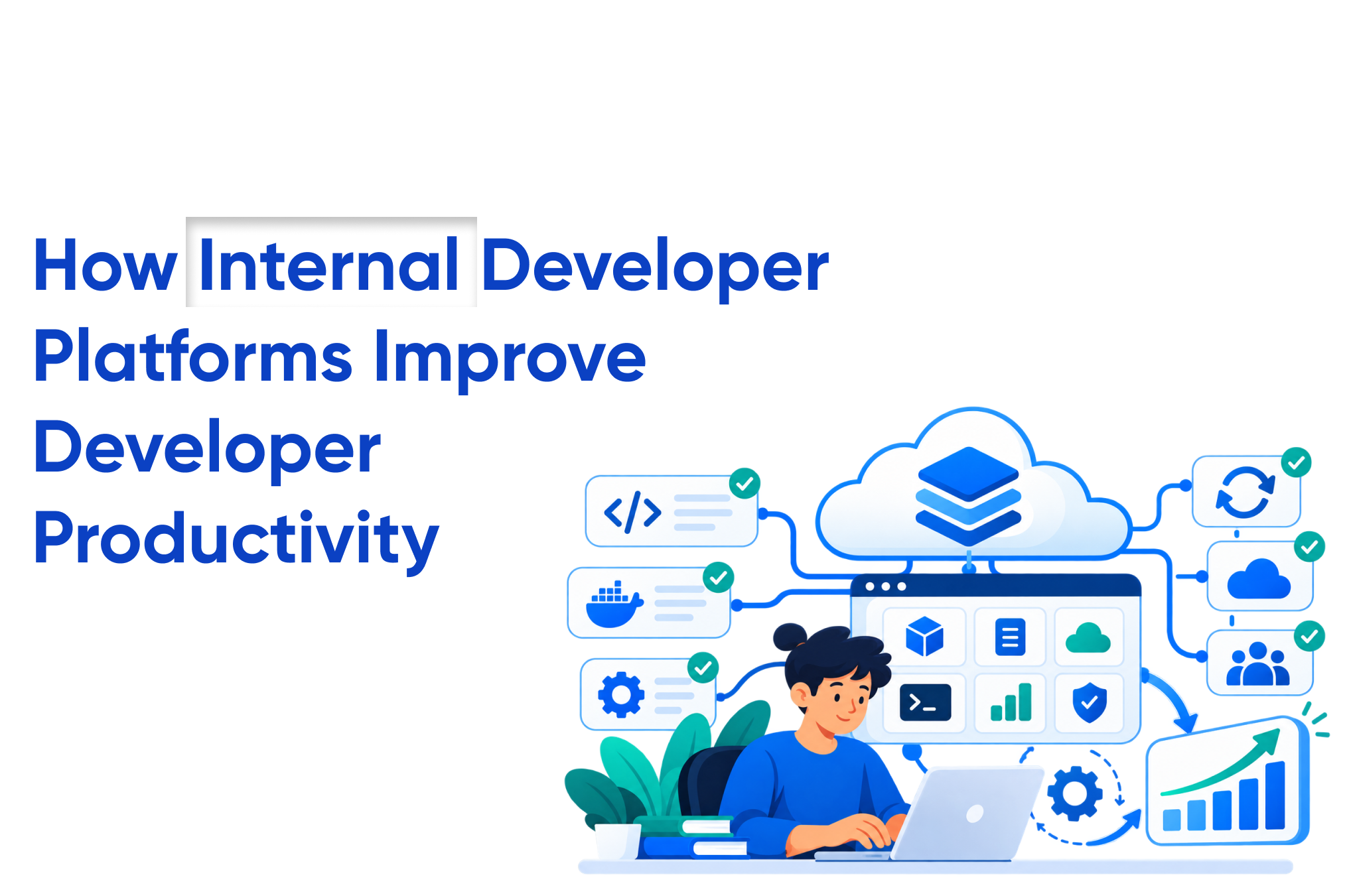
Developers spend much of their time writing code, testing applications, fixing issues, and delivering new features. However, a significant part of their day can also go into setting up environments, requesting access, managing infrastructure, and handling repetitive operational tasks.
These activities are necessary, but they can slow down development when every request depends on another team. An Internal Developer Platform helps address this challenge by giving developers a central place to access tools, resources, and automated workflows.
With the right platform, developers can complete common tasks independently while infrastructure and operations teams maintain the required standards. This approach improves productivity, supports collaboration, and creates a more consistent software delivery process.
An Internal Developer Platform is a collection of tools, services, workflows, and resources designed to help developers build and deploy applications more efficiently. It brings commonly required capabilities into one organized environment.
Instead of asking different teams for every infrastructure or deployment requirement, developers can use the platform to perform approved tasks through a self-service interface.
Depending on business needs, an internal platform may provide access to:
The platform does not need to look the same in every organization. Its design should reflect the technology stack, development process, and needs of the teams using it.
Writing code is only one part of delivering software. Developers also need to prepare environments, configure services, check deployment requirements, and coordinate with infrastructure teams.
When these tasks are handled manually, small requests can create delays. A developer may need to wait for access approval, environment setup, or assistance with a deployment issue before continuing their work.
This problem becomes more visible as an organization grows. More developers, applications, and infrastructure resources often mean more internal requests.
An internal platform helps reduce these delays by making frequently used processes easier to access. Developers can complete standard tasks through predefined workflows instead of starting from scratch each time.
Developer self-service is one of the main benefits of an internal developer platform. It allows developers to access approved resources and perform common actions without depending on manual support for every step.
For example, a developer may need a temporary testing environment for a new application. Through a self-service platform, they can request or create the environment using an approved template.
This approach can help developers:
Self-service does not mean removing all controls. Organizations can introduce permissions, approval steps, usage limits, and security checks based on the type of request.
The objective is to reduce avoidable delays while maintaining proper governance.
Platform engineering tools provide the technical foundation for creating and managing internal developer platforms. These tools may support infrastructure provisioning, deployment automation, service catalogs, monitoring, security, and workflow management.
A platform team can combine different tools to create a smoother developer experience. For example, infrastructure provisioning tools can automate resource creation, while deployment tools can help teams release applications using consistent processes.
The platform may also include a service catalog where developers can find approved templates, services, and documentation. This reduces the need to search through multiple systems for basic information.
The value does not come from using the largest number of tools. It comes from connecting the right tools in a way that makes daily development work easier.
Not every development team needs to follow the exact same process. However, most organizations have certain tasks that are repeated across projects, such as creating a service, configuring monitoring, or deploying an application.
Golden paths provide recommended and supported ways to complete these common tasks. They give developers a starting point that already includes important configurations, security controls, and operational requirements.
For example, a golden path for creating a new web service may include:
Golden paths should guide developers without making their work unnecessarily restrictive. Teams should still have the flexibility to make justified changes when project requirements differ.
When designed properly, golden paths reduce repeated decisions and help developers follow proven practices.
DevOps productivity is not only about releasing software faster. It also involves reducing friction between development and operations while improving quality and reliability.
An internal platform can bring development, infrastructure, and security requirements into shared workflows. This helps teams follow consistent processes without requiring every developer to understand the full complexity of the underlying infrastructure.
Automated workflows can support activities such as testing, deployment, environment creation, configuration updates, and resource management.
Developers can focus on writing and improving application code, while platform teams maintain the systems that support these activities.
This division of responsibilities can improve collaboration. Developers receive easier access to the resources they need, while operations teams can manage standards through reusable templates and centralized controls.
A platform should be designed around actual developer needs rather than only technical preferences. If the interface is confusing or workflows require too many steps, developers may avoid using it.
Before building a platform, organizations should understand where developers face the most common delays. This may include environment setup, deployment approvals, documentation, infrastructure access, or troubleshooting.
The platform should then focus on solving these specific problems.
Useful features may include clear instructions, searchable documentation, automated status updates, reusable templates, and simple ways to request support when self-service is not enough.
Regular feedback is important. Platform teams should review usage patterns and speak with developers to understand which workflows are useful and which need improvement.
An internal platform should make development easier without weakening security. Automated access and deployment workflows need clearly defined permissions and controls.
Organizations should ensure that developers receive only the access required for their responsibilities. Secrets should be protected, infrastructure changes should be traceable, and sensitive operations may require additional approvals.
Security checks can be included in standard workflows so that developers do not need to handle every control manually. This can help make secure practices part of normal development activities.
Documentation and audit records also support better accountability. Teams can review who made a change, which process was followed, and whether the required checks were completed.
Organizations do not need to create a complete platform in one step. Starting with a focused problem can make adoption easier.
First, identify the repetitive tasks that consume the most developer time. Next, select one or two workflows that can benefit from automation, such as application deployment or development environment creation.
After testing the initial solution, the platform team can collect feedback and gradually add more services.
A successful platform should have clear ownership, reliable documentation, measurable goals, and regular improvements. Its success should be assessed through practical outcomes, such as reduced setup time, fewer manual requests, improved deployment consistency, and developer satisfaction.
An Internal Developer Platform can help organizations create a more organized and productive development environment. By bringing self-service, automation, approved workflows, and technical resources into one place, it reduces unnecessary complexity for development teams.
The platform also helps infrastructure and operations teams maintain consistency without becoming a bottleneck for every routine request.
However, technology alone does not guarantee better productivity. The platform must be easy to use, regularly maintained, and designed around the real nneeds of developers.
When supported by strong platform engineering tools, useful golden paths, and effective governance, an internal developer platform can help teams spend less time managing routine processes and more time creating valuable software.










 India
India

 Canada
 United Kingdom
 New Zealand
 USA
USA
 UAE
UAE
 SGP
SGP
 Australia
 CALL
NOW
CALL
NOW